

The region where the viscosity is felt is called the flow boundary layer (Figs. A2-7
and A2-8, Annex II). The thickness of the boundary layer is defined by the vertical
ordinate which corresponds to particle velocity of about 0.99 of the flow velocities.
Under the described conditions, the flow becomes irregular and disordered at a
distance, D t , from the point of contact with the flat surface. The flow evolves from
an ordered laminar to a turbulent state in which fluid particles move randomly.
A common dimensionless parameter that quantifies the laminar or turbulent of flow
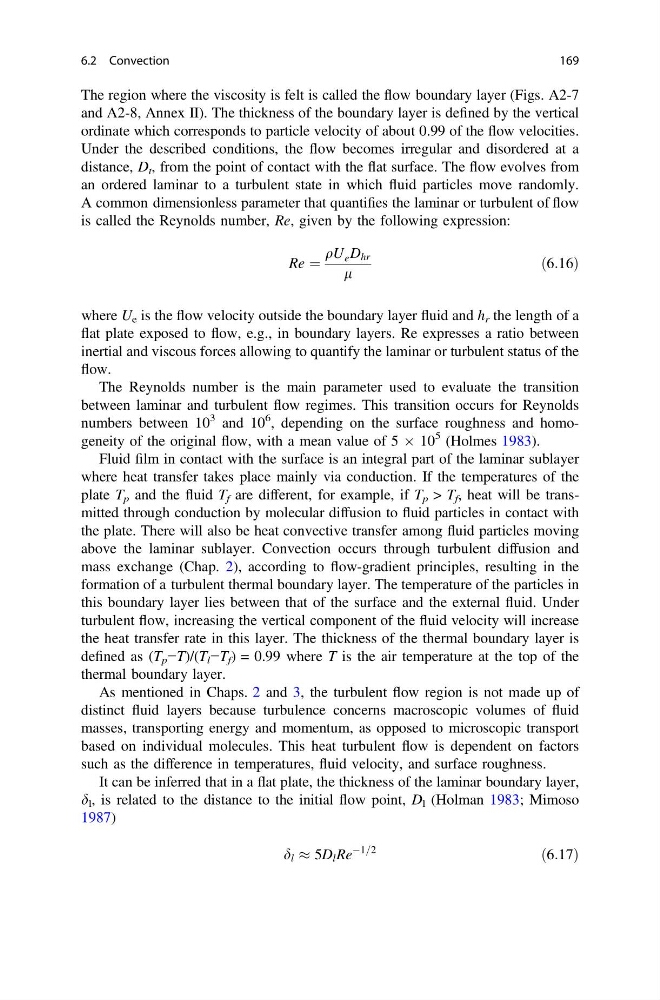
is called the Reynolds number, Re, given by the following expression:
Re ¼
qU e D hr
l
ð6:16Þ
where U e is the flow velocity outside the boundary layer fluid and h r the length of a
flat plate exposed to flow, e.g., in boundary layers. Re expresses a ratio between
inertial and viscous forces allowing to quantify the laminar or turbulent status of the
flow.
The Reynolds number is the main parameter used to evaluate the transition
between laminar and turbulent flow regimes. This transition occurs for Reynolds
numbers between 10
3 and 10
6 , depending on the surface roughness and homogeneity of the original flow, with a mean value of 5 Â 10
5 (Holmes 1983).
Fluid film in contact with the surface is an integral part of the laminar sublayer
where heat transfer takes place mainly via conduction. If the temperatures of the
plate T p and the fluid T f are different, for example, if T p > T f , heat will be transmitted through conduction by molecular diffusion to fluid particles in contact with
the plate. There will also be heat convective transfer among fluid particles moving
above the laminar sublayer. Convection occurs through turbulent diffusion and
mass exchange (Chap. 2), according to flow-gradient principles, resulting in the
formation of a turbulent thermal boundary layer. The temperature of the particles in
this boundary layer lies between that of the surface and the external fluid. Under
turbulent flow, increasing the vertical component of the fluid velocity will increase
the heat transfer rate in this layer. The thickness of the thermal boundary layer is
defined as (T p −T)/(T l −T f ) = 0.99 where T is the air temperature at the top of the
thermal boundary layer.
As mentioned in Chaps. 2 and 3, the turbulent flow region is not made up of
distinct fluid layers because turbulence concerns macroscopic volumes of fluid
masses, transporting energy and momentum, as opposed to microscopic transport
based on individual molecules. This heat turbulent flow is dependent on factors
such as the difference in temperatures, fluid velocity, and surface roughness.
It can be inferred that in a flat plate, the thickness of the laminar boundary layer,
d l , is related to the distance to the initial flow point, D l (Holman 1983; Mimoso
1987)
d l % 5D l Re
À1=2
ð6:17Þ
6.2 Convection
169
and A2-8, Annex II). The thickness of the boundary layer is defined by the vertical
ordinate which corresponds to particle velocity of about 0.99 of the flow velocities.
Under the described conditions, the flow becomes irregular and disordered at a
distance, D t , from the point of contact with the flat surface. The flow evolves from
an ordered laminar to a turbulent state in which fluid particles move randomly.
A common dimensionless parameter that quantifies the laminar or turbulent of flow
is called the Reynolds number, Re, given by the following expression:
Re ¼
qU e D hr
l
ð6:16Þ
where U e is the flow velocity outside the boundary layer fluid and h r the length of a
flat plate exposed to flow, e.g., in boundary layers. Re expresses a ratio between
inertial and viscous forces allowing to quantify the laminar or turbulent status of the
flow.
The Reynolds number is the main parameter used to evaluate the transition
between laminar and turbulent flow regimes. This transition occurs for Reynolds
numbers between 10
3 and 10
6 , depending on the surface roughness and homogeneity of the original flow, with a mean value of 5 Â 10
5 (Holmes 1983).
Fluid film in contact with the surface is an integral part of the laminar sublayer
where heat transfer takes place mainly via conduction. If the temperatures of the
plate T p and the fluid T f are different, for example, if T p > T f , heat will be transmitted through conduction by molecular diffusion to fluid particles in contact with
the plate. There will also be heat convective transfer among fluid particles moving
above the laminar sublayer. Convection occurs through turbulent diffusion and
mass exchange (Chap. 2), according to flow-gradient principles, resulting in the
formation of a turbulent thermal boundary layer. The temperature of the particles in
this boundary layer lies between that of the surface and the external fluid. Under
turbulent flow, increasing the vertical component of the fluid velocity will increase
the heat transfer rate in this layer. The thickness of the thermal boundary layer is
defined as (T p −T)/(T l −T f ) = 0.99 where T is the air temperature at the top of the
thermal boundary layer.
As mentioned in Chaps. 2 and 3, the turbulent flow region is not made up of
distinct fluid layers because turbulence concerns macroscopic volumes of fluid
masses, transporting energy and momentum, as opposed to microscopic transport
based on individual molecules. This heat turbulent flow is dependent on factors
such as the difference in temperatures, fluid velocity, and surface roughness.
It can be inferred that in a flat plate, the thickness of the laminar boundary layer,
d l , is related to the distance to the initial flow point, D l (Holman 1983; Mimoso
1987)
d l % 5D l Re
À1=2
ð6:17Þ
6.2 Convection
169