

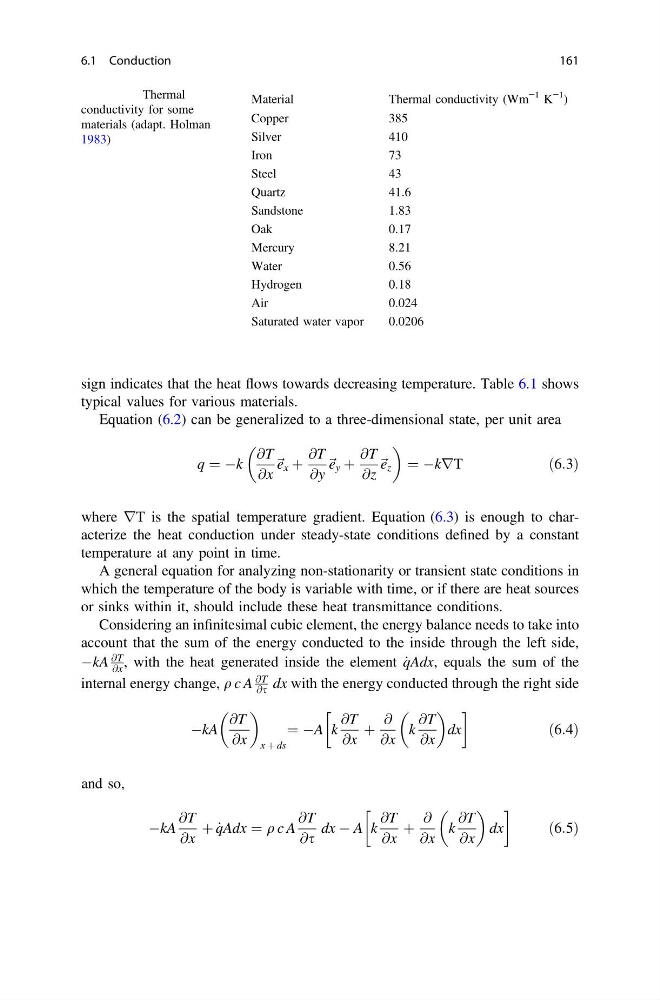
sign indicates that the heat flows towards decreasing temperature. Table 6.1 shows
typical values for various materials.
Equation (6.2) can be generalized to a three-dimensional state, per unit area
q ¼ Àk
@T
@x
~ e x þ
@T
@y
~ e y þ
@T
@z
~ e z
¼ ÀkrT
ð6:3Þ
where rT is the spatial temperature gradient. Equation (6.3) is enough to characterize the heat conduction under steady-state conditions defined by a constant
temperature at any point in time.
A general equation for analyzing non-stationarity or transient state conditions in
which the temperature of the body is variable with time, or if there are heat sources
or sinks within it, should include these heat transmittance conditions.
Considering an infinitesimal cubic element, the energy balance needs to take into
account that the sum of the energy conducted to the inside through the left side,
ÀkA
@T
@x , with the heat generated inside the element _
qAdx, equals the sum of the
internal energy change, q c A
@T
@s dx with the energy conducted through the right side
ÀkA
@T
@x
x þ ds
¼ ÀA k
@T
@x
þ
@
@x
k
@T
@x
dx
!
ð6:4Þ
and so,
ÀkA
@T
@x
þ _
qAdx ¼ q c A
@T
@s
dx À A k
@T
@x
þ
@
@x
k
@T
@x
dx
!
ð6:5Þ
Table 6.1 Thermal
conductivity for some
materials (adapt. Holman
1983)
Material
Thermal conductivity (Wm
−1 K
−1
)
Copper
385
Silver
410
Iron
73
Steel
43
Quartz
41.6
Sandstone
1.83
Oak
0.17
Mercury
8.21
Water
0.56
Hydrogen
0.18
Air
0.024
Saturated water vapor
0.0206
6.1 Conduction
161
typical values for various materials.
Equation (6.2) can be generalized to a three-dimensional state, per unit area
q ¼ Àk
@T
@x
~ e x þ
@T
@y
~ e y þ
@T
@z
~ e z
¼ ÀkrT
ð6:3Þ
where rT is the spatial temperature gradient. Equation (6.3) is enough to characterize the heat conduction under steady-state conditions defined by a constant
temperature at any point in time.
A general equation for analyzing non-stationarity or transient state conditions in
which the temperature of the body is variable with time, or if there are heat sources
or sinks within it, should include these heat transmittance conditions.
Considering an infinitesimal cubic element, the energy balance needs to take into
account that the sum of the energy conducted to the inside through the left side,
ÀkA
@T
@x , with the heat generated inside the element _
qAdx, equals the sum of the
internal energy change, q c A
@T
@s dx with the energy conducted through the right side
ÀkA
@T
@x
x þ ds
¼ ÀA k
@T
@x
þ
@
@x
k
@T
@x
dx
!
ð6:4Þ
and so,
ÀkA
@T
@x
þ _
qAdx ¼ q c A
@T
@s
dx À A k
@T
@x
þ
@
@x
k
@T
@x
dx
!
ð6:5Þ
Table 6.1 Thermal
conductivity for some
materials (adapt. Holman
1983)
Material
Thermal conductivity (Wm
−1 K
−1
)
Copper
385
Silver
410
Iron
73
Steel
43
Quartz
41.6
Sandstone
1.83
Oak
0.17
Mercury
8.21
Water
0.56
Hydrogen
0.18
Air
0.024
Saturated water vapor
0.0206
6.1 Conduction
161