

materials act as transient thermal reservoirs which attenuate the atmosphere climate
near the ground. In plants and cold-blooded animals, internal energy production is
low, and the organism’s function as passive conductors. Warm-blooded animals
generate large amounts of internal energy and can, in principle, provide thermal
energy to the environment (Lee 1978).
Heat transmission mechanisms involving conduction, convection, and radiation
are key physical processes for the stationary and transient surface temperature
regimes. These processes ensure that physical bodies at different temperatures
transfer heat from the hot to the colder body. These bodies at different temperatures
promote energy transfer from molecules with higher to lower energy levels.
Conduction is the primary way of heat propagation within a body through
internal molecular motion in solids and fluids at rest. Gaseous thermal conduction
involves molecular kinetic energy so that in a given volume at high temperature its
molecules are at higher velocity/speeds than a volume of gas at lower temperatures.
Molecules tend to move between these volumes at different temperatures and
transfer kinetic energy and momentum between them. The mechanism of thermal
energy conduction in liquids is qualitatively similar (Holman 1983), except that the
constituent molecules are closer to each other and the molecular force fields exert a
greater influence on energy exchange during a collision, allowing a greater heat
transfer rate. In good solid conductors, the heat conduction occurs primarily by
transport by free electrons moving between zones at different temperatures. Solids
that are good heat conductors are generally good electrical conductors. Thermal
conduction in solids via vibration of the structure, typical of insulating solids, is not
as efficient as energy transmission by electrons in motion (Holman 1983).
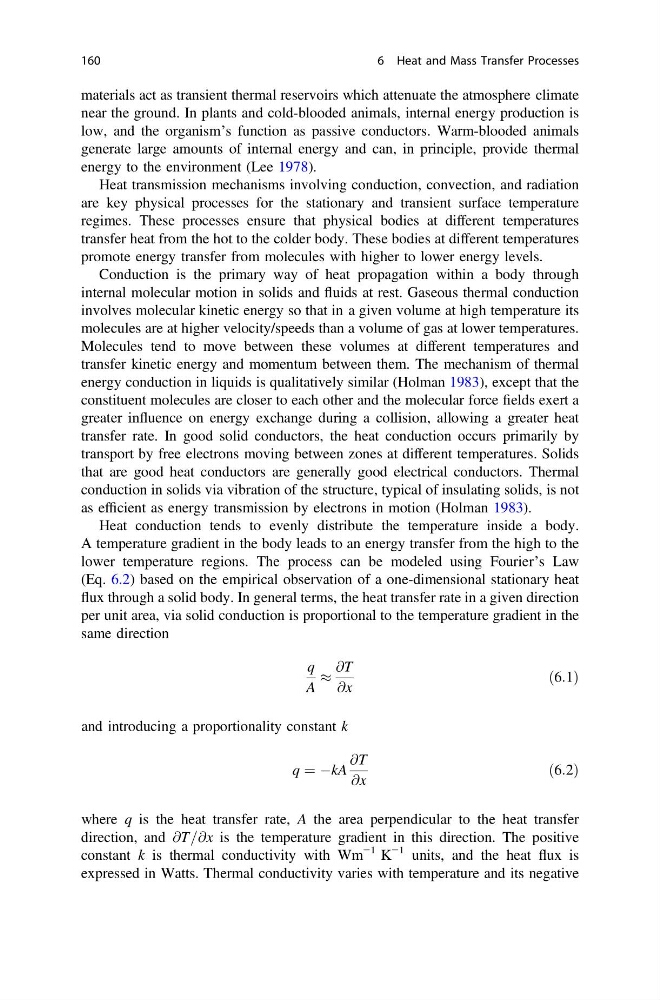
Heat conduction tends to evenly distribute the temperature inside a body.
A temperature gradient in the body leads to an energy transfer from the high to the
lower temperature regions. The process can be modeled using Fourier’s Law
(Eq. 6.2) based on the empirical observation of a one-dimensional stationary heat
flux through a solid body. In general terms, the heat transfer rate in a given direction
per unit area, via solid conduction is proportional to the temperature gradient in the
same direction
q
A
%
@T
@x
ð6:1Þ
and introducing a proportionality constant k
q ¼ ÀkA
@T
@x
ð6:2Þ
where q is the heat transfer rate, A the area perpendicular to the heat transfer
direction, and @T=@x is the temperature gradient in this direction. The positive
constant k is thermal conductivity with Wm
−1 K
−1 units, and the heat flux is
expressed in Watts. Thermal conductivity varies with temperature and its negative
160
6 Heat and Mass Transfer Processes
near the ground. In plants and cold-blooded animals, internal energy production is
low, and the organism’s function as passive conductors. Warm-blooded animals
generate large amounts of internal energy and can, in principle, provide thermal
energy to the environment (Lee 1978).
Heat transmission mechanisms involving conduction, convection, and radiation
are key physical processes for the stationary and transient surface temperature
regimes. These processes ensure that physical bodies at different temperatures
transfer heat from the hot to the colder body. These bodies at different temperatures
promote energy transfer from molecules with higher to lower energy levels.
Conduction is the primary way of heat propagation within a body through
internal molecular motion in solids and fluids at rest. Gaseous thermal conduction
involves molecular kinetic energy so that in a given volume at high temperature its
molecules are at higher velocity/speeds than a volume of gas at lower temperatures.
Molecules tend to move between these volumes at different temperatures and
transfer kinetic energy and momentum between them. The mechanism of thermal
energy conduction in liquids is qualitatively similar (Holman 1983), except that the
constituent molecules are closer to each other and the molecular force fields exert a
greater influence on energy exchange during a collision, allowing a greater heat
transfer rate. In good solid conductors, the heat conduction occurs primarily by
transport by free electrons moving between zones at different temperatures. Solids
that are good heat conductors are generally good electrical conductors. Thermal
conduction in solids via vibration of the structure, typical of insulating solids, is not
as efficient as energy transmission by electrons in motion (Holman 1983).
Heat conduction tends to evenly distribute the temperature inside a body.
A temperature gradient in the body leads to an energy transfer from the high to the
lower temperature regions. The process can be modeled using Fourier’s Law
(Eq. 6.2) based on the empirical observation of a one-dimensional stationary heat
flux through a solid body. In general terms, the heat transfer rate in a given direction
per unit area, via solid conduction is proportional to the temperature gradient in the
same direction
q
A
%
@T
@x
ð6:1Þ
and introducing a proportionality constant k
q ¼ ÀkA
@T
@x
ð6:2Þ
where q is the heat transfer rate, A the area perpendicular to the heat transfer
direction, and @T=@x is the temperature gradient in this direction. The positive
constant k is thermal conductivity with Wm
−1 K
−1 units, and the heat flux is
expressed in Watts. Thermal conductivity varies with temperature and its negative
160
6 Heat and Mass Transfer Processes