

or
@
@x
k
@T
@x
þ _
q
!
¼ q c
@T
@s
ð6:6Þ
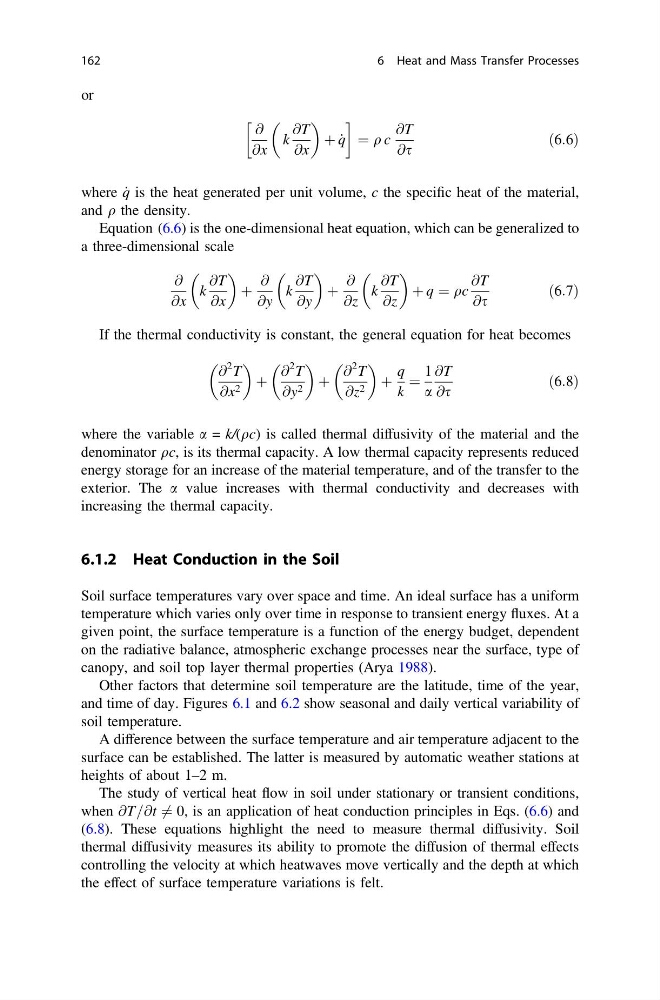
where _
q is the heat generated per unit volume, c the specific heat of the material,
and q the density.
Equation (6.6) is the one-dimensional heat equation, which can be generalized to
a three-dimensional scale
@
@x
k
@T
@x
þ
@
@y
k
@T
@y
þ
@
@z
k
@T
@z
þ q ¼ qc
@T
@s
ð6:7Þ
If the thermal conductivity is constant, the general equation for heat becomes
@
2 T
@x 2
þ
@
2 T
@y 2
þ
@
2 T
@z 2
þ
q
k
¼
1
a
@T
@s
ð6:8Þ
where the variable a = k/(qc) is called thermal diffusivity of the material and the
denominator qc, is its thermal capacity. A low thermal capacity represents reduced
energy storage for an increase of the material temperature, and of the transfer to the
exterior. The a value increases with thermal conductivity and decreases with
increasing the thermal capacity.
6.1.2 Heat Conduction in the Soil
Soil surface temperatures vary over space and time. An ideal surface has a uniform
temperature which varies only over time in response to transient energy fluxes. At a
given point, the surface temperature is a function of the energy budget, dependent
on the radiative balance, atmospheric exchange processes near the surface, type of
canopy, and soil top layer thermal properties (Arya 1988).
Other factors that determine soil temperature are the latitude, time of the year,
and time of day. Figures 6.1 and 6.2 show seasonal and daily vertical variability of
soil temperature.
A difference between the surface temperature and air temperature adjacent to the
surface can be established. The latter is measured by automatic weather stations at
heights of about 1–2 m.
The study of vertical heat flow in soil under stationary or transient conditions,
when @T=@t 6 ¼ 0, is an application of heat conduction principles in Eqs. (6.6) and
(6.8). These equations highlight the need to measure thermal diffusivity. Soil
thermal diffusivity measures its ability to promote the diffusion of thermal effects
controlling the velocity at which heatwaves move vertically and the depth at which
the effect of surface temperature variations is felt.
162
6 Heat and Mass Transfer Processes
@
@x
k
@T
@x
þ _
q
!
¼ q c
@T
@s
ð6:6Þ
where _
q is the heat generated per unit volume, c the specific heat of the material,
and q the density.
Equation (6.6) is the one-dimensional heat equation, which can be generalized to
a three-dimensional scale
@
@x
k
@T
@x
þ
@
@y
k
@T
@y
þ
@
@z
k
@T
@z
þ q ¼ qc
@T
@s
ð6:7Þ
If the thermal conductivity is constant, the general equation for heat becomes
@
2 T
@x 2
þ
@
2 T
@y 2
þ
@
2 T
@z 2
þ
q
k
¼
1
a
@T
@s
ð6:8Þ
where the variable a = k/(qc) is called thermal diffusivity of the material and the
denominator qc, is its thermal capacity. A low thermal capacity represents reduced
energy storage for an increase of the material temperature, and of the transfer to the
exterior. The a value increases with thermal conductivity and decreases with
increasing the thermal capacity.
6.1.2 Heat Conduction in the Soil
Soil surface temperatures vary over space and time. An ideal surface has a uniform
temperature which varies only over time in response to transient energy fluxes. At a
given point, the surface temperature is a function of the energy budget, dependent
on the radiative balance, atmospheric exchange processes near the surface, type of
canopy, and soil top layer thermal properties (Arya 1988).
Other factors that determine soil temperature are the latitude, time of the year,
and time of day. Figures 6.1 and 6.2 show seasonal and daily vertical variability of
soil temperature.
A difference between the surface temperature and air temperature adjacent to the
surface can be established. The latter is measured by automatic weather stations at
heights of about 1–2 m.
The study of vertical heat flow in soil under stationary or transient conditions,
when @T=@t 6 ¼ 0, is an application of heat conduction principles in Eqs. (6.6) and
(6.8). These equations highlight the need to measure thermal diffusivity. Soil
thermal diffusivity measures its ability to promote the diffusion of thermal effects
controlling the velocity at which heatwaves move vertically and the depth at which
the effect of surface temperature variations is felt.
162
6 Heat and Mass Transfer Processes