

or by smooth obstacles. The wakes can be divided into a near and far wake region.
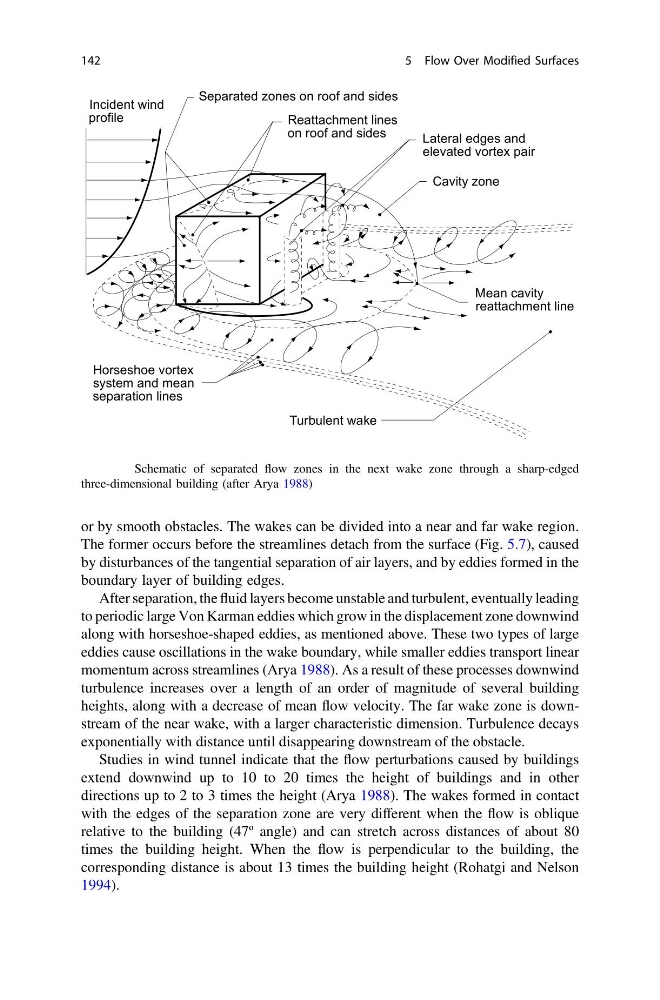
The former occurs before the streamlines detach from the surface (Fig. 5.7), caused
by disturbances of the tangential separation of air layers, and by eddies formed in the
boundary layer of building edges.
After separation, the fluid layers become unstable and turbulent, eventually leading
to periodic large Von Karman eddies which grow in the displacement zone downwind
along with horseshoe-shaped eddies, as mentioned above. These two types of large
eddies cause oscillations in the wake boundary, while smaller eddies transport linear
momentum across streamlines (Arya 1988). As a result of these processes downwind
turbulence increases over a length of an order of magnitude of several building
heights, along with a decrease of mean flow velocity. The far wake zone is downstream of the near wake, with a larger characteristic dimension. Turbulence decays
exponentially with distance until disappearing downstream of the obstacle.
Studies in wind tunnel indicate that the flow perturbations caused by buildings
extend downwind up to 10 to 20 times the height of buildings and in other
directions up to 2 to 3 times the height (Arya 1988). The wakes formed in contact
with the edges of the separation zone are very different when the flow is oblique
relative to the building (47º angle) and can stretch across distances of about 80
times the building height. When the flow is perpendicular to the building, the
corresponding distance is about 13 times the building height (Rohatgi and Nelson
1994).
Incident wind
profile
Separated zones on roof and sides
Reattachment lines
on roof and sides
Mean cavity
reattachment line
Turbulent wake
Horseshoe vortex
system and mean
separation lines
Lateral edges and
elevated vortex pair
Cavity zone
Fig. 5.7 Schematic of separated flow zones in the next wake zone through a sharp-edged
three-dimensional building (after Arya 1988)
142
5 Flow Over Modified Surfaces
The former occurs before the streamlines detach from the surface (Fig. 5.7), caused
by disturbances of the tangential separation of air layers, and by eddies formed in the
boundary layer of building edges.
After separation, the fluid layers become unstable and turbulent, eventually leading
to periodic large Von Karman eddies which grow in the displacement zone downwind
along with horseshoe-shaped eddies, as mentioned above. These two types of large
eddies cause oscillations in the wake boundary, while smaller eddies transport linear
momentum across streamlines (Arya 1988). As a result of these processes downwind
turbulence increases over a length of an order of magnitude of several building
heights, along with a decrease of mean flow velocity. The far wake zone is downstream of the near wake, with a larger characteristic dimension. Turbulence decays
exponentially with distance until disappearing downstream of the obstacle.
Studies in wind tunnel indicate that the flow perturbations caused by buildings
extend downwind up to 10 to 20 times the height of buildings and in other
directions up to 2 to 3 times the height (Arya 1988). The wakes formed in contact
with the edges of the separation zone are very different when the flow is oblique
relative to the building (47º angle) and can stretch across distances of about 80
times the building height. When the flow is perpendicular to the building, the
corresponding distance is about 13 times the building height (Rohatgi and Nelson
1994).
Incident wind
profile
Separated zones on roof and sides
Reattachment lines
on roof and sides
Mean cavity
reattachment line
Turbulent wake
Horseshoe vortex
system and mean
separation lines
Lateral edges and
elevated vortex pair
Cavity zone
Fig. 5.7 Schematic of separated flow zones in the next wake zone through a sharp-edged
three-dimensional building (after Arya 1988)
142
5 Flow Over Modified Surfaces