

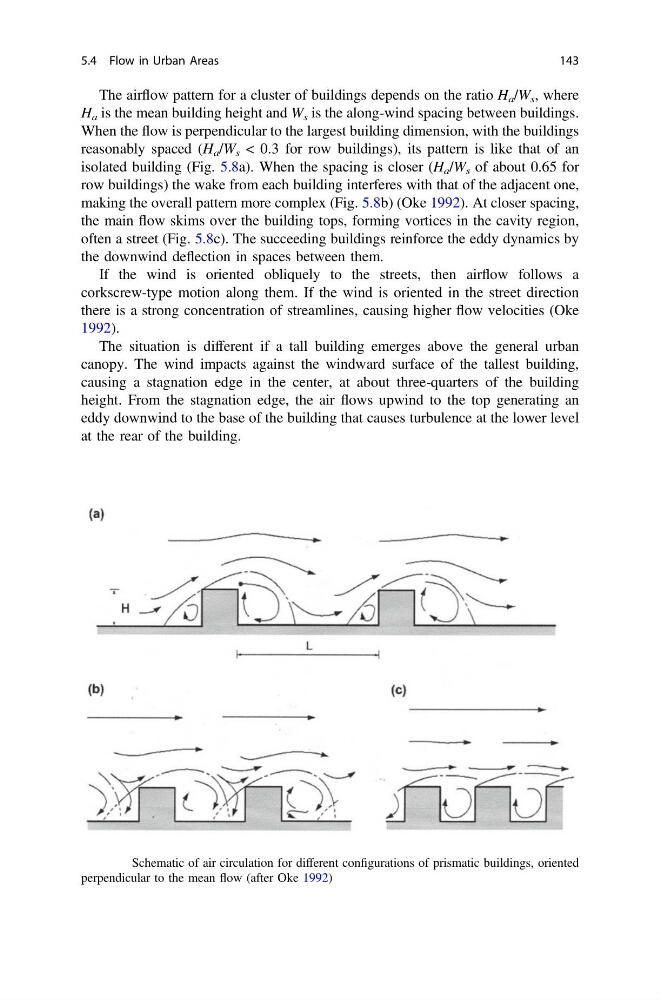
The airflow pattern for a cluster of buildings depends on the ratio H a /W s , where
H a is the mean building height and W s is the along-wind spacing between buildings.
When the flow is perpendicular to the largest building dimension, with the buildings
reasonably spaced (H a /W s < 0.3 for row buildings), its pattern is like that of an
isolated building (Fig. 5.8a). When the spacing is closer (H a /W s of about 0.65 for
row buildings) the wake from each building interferes with that of the adjacent one,
making the overall pattern more complex (Fig. 5.8b) (Oke 1992). At closer spacing,
the main flow skims over the building tops, forming vortices in the cavity region,
often a street (Fig. 5.8c). The succeeding buildings reinforce the eddy dynamics by
the downwind deflection in spaces between them.
If the wind is oriented obliquely to the streets, then airflow follows a
corkscrew-type motion along them. If the wind is oriented in the street direction
there is a strong concentration of streamlines, causing higher flow velocities (Oke
1992).
The situation is different if a tall building emerges above the general urban
canopy. The wind impacts against the windward surface of the tallest building,
causing a stagnation edge in the center, at about three-quarters of the building
height. From the stagnation edge, the air flows upwind to the top generating an
eddy downwind to the base of the building that causes turbulence at the lower level
at the rear of the building.
Fig. 5.8 Schematic of air circulation for different configurations of prismatic buildings, oriented
perpendicular to the mean flow (after Oke 1992)
5.4 Flow in Urban Areas
143
H a is the mean building height and W s is the along-wind spacing between buildings.
When the flow is perpendicular to the largest building dimension, with the buildings
reasonably spaced (H a /W s < 0.3 for row buildings), its pattern is like that of an
isolated building (Fig. 5.8a). When the spacing is closer (H a /W s of about 0.65 for
row buildings) the wake from each building interferes with that of the adjacent one,
making the overall pattern more complex (Fig. 5.8b) (Oke 1992). At closer spacing,
the main flow skims over the building tops, forming vortices in the cavity region,
often a street (Fig. 5.8c). The succeeding buildings reinforce the eddy dynamics by
the downwind deflection in spaces between them.
If the wind is oriented obliquely to the streets, then airflow follows a
corkscrew-type motion along them. If the wind is oriented in the street direction
there is a strong concentration of streamlines, causing higher flow velocities (Oke
1992).
The situation is different if a tall building emerges above the general urban
canopy. The wind impacts against the windward surface of the tallest building,
causing a stagnation edge in the center, at about three-quarters of the building
height. From the stagnation edge, the air flows upwind to the top generating an
eddy downwind to the base of the building that causes turbulence at the lower level
at the rear of the building.
Fig. 5.8 Schematic of air circulation for different configurations of prismatic buildings, oriented
perpendicular to the mean flow (after Oke 1992)
5.4 Flow in Urban Areas
143