

The atmosphere above the internal boundary layer is not modified by the
characteristics of the surfaces upstream of the initial surface roughness change. The
height of the internal boundary layer, above a given point, depends on the horizontal distance from this point to that of the initial transition in surface roughness,
with the length of this influence length defined as fetch.
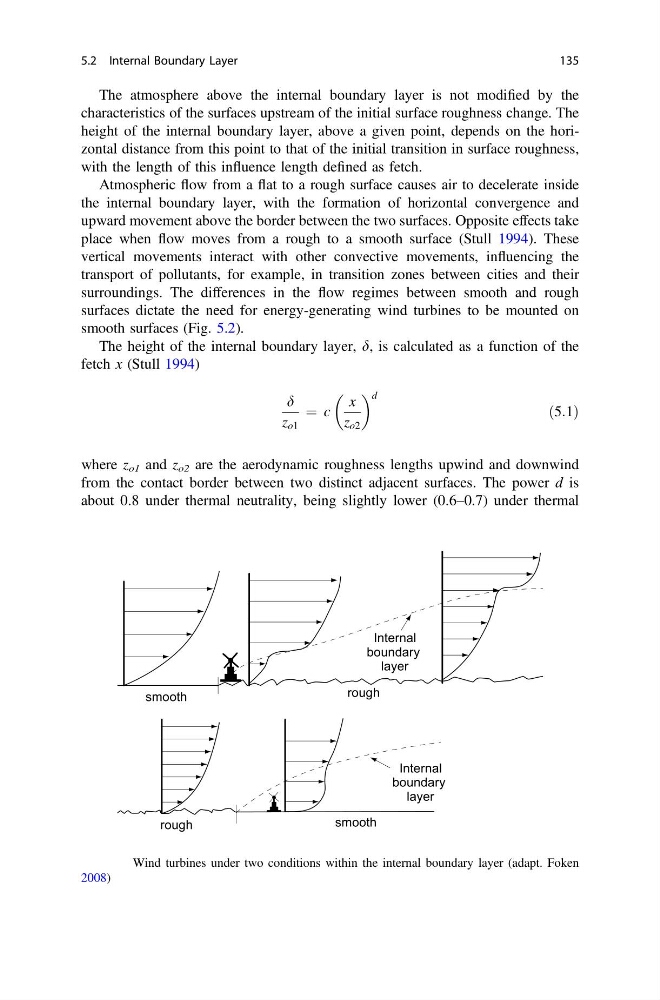
Atmospheric flow from a flat to a rough surface causes air to decelerate inside
the internal boundary layer, with the formation of horizontal convergence and
upward movement above the border between the two surfaces. Opposite effects take
place when flow moves from a rough to a smooth surface (Stull 1994). These
vertical movements interact with other convective movements, influencing the
transport of pollutants, for example, in transition zones between cities and their
surroundings. The differences in the flow regimes between smooth and rough
surfaces dictate the need for energy-generating wind turbines to be mounted on
smooth surfaces (Fig. 5.2).
The height of the internal boundary layer, d, is calculated as a function of the
fetch x (Stull 1994)
d
z o1
¼ c
x
z o2
d
ð5:1Þ
where z o1 and z o2 are the aerodynamic roughness lengths upwind and downwind
from the contact border between two distinct adjacent surfaces. The power d is
about 0.8 under thermal neutrality, being slightly lower (0.6–0.7) under thermal
smooth
smooth
rough
Internal
boundary
layer
Internal
boundary
layer
rough
Fig. 5.2 Wind turbines under two conditions within the internal boundary layer (adapt. Foken
2008)
5.2 Internal Boundary Layer
135
characteristics of the surfaces upstream of the initial surface roughness change. The
height of the internal boundary layer, above a given point, depends on the horizontal distance from this point to that of the initial transition in surface roughness,
with the length of this influence length defined as fetch.
Atmospheric flow from a flat to a rough surface causes air to decelerate inside
the internal boundary layer, with the formation of horizontal convergence and
upward movement above the border between the two surfaces. Opposite effects take
place when flow moves from a rough to a smooth surface (Stull 1994). These
vertical movements interact with other convective movements, influencing the
transport of pollutants, for example, in transition zones between cities and their
surroundings. The differences in the flow regimes between smooth and rough
surfaces dictate the need for energy-generating wind turbines to be mounted on
smooth surfaces (Fig. 5.2).
The height of the internal boundary layer, d, is calculated as a function of the
fetch x (Stull 1994)
d
z o1
¼ c
x
z o2
d
ð5:1Þ
where z o1 and z o2 are the aerodynamic roughness lengths upwind and downwind
from the contact border between two distinct adjacent surfaces. The power d is
about 0.8 under thermal neutrality, being slightly lower (0.6–0.7) under thermal
smooth
smooth
rough
Internal
boundary
layer
Internal
boundary
layer
rough
Fig. 5.2 Wind turbines under two conditions within the internal boundary layer (adapt. Foken
2008)
5.2 Internal Boundary Layer
135