

areas, as well as between different vegetation types. Flow over these obstacles
changes due to factors such as surface roughness, temperature, humidity, and
altitude, which may act in concert. The combined action of these factors is
unpredictable and nonlinear (Arya 1988).
Cold air flows from source areas as open hilltops, forest slopes, and other
inclined surface areas are the most common micrometeorological phenomena.
Basically, these processes can be envisaged as flows of compacted air parcels which
can be interrupted or damped by obstacles. These flows show several levels of risk
of frost deposition, e.g., in cold air nights with strong cooling by longwave radiation
due to cloudless skies (Foken 2017).
This chapter covers some fundamentals on the interactions between transport of
air mass in movement and urban canopies (in analogy with forest canopies) or small
topography changes in the realm of environmental physics. For further details, the
reader is referred to Arya (1988), Stull (1994), Oke (1992), Garratt (1994), and
Foken (2017).
5.2 Internal Boundary Layer
Modification of surface roughness affects the boundary layer structure, with the
formation of layers for each boundary surface. Changes in the surface roughness are
very common due, e.g., to deforestation or building development (e.g., Foken 2017)
and localized profiles for velocity, temperature, and air humidity depend on the
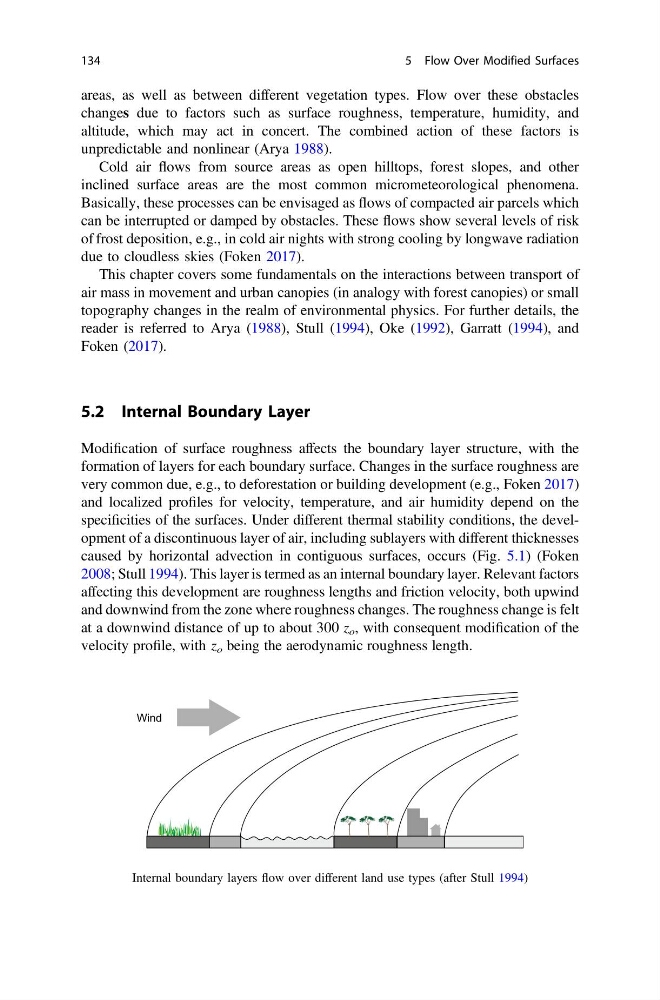
specificities of the surfaces. Under different thermal stability conditions, the development of a discontinuous layer of air, including sublayers with different thicknesses
caused by horizontal advection in contiguous surfaces, occurs (Fig. 5.1) (Foken
2008; Stull 1994). This layer is termed as an internal boundary layer. Relevant factors
affecting this development are roughness lengths and friction velocity, both upwind
and downwind from the zone where roughness changes. The roughness change is felt
at a downwind distance of up to about 300 z o , with consequent modification of the
velocity profile, with z o being the aerodynamic roughness length.
Wind
Fig. 5.1 Internal boundary layers flow over different land use types (after Stull 1994)
134
5 Flow Over Modified Surfaces
changes due to factors such as surface roughness, temperature, humidity, and
altitude, which may act in concert. The combined action of these factors is
unpredictable and nonlinear (Arya 1988).
Cold air flows from source areas as open hilltops, forest slopes, and other
inclined surface areas are the most common micrometeorological phenomena.
Basically, these processes can be envisaged as flows of compacted air parcels which
can be interrupted or damped by obstacles. These flows show several levels of risk
of frost deposition, e.g., in cold air nights with strong cooling by longwave radiation
due to cloudless skies (Foken 2017).
This chapter covers some fundamentals on the interactions between transport of
air mass in movement and urban canopies (in analogy with forest canopies) or small
topography changes in the realm of environmental physics. For further details, the
reader is referred to Arya (1988), Stull (1994), Oke (1992), Garratt (1994), and
Foken (2017).
5.2 Internal Boundary Layer
Modification of surface roughness affects the boundary layer structure, with the
formation of layers for each boundary surface. Changes in the surface roughness are
very common due, e.g., to deforestation or building development (e.g., Foken 2017)
and localized profiles for velocity, temperature, and air humidity depend on the
specificities of the surfaces. Under different thermal stability conditions, the development of a discontinuous layer of air, including sublayers with different thicknesses
caused by horizontal advection in contiguous surfaces, occurs (Fig. 5.1) (Foken
2008; Stull 1994). This layer is termed as an internal boundary layer. Relevant factors
affecting this development are roughness lengths and friction velocity, both upwind
and downwind from the zone where roughness changes. The roughness change is felt
at a downwind distance of up to about 300 z o , with consequent modification of the
velocity profile, with z o being the aerodynamic roughness length.
Wind
Fig. 5.1 Internal boundary layers flow over different land use types (after Stull 1994)
134
5 Flow Over Modified Surfaces