

The SRC can be grown in abandoned or contaminated agricultural land, so as not
to compete with crops in fertile soils with less energy-intensive management.
Basically, this type of culture is based on the intensive exploitation of forest species,
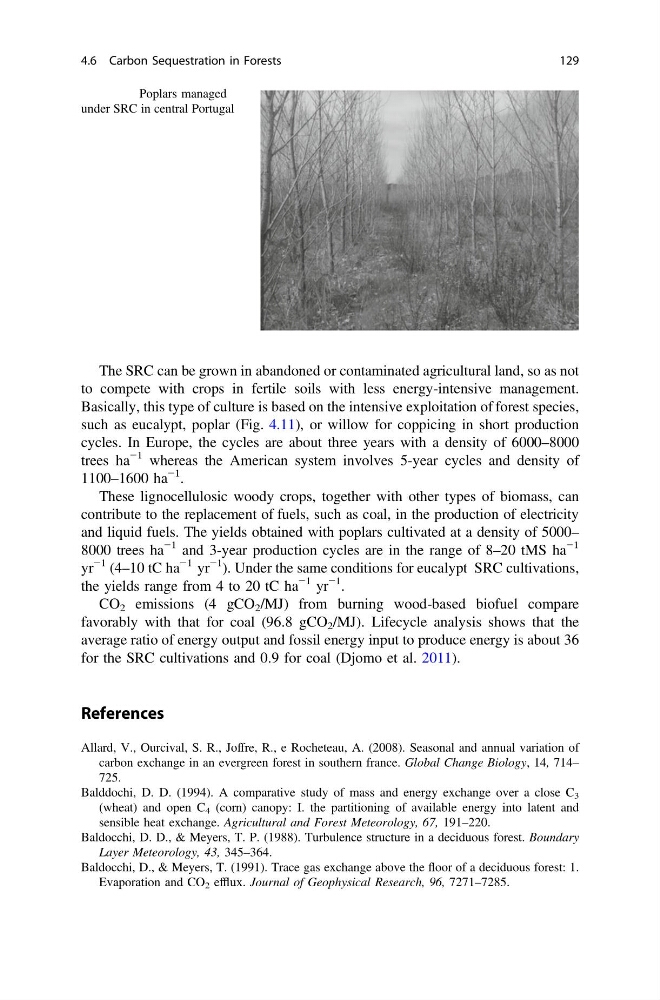
such as eucalypt, poplar (Fig. 4.11), or willow for coppicing in short production
cycles. In Europe, the cycles are about three years with a density of 6000–8000
trees ha
−1 whereas the American system involves 5-year cycles and density of
1100–1600 ha
−1 .
These lignocellulosic woody crops, together with other types of biomass, can
contribute to the replacement of fuels, such as coal, in the production of electricity
and liquid fuels. The yields obtained with poplars cultivated at a density of 5000–
8000 trees ha
−1 and 3-year production cycles are in the range of 8–20 tMS ha
−1
yr
−1 (4–10 tC ha
−1 yr
−1 ). Under the same conditions for eucalypt SRC cultivations,
the yields range from 4 to 20 tC ha
−1 yr
−1 .
CO 2 emissions (4 gCO 2 /MJ) from burning wood-based biofuel compare
favorably with that for coal (96.8 gCO 2 /MJ). Lifecycle analysis shows that the
average ratio of energy output and fossil energy input to produce energy is about 36
for the SRC cultivations and 0.9 for coal (Djomo et al. 2011).
References
Allard, V., Ourcival, S. R., Joffre, R., e Rocheteau, A. (2008). Seasonal and annual variation of
carbon exchange in an evergreen forest in southern france. Global Change Biology, 14, 714–
725.
Balddochi, D. D. (1994). A comparative study of mass and energy exchange over a close C 3
(wheat) and open C 4 (corn) canopy: I. the partitioning of available energy into latent and
sensible heat exchange. Agricultural and Forest Meteorology, 67, 191–220.
Baldocchi, D. D., & Meyers, T. P. (1988). Turbulence structure in a deciduous forest. Boundary
Layer Meteorology, 43, 345–364.
Baldocchi, D., & Meyers, T. (1991). Trace gas exchange above the floor of a deciduous forest: 1.
Evaporation and CO 2 efflux. Journal of Geophysical Research, 96, 7271–7285.
Fig. 4.11 Poplars managed
under SRC in central Portugal
4.6 Carbon Sequestration in Forests
129
to compete with crops in fertile soils with less energy-intensive management.
Basically, this type of culture is based on the intensive exploitation of forest species,
such as eucalypt, poplar (Fig. 4.11), or willow for coppicing in short production
cycles. In Europe, the cycles are about three years with a density of 6000–8000
trees ha
−1 whereas the American system involves 5-year cycles and density of
1100–1600 ha
−1 .
These lignocellulosic woody crops, together with other types of biomass, can
contribute to the replacement of fuels, such as coal, in the production of electricity
and liquid fuels. The yields obtained with poplars cultivated at a density of 5000–
8000 trees ha
−1 and 3-year production cycles are in the range of 8–20 tMS ha
−1
yr
−1 (4–10 tC ha
−1 yr
−1 ). Under the same conditions for eucalypt SRC cultivations,
the yields range from 4 to 20 tC ha
−1 yr
−1 .
CO 2 emissions (4 gCO 2 /MJ) from burning wood-based biofuel compare
favorably with that for coal (96.8 gCO 2 /MJ). Lifecycle analysis shows that the
average ratio of energy output and fossil energy input to produce energy is about 36
for the SRC cultivations and 0.9 for coal (Djomo et al. 2011).
References
Allard, V., Ourcival, S. R., Joffre, R., e Rocheteau, A. (2008). Seasonal and annual variation of
carbon exchange in an evergreen forest in southern france. Global Change Biology, 14, 714–
725.
Balddochi, D. D. (1994). A comparative study of mass and energy exchange over a close C 3
(wheat) and open C 4 (corn) canopy: I. the partitioning of available energy into latent and
sensible heat exchange. Agricultural and Forest Meteorology, 67, 191–220.
Baldocchi, D. D., & Meyers, T. P. (1988). Turbulence structure in a deciduous forest. Boundary
Layer Meteorology, 43, 345–364.
Baldocchi, D., & Meyers, T. (1991). Trace gas exchange above the floor of a deciduous forest: 1.
Evaporation and CO 2 efflux. Journal of Geophysical Research, 96, 7271–7285.
Fig. 4.11 Poplars managed
under SRC in central Portugal
4.6 Carbon Sequestration in Forests
129