

The water vapor pressure deficit in the atmosphere, for the three different forest
covers, was highest in June (5 hPa) for a Scots pine stand , in July (19 hPa) for holm
oak , and in August (24 hPa) for eucalypt. The typical annual GPP for pine cover was
about 1200 gCcm
−2 (Carrara et al. 2003) and for the holm oak forest cover in
Puechabon was 1300 gCcm
−2 (Allard et al. 2008). These values relating to different
parts of the European continent were lower than the GPP for eucalypt, 2206 gCcm
−2 .
Clearly, the main reason for this difference, despite the more intensive farming system,
is the availability of solar radiation. The average annual NEE (1999–2002) for the
Scots pine cover was 120 gCcm
−2 , with a 2-year period (1999 and 2000) as a carbon
sink. The corresponding NEE holm oak in France (2001–2006) was about 300
gCcm
−2 . NEE values of these two forest types are lower than NEE values for eucalypt
(865 gCcm
−2 in a normal year and 357 gCcm
−2 in a dry year).
The fixation monthly variation pattern for the Scots pine canopy was different
from that for eucalypt, with carbon uptake only during the summer and autumn and
physiological activity being lower during the remainder of the year. In contrast, the
pattern of carbon fixation over a similar period for the holm oak canopy stretched
over the whole year without any interruption in the summer due to water stress. The
decoupling coefficient was lowest for the eucalypt canopy, where the annual mean
was about 0.1 in 2005, when climatic factors inducing water stress (global solar
radiation and vapor pressure deficit) were more severe.
These three case studies of forest canopies in Europe serve to evaluate differences in patterns and variability of carbon sequestration regimes over annual and
seasonal periods. Interactions between fluxes of carbon and water vapor and
between physical and physiological variables were also found to be different.
An application of carbon sink capacity by forest canopies is the use of short
rotation coppice (SRC) for biomass production for energy. This cluster should be
evaluated under global forecasting scenarios, that indicate by the year 2050 energy
demand will be about 1041 EJ. In the same year the potential for total biomass
production, without affecting food production is estimated at 1135 EJ (Ladanai and
Vinterbäck 2009).
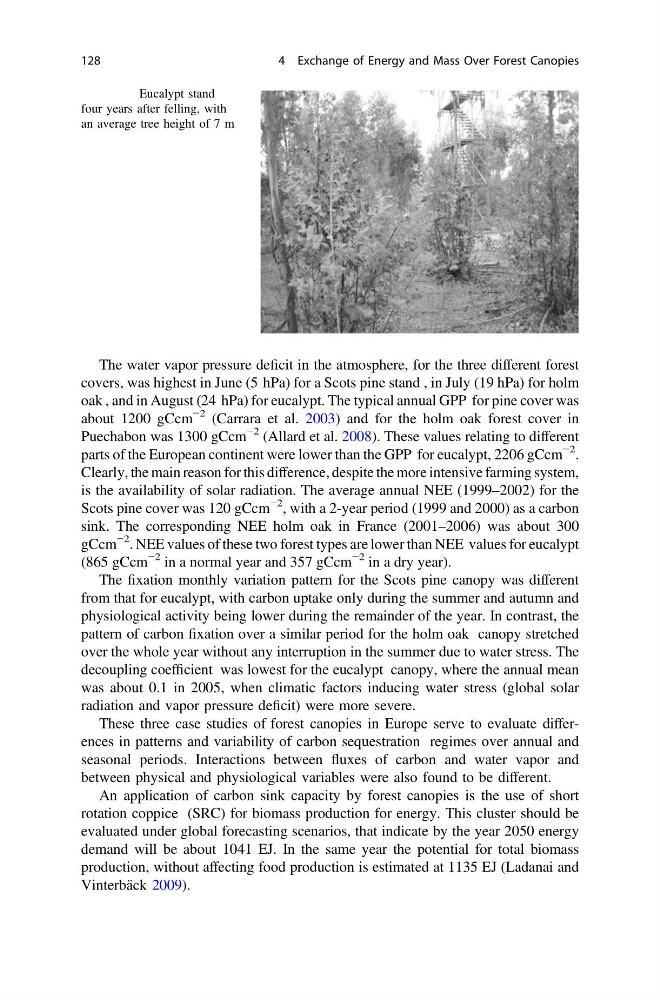
Fig. 4.10 Eucalypt stand
four years after felling, with
an average tree height of 7 m
128
4 Exchange of Energy and Mass Over Forest Canopies
covers, was highest in June (5 hPa) for a Scots pine stand , in July (19 hPa) for holm
oak , and in August (24 hPa) for eucalypt. The typical annual GPP for pine cover was
about 1200 gCcm
−2 (Carrara et al. 2003) and for the holm oak forest cover in
Puechabon was 1300 gCcm
−2 (Allard et al. 2008). These values relating to different
parts of the European continent were lower than the GPP for eucalypt, 2206 gCcm
−2 .
Clearly, the main reason for this difference, despite the more intensive farming system,
is the availability of solar radiation. The average annual NEE (1999–2002) for the
Scots pine cover was 120 gCcm
−2 , with a 2-year period (1999 and 2000) as a carbon
sink. The corresponding NEE holm oak in France (2001–2006) was about 300
gCcm
−2 . NEE values of these two forest types are lower than NEE values for eucalypt
(865 gCcm
−2 in a normal year and 357 gCcm
−2 in a dry year).
The fixation monthly variation pattern for the Scots pine canopy was different
from that for eucalypt, with carbon uptake only during the summer and autumn and
physiological activity being lower during the remainder of the year. In contrast, the
pattern of carbon fixation over a similar period for the holm oak canopy stretched
over the whole year without any interruption in the summer due to water stress. The
decoupling coefficient was lowest for the eucalypt canopy, where the annual mean
was about 0.1 in 2005, when climatic factors inducing water stress (global solar
radiation and vapor pressure deficit) were more severe.
These three case studies of forest canopies in Europe serve to evaluate differences in patterns and variability of carbon sequestration regimes over annual and
seasonal periods. Interactions between fluxes of carbon and water vapor and
between physical and physiological variables were also found to be different.
An application of carbon sink capacity by forest canopies is the use of short
rotation coppice (SRC) for biomass production for energy. This cluster should be
evaluated under global forecasting scenarios, that indicate by the year 2050 energy
demand will be about 1041 EJ. In the same year the potential for total biomass
production, without affecting food production is estimated at 1135 EJ (Ladanai and
Vinterbäck 2009).
Fig. 4.10 Eucalypt stand
four years after felling, with
an average tree height of 7 m
128
4 Exchange of Energy and Mass Over Forest Canopies