

548 gCcm
−2 , and 510 gCcm
−2 during the hydrological year 2004/2005. The corresponding values were 140 gCcm
−2 , 1400 gCcm
−2 e 1260 gCcm
−2 during the
hydrological year 2005/2006, when precipitation was 685 mm.
This pattern of annual carbon sequestration in Mediterranean regions shows
seasonal variation, corresponding to a year of physiological activity. In summer,
stomata close in response to severe water stress due to high solar radiation (above
2000 MJm
−2 ), high relative humidity and air temperature, and overall tight coupling
with atmospheric conditions. Monthly accumulated values of NEE and GPP were
dependent on photosynthetically active radiation and atmospheric vapor pressure
deficit.
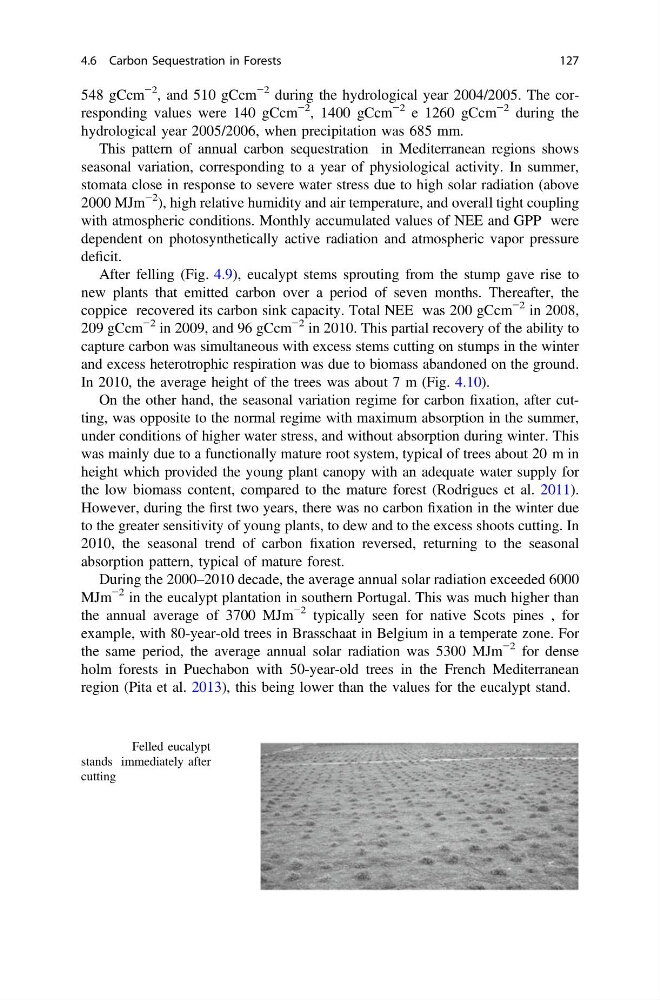
After felling (Fig. 4.9), eucalypt stems sprouting from the stump gave rise to
new plants that emitted carbon over a period of seven months. Thereafter, the
coppice recovered its carbon sink capacity. Total NEE was 200 gCcm
−2 in 2008,
209 gCcm
−2 in 2009, and 96 gCcm
−2 in 2010. This partial recovery of the ability to
capture carbon was simultaneous with excess stems cutting on stumps in the winter
and excess heterotrophic respiration was due to biomass abandoned on the ground.
In 2010, the average height of the trees was about 7 m (Fig. 4.10).
On the other hand, the seasonal variation regime for carbon fixation, after cutting, was opposite to the normal regime with maximum absorption in the summer,
under conditions of higher water stress, and without absorption during winter. This
was mainly due to a functionally mature root system, typical of trees about 20 m in
height which provided the young plant canopy with an adequate water supply for
the low biomass content, compared to the mature forest (Rodrigues et al. 2011).
However, during the first two years, there was no carbon fixation in the winter due
to the greater sensitivity of young plants, to dew and to the excess shoots cutting. In
2010, the seasonal trend of carbon fixation reversed, returning to the seasonal
absorption pattern, typical of mature forest.
During the 2000–2010 decade, the average annual solar radiation exceeded 6000
MJm
−2 in the eucalypt plantation in southern Portugal. This was much higher than
the annual average of 3700 MJm
−2 typically seen for native Scots pines , for
example, with 80-year-old trees in Brasschaat in Belgium in a temperate zone. For
the same period, the average annual solar radiation was 5300 MJm
−2 for dense
holm forests in Puechabon with 50-year-old trees in the French Mediterranean
region (Pita et al. 2013), this being lower than the values for the eucalypt stand.
Fig. 4.9 Felled eucalypt
stands immediately after
cutting
4.6 Carbon Sequestration in Forests
127
−2 , and 510 gCcm
−2 during the hydrological year 2004/2005. The corresponding values were 140 gCcm
−2 , 1400 gCcm
−2 e 1260 gCcm
−2 during the
hydrological year 2005/2006, when precipitation was 685 mm.
This pattern of annual carbon sequestration in Mediterranean regions shows
seasonal variation, corresponding to a year of physiological activity. In summer,
stomata close in response to severe water stress due to high solar radiation (above
2000 MJm
−2 ), high relative humidity and air temperature, and overall tight coupling
with atmospheric conditions. Monthly accumulated values of NEE and GPP were
dependent on photosynthetically active radiation and atmospheric vapor pressure
deficit.
After felling (Fig. 4.9), eucalypt stems sprouting from the stump gave rise to
new plants that emitted carbon over a period of seven months. Thereafter, the
coppice recovered its carbon sink capacity. Total NEE was 200 gCcm
−2 in 2008,
209 gCcm
−2 in 2009, and 96 gCcm
−2 in 2010. This partial recovery of the ability to
capture carbon was simultaneous with excess stems cutting on stumps in the winter
and excess heterotrophic respiration was due to biomass abandoned on the ground.
In 2010, the average height of the trees was about 7 m (Fig. 4.10).
On the other hand, the seasonal variation regime for carbon fixation, after cutting, was opposite to the normal regime with maximum absorption in the summer,
under conditions of higher water stress, and without absorption during winter. This
was mainly due to a functionally mature root system, typical of trees about 20 m in
height which provided the young plant canopy with an adequate water supply for
the low biomass content, compared to the mature forest (Rodrigues et al. 2011).
However, during the first two years, there was no carbon fixation in the winter due
to the greater sensitivity of young plants, to dew and to the excess shoots cutting. In
2010, the seasonal trend of carbon fixation reversed, returning to the seasonal
absorption pattern, typical of mature forest.
During the 2000–2010 decade, the average annual solar radiation exceeded 6000
MJm
−2 in the eucalypt plantation in southern Portugal. This was much higher than
the annual average of 3700 MJm
−2 typically seen for native Scots pines , for
example, with 80-year-old trees in Brasschaat in Belgium in a temperate zone. For
the same period, the average annual solar radiation was 5300 MJm
−2 for dense
holm forests in Puechabon with 50-year-old trees in the French Mediterranean
region (Pita et al. 2013), this being lower than the values for the eucalypt stand.
Fig. 4.9 Felled eucalypt
stands immediately after
cutting
4.6 Carbon Sequestration in Forests
127