

Baldocchi and Meyers (1991) mentioned that the dominant timescale for turbulent fluxes in a moderately open deciduous forest canopy ranged between 200
and 300 s corresponding to an eddy frequency under which large-scale vortices
swept into the trunk space from above, inducing an ejection of air from the canopy.
During the quiescent transitory periods between events, air humidity, and respired
carbon dioxide accumulated inside the canopy atmosphere, insofar that it could be
considered that evaporation from forest soil/litter surfaces and understory, was a
non-steady-state process quasi-close coupled with the above canopy saturation
deficit.
The following equation interprets how soil moisture evapotranspiration from
soil/litter surfaces in forest understory, during quiescent periods, influence saturation deficit D(t) decreases with time:
dD t
ð Þ
dt
¼
D R n À G
ð
ÞÀ D þ c
ð
ÞLE t
ð Þ
qhc p
ð4:30Þ
with h being the height of control volume for evapotranspiration calculation.
Equation (4.30) allows by differentiation obtaining the time variation of evapotranspiration in the understory (Monteith and Unsworth 2013):
LE t
ð Þ ¼ LE 0
ð Þexp À
t
s
þ
D
D þ c
R n À G
ð
Þ 1 À exp
Àt
s
h
i
ð4:31Þ
being LE (0) the latent heat at the beginning of the transitory period when the
saturation deficit in the understory strata is equal to that of the air above the
canopy. From Eq. (4.25) defining equilibrium evapotranspiration , Eq. (4.31) can
be written as
0
4
8
1 2
1 6
2 0
Specific humidity (g/kg)
Anopy resistance (s/m)
60
75
100
1000
300
150
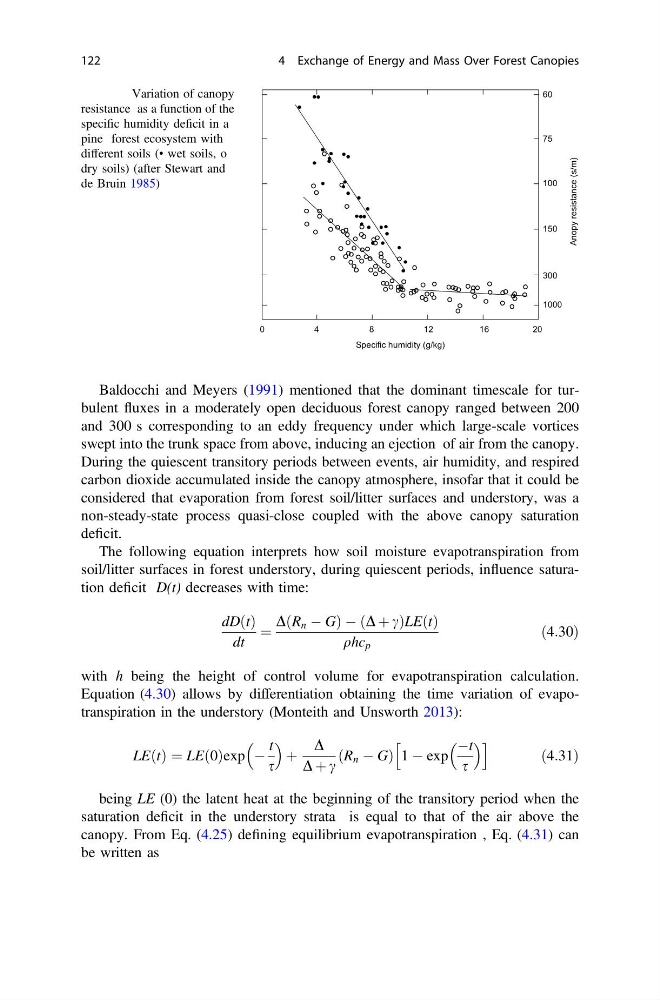
Fig. 4.6 Variation of canopy
resistance as a function of the
specific humidity deficit in a
pine forest ecosystem with
different soils (• wet soils, o
dry soils) (after Stewart and
de Bruin 1985)
122
4 Exchange of Energy and Mass Over Forest Canopies
and 300 s corresponding to an eddy frequency under which large-scale vortices
swept into the trunk space from above, inducing an ejection of air from the canopy.
During the quiescent transitory periods between events, air humidity, and respired
carbon dioxide accumulated inside the canopy atmosphere, insofar that it could be
considered that evaporation from forest soil/litter surfaces and understory, was a
non-steady-state process quasi-close coupled with the above canopy saturation
deficit.
The following equation interprets how soil moisture evapotranspiration from
soil/litter surfaces in forest understory, during quiescent periods, influence saturation deficit D(t) decreases with time:
dD t
ð Þ
dt
¼
D R n À G
ð
ÞÀ D þ c
ð
ÞLE t
ð Þ
qhc p
ð4:30Þ
with h being the height of control volume for evapotranspiration calculation.
Equation (4.30) allows by differentiation obtaining the time variation of evapotranspiration in the understory (Monteith and Unsworth 2013):
LE t
ð Þ ¼ LE 0
ð Þexp À
t
s
þ
D
D þ c
R n À G
ð
Þ 1 À exp
Àt
s
h
i
ð4:31Þ
being LE (0) the latent heat at the beginning of the transitory period when the
saturation deficit in the understory strata is equal to that of the air above the
canopy. From Eq. (4.25) defining equilibrium evapotranspiration , Eq. (4.31) can
be written as
0
4
8
1 2
1 6
2 0
Specific humidity (g/kg)
Anopy resistance (s/m)
60
75
100
1000
300
150
Fig. 4.6 Variation of canopy
resistance as a function of the
specific humidity deficit in a
pine forest ecosystem with
different soils (• wet soils, o
dry soils) (after Stewart and
de Bruin 1985)
122
4 Exchange of Energy and Mass Over Forest Canopies