

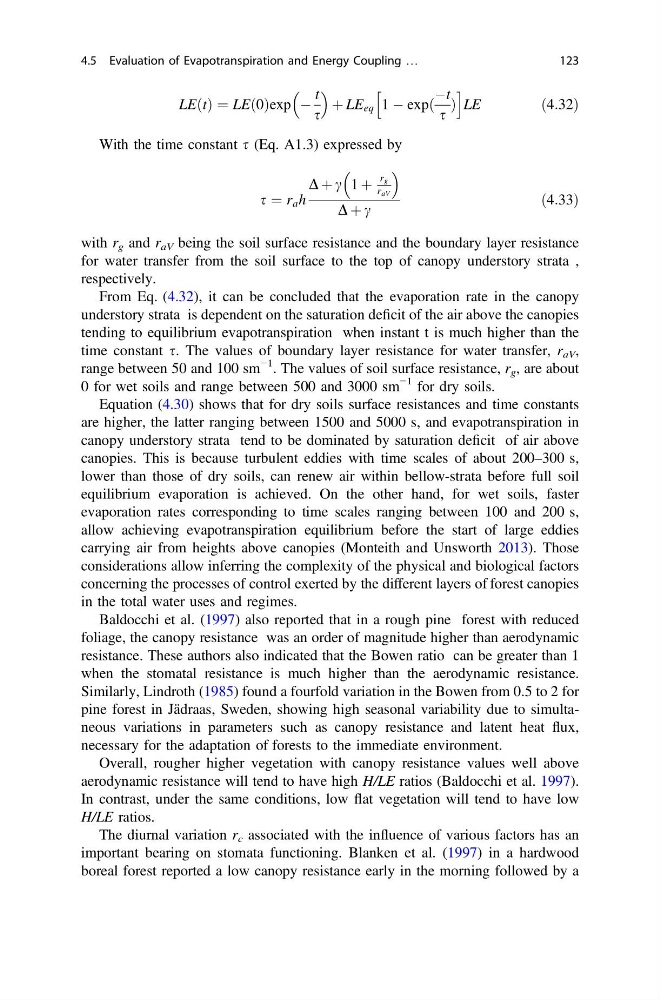
LE t
ð Þ ¼ LE 0
ð Þexp À
t
s
þ LE eq 1 À expð
Àt
s
Þ
h
i
LE
ð4:32Þ
With the time constant s (Eq. A1.3) expressed by
s ¼ r a h
D þ c 1 þ
r g
r aV
D þ c
ð4:33Þ
with r g and r aV being the soil surface resistance and the boundary layer resistance
for water transfer from the soil surface to the top of canopy understory strata ,
respectively.
From Eq. (4.32), it can be concluded that the evaporation rate in the canopy
understory strata is dependent on the saturation deficit of the air above the canopies
tending to equilibrium evapotranspiration when instant t is much higher than the
time constant s. The values of boundary layer resistance for water transfer, r aV ,
range between 50 and 100 sm
−1 . The values of soil surface resistance, r g , are about
0 for wet soils and range between 500 and 3000 sm
−1 for dry soils.
Equation (4.30) shows that for dry soils surface resistances and time constants
are higher, the latter ranging between 1500 and 5000 s, and evapotranspiration in
canopy understory strata tend to be dominated by saturation deficit of air above
canopies. This is because turbulent eddies with time scales of about 200–300 s,
lower than those of dry soils, can renew air within bellow-strata before full soil
equilibrium evaporation is achieved. On the other hand, for wet soils, faster
evaporation rates corresponding to time scales ranging between 100 and 200 s,
allow achieving evapotranspiration equilibrium before the start of large eddies
carrying air from heights above canopies (Monteith and Unsworth 2013). Those
considerations allow inferring the complexity of the physical and biological factors
concerning the processes of control exerted by the different layers of forest canopies
in the total water uses and regimes.
Baldocchi et al. (1997) also reported that in a rough pine forest with reduced
foliage, the canopy resistance was an order of magnitude higher than aerodynamic
resistance. These authors also indicated that the Bowen ratio can be greater than 1
when the stomatal resistance is much higher than the aerodynamic resistance.
Similarly, Lindroth (1985) found a fourfold variation in the Bowen from 0.5 to 2 for
pine forest in Jädraas, Sweden, showing high seasonal variability due to simultaneous variations in parameters such as canopy resistance and latent heat flux,
necessary for the adaptation of forests to the immediate environment.
Overall, rougher higher vegetation with canopy resistance values well above
aerodynamic resistance will tend to have high H/LE ratios (Baldocchi et al. 1997).
In contrast, under the same conditions, low flat vegetation will tend to have low
H/LE ratios.
The diurnal variation r c associated with the influence of various factors has an
important bearing on stomata functioning. Blanken et al. (1997) in a hardwood
boreal forest reported a low canopy resistance early in the morning followed by a
4.5 Evaluation of Evapotranspiration and Energy Coupling …
123
ð Þ ¼ LE 0
ð Þexp À
t
s
þ LE eq 1 À expð
Àt
s
Þ
h
i
LE
ð4:32Þ
With the time constant s (Eq. A1.3) expressed by
s ¼ r a h
D þ c 1 þ
r g
r aV
D þ c
ð4:33Þ
with r g and r aV being the soil surface resistance and the boundary layer resistance
for water transfer from the soil surface to the top of canopy understory strata ,
respectively.
From Eq. (4.32), it can be concluded that the evaporation rate in the canopy
understory strata is dependent on the saturation deficit of the air above the canopies
tending to equilibrium evapotranspiration when instant t is much higher than the
time constant s. The values of boundary layer resistance for water transfer, r aV ,
range between 50 and 100 sm
−1 . The values of soil surface resistance, r g , are about
0 for wet soils and range between 500 and 3000 sm
−1 for dry soils.
Equation (4.30) shows that for dry soils surface resistances and time constants
are higher, the latter ranging between 1500 and 5000 s, and evapotranspiration in
canopy understory strata tend to be dominated by saturation deficit of air above
canopies. This is because turbulent eddies with time scales of about 200–300 s,
lower than those of dry soils, can renew air within bellow-strata before full soil
equilibrium evaporation is achieved. On the other hand, for wet soils, faster
evaporation rates corresponding to time scales ranging between 100 and 200 s,
allow achieving evapotranspiration equilibrium before the start of large eddies
carrying air from heights above canopies (Monteith and Unsworth 2013). Those
considerations allow inferring the complexity of the physical and biological factors
concerning the processes of control exerted by the different layers of forest canopies
in the total water uses and regimes.
Baldocchi et al. (1997) also reported that in a rough pine forest with reduced
foliage, the canopy resistance was an order of magnitude higher than aerodynamic
resistance. These authors also indicated that the Bowen ratio can be greater than 1
when the stomatal resistance is much higher than the aerodynamic resistance.
Similarly, Lindroth (1985) found a fourfold variation in the Bowen from 0.5 to 2 for
pine forest in Jädraas, Sweden, showing high seasonal variability due to simultaneous variations in parameters such as canopy resistance and latent heat flux,
necessary for the adaptation of forests to the immediate environment.
Overall, rougher higher vegetation with canopy resistance values well above
aerodynamic resistance will tend to have high H/LE ratios (Baldocchi et al. 1997).
In contrast, under the same conditions, low flat vegetation will tend to have low
H/LE ratios.
The diurnal variation r c associated with the influence of various factors has an
important bearing on stomata functioning. Blanken et al. (1997) in a hardwood
boreal forest reported a low canopy resistance early in the morning followed by a
4.5 Evaluation of Evapotranspiration and Energy Coupling …
123