

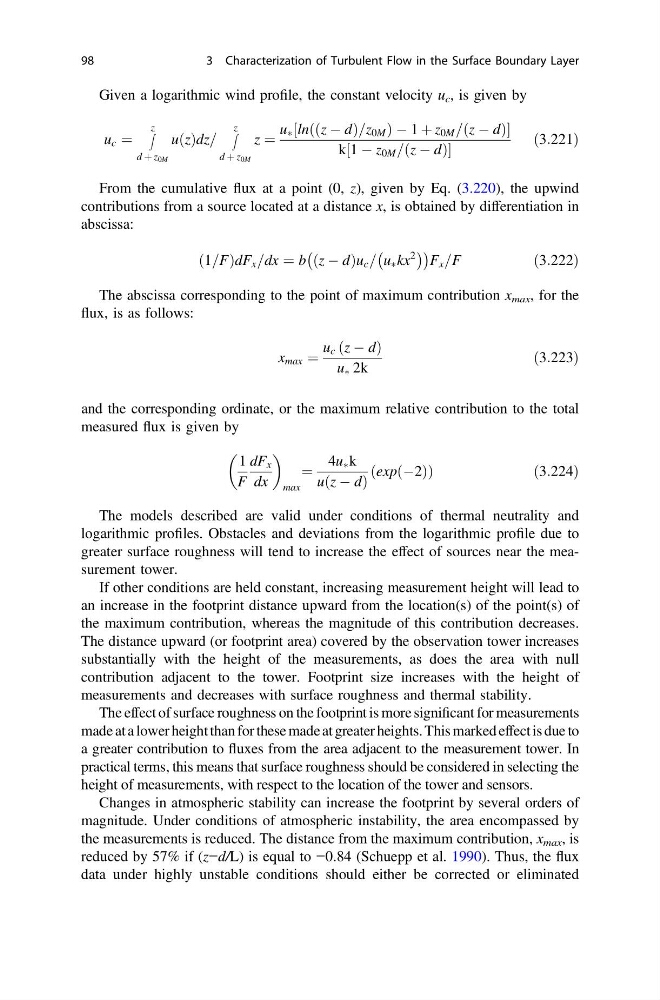
Given a logarithmic wind profile, the constant velocity u c , is given by
u c ¼
Z z
d þ z 0M
uðzÞdz=
Z z
d þ z 0M
z ¼
u à lnððz À dÞ=z 0M Þ À 1 þ z 0M =ðz À dÞ
½
k 1 À z 0M =ðz À dÞ
½
ð3:221Þ
From the cumulative flux at a point (0, z), given by Eq. (3.220), the upwind
contributions from a source located at a distance x, is obtained by differentiation in
abscissa:
ð1=FÞdF x =dx ¼ b ðz À dÞu c = u à kx
2
À
Á
À
Á
F x =F
ð3:222Þ
The abscissa corresponding to the point of maximum contribution x max , for the
flux, is as follows:
x max ¼
u c ðz À dÞ
u à 2k
ð3:223Þ
and the corresponding ordinate, or the maximum relative contribution to the total
measured flux is given by
1
F
dF x
dx
max
¼
4u à k
uðz À dÞ
ðexpðÀ2ÞÞ
ð3:224Þ
The models described are valid under conditions of thermal neutrality and
logarithmic profiles. Obstacles and deviations from the logarithmic profile due to
greater surface roughness will tend to increase the effect of sources near the measurement tower.
If other conditions are held constant, increasing measurement height will lead to
an increase in the footprint distance upward from the location(s) of the point(s) of
the maximum contribution, whereas the magnitude of this contribution decreases.
The distance upward (or footprint area) covered by the observation tower increases
substantially with the height of the measurements, as does the area with null
contribution adjacent to the tower. Footprint size increases with the height of
measurements and decreases with surface roughness and thermal stability.
The effect of surface roughness on the footprint is more significant for measurements
made at a lower height than for these made at greater heights. This marked effect is due to
a greater contribution to fluxes from the area adjacent to the measurement tower. In
practical terms, this means that surface roughness should be considered in selecting the
height of measurements, with respect to the location of the tower and sensors.
Changes in atmospheric stability can increase the footprint by several orders of
magnitude. Under conditions of atmospheric instability, the area encompassed by
the measurements is reduced. The distance from the maximum contribution, x max , is
reduced by 57% if (z−d/L) is equal to −0.84 (Schuepp et al. 1990). Thus, the flux
data under highly unstable conditions should either be corrected or eliminated
98
3 Characterization of Turbulent Flow in the Surface Boundary Layer
u c ¼
Z z
d þ z 0M
uðzÞdz=
Z z
d þ z 0M
z ¼
u à lnððz À dÞ=z 0M Þ À 1 þ z 0M =ðz À dÞ
½
k 1 À z 0M =ðz À dÞ
½
ð3:221Þ
From the cumulative flux at a point (0, z), given by Eq. (3.220), the upwind
contributions from a source located at a distance x, is obtained by differentiation in
abscissa:
ð1=FÞdF x =dx ¼ b ðz À dÞu c = u à kx
2
À
Á
À
Á
F x =F
ð3:222Þ
The abscissa corresponding to the point of maximum contribution x max , for the
flux, is as follows:
x max ¼
u c ðz À dÞ
u à 2k
ð3:223Þ
and the corresponding ordinate, or the maximum relative contribution to the total
measured flux is given by
1
F
dF x
dx
max
¼
4u à k
uðz À dÞ
ðexpðÀ2ÞÞ
ð3:224Þ
The models described are valid under conditions of thermal neutrality and
logarithmic profiles. Obstacles and deviations from the logarithmic profile due to
greater surface roughness will tend to increase the effect of sources near the measurement tower.
If other conditions are held constant, increasing measurement height will lead to
an increase in the footprint distance upward from the location(s) of the point(s) of
the maximum contribution, whereas the magnitude of this contribution decreases.
The distance upward (or footprint area) covered by the observation tower increases
substantially with the height of the measurements, as does the area with null
contribution adjacent to the tower. Footprint size increases with the height of
measurements and decreases with surface roughness and thermal stability.
The effect of surface roughness on the footprint is more significant for measurements
made at a lower height than for these made at greater heights. This marked effect is due to
a greater contribution to fluxes from the area adjacent to the measurement tower. In
practical terms, this means that surface roughness should be considered in selecting the
height of measurements, with respect to the location of the tower and sensors.
Changes in atmospheric stability can increase the footprint by several orders of
magnitude. Under conditions of atmospheric instability, the area encompassed by
the measurements is reduced. The distance from the maximum contribution, x max , is
reduced by 57% if (z−d/L) is equal to −0.84 (Schuepp et al. 1990). Thus, the flux
data under highly unstable conditions should either be corrected or eliminated
98
3 Characterization of Turbulent Flow in the Surface Boundary Layer