

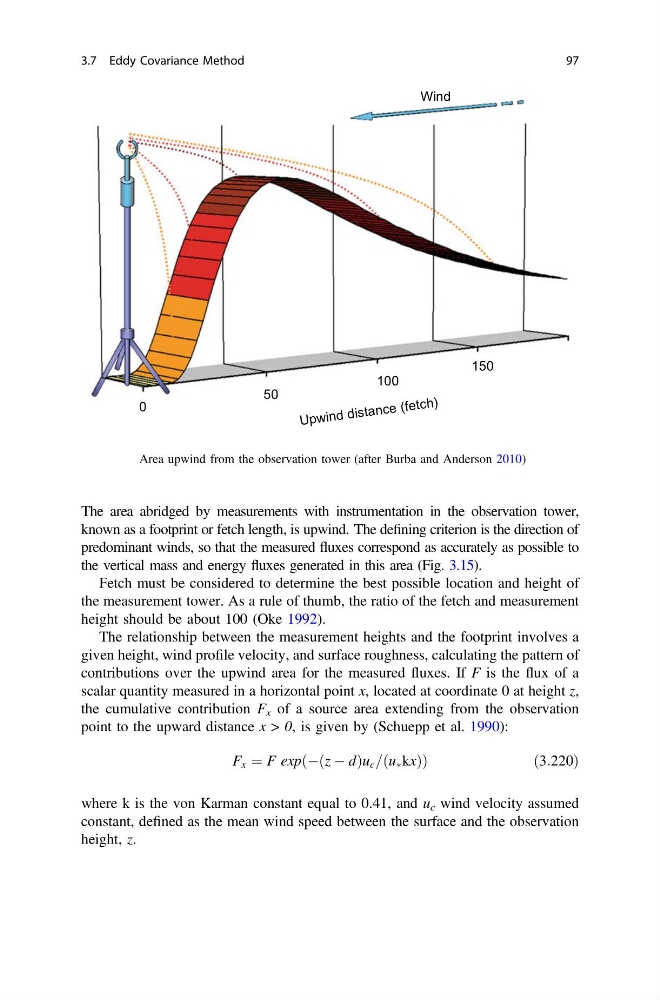
The area abridged by measurements with instrumentation in the observation tower,
known as a footprint or fetch length, is upwind. The defining criterion is the direction of
predominant winds, so that the measured fluxes correspond as accurately as possible to
the vertical mass and energy fluxes generated in this area (Fig. 3.15).
Fetch must be considered to determine the best possible location and height of
the measurement tower. As a rule of thumb, the ratio of the fetch and measurement
height should be about 100 (Oke 1992).
The relationship between the measurement heights and the footprint involves a
given height, wind profile velocity, and surface roughness, calculating the pattern of
contributions over the upwind area for the measured fluxes. If F is the flux of a
scalar quantity measured in a horizontal point x, located at coordinate 0 at height z,
the cumulative contribution F x of a source area extending from the observation
point to the upward distance x > 0, is given by (Schuepp et al. 1990):
F x ¼ F exp Àðz À dÞu c = u à kx
ð
Þ
ð
Þ
ð 3:220Þ
where k is the von Karman constant equal to 0.41, and u c wind velocity assumed
constant, defined as the mean wind speed between the surface and the observation
height, z.
0
50
Up wi nd dis tan ce (fe tch )
100
150
Wind
Fig. 3.15 Area upwind from the observation tower (after Burba and Anderson 2010)
3.7 Eddy Covariance Method
97
known as a footprint or fetch length, is upwind. The defining criterion is the direction of
predominant winds, so that the measured fluxes correspond as accurately as possible to
the vertical mass and energy fluxes generated in this area (Fig. 3.15).
Fetch must be considered to determine the best possible location and height of
the measurement tower. As a rule of thumb, the ratio of the fetch and measurement
height should be about 100 (Oke 1992).
The relationship between the measurement heights and the footprint involves a
given height, wind profile velocity, and surface roughness, calculating the pattern of
contributions over the upwind area for the measured fluxes. If F is the flux of a
scalar quantity measured in a horizontal point x, located at coordinate 0 at height z,
the cumulative contribution F x of a source area extending from the observation
point to the upward distance x > 0, is given by (Schuepp et al. 1990):
F x ¼ F exp Àðz À dÞu c = u à kx
ð
Þ
ð
Þ
ð 3:220Þ
where k is the von Karman constant equal to 0.41, and u c wind velocity assumed
constant, defined as the mean wind speed between the surface and the observation
height, z.
0
50
Up wi nd dis tan ce (fe tch )
100
150
Wind
Fig. 3.15 Area upwind from the observation tower (after Burba and Anderson 2010)
3.7 Eddy Covariance Method
97