

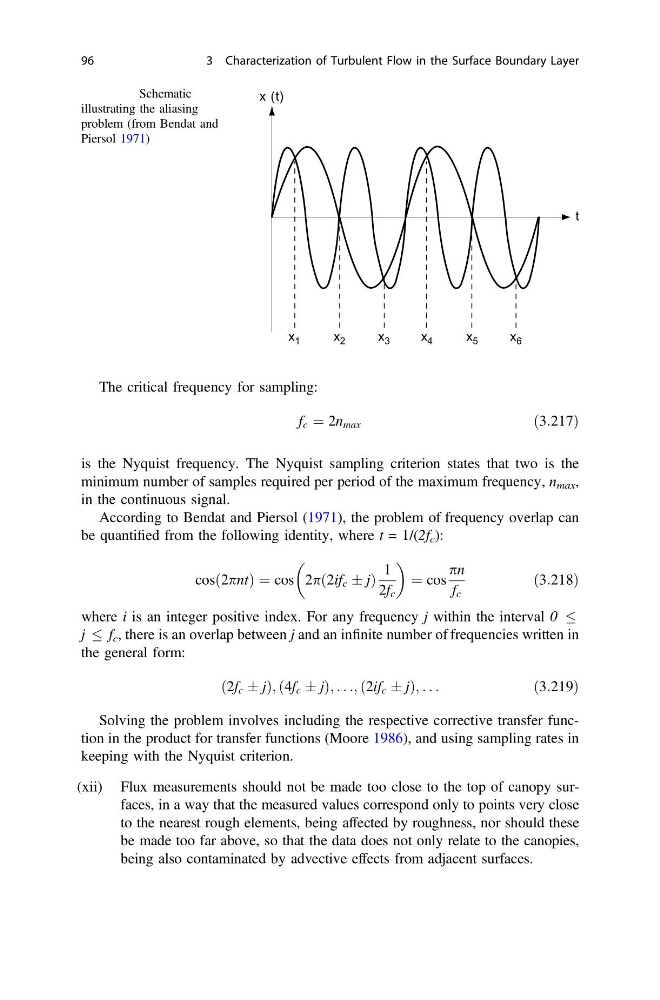
The critical frequency for sampling:
f c ¼ 2n max
ð3:217Þ
is the Nyquist frequency. The Nyquist sampling criterion states that two is the
minimum number of samples required per period of the maximum frequency, n max ,
in the continuous signal.
According to Bendat and Piersol (1971), the problem of frequency overlap can
be quantified from the following identity, where t = 1/(2f c ):
cosð2pntÞ ¼ cos 2p 2if c Æ j
ð
Þ
1
2f c
¼ cos
pn
f c
ð3:218Þ
where i is an integer positive index. For any frequency j within the interval 0
j
f c , there is an overlap between j and an infinite number of frequencies written in
the general form:
2f c Æ j
ð
Þ; 4f c Æ j
ð
Þ; . . .; 2if c Æ j
ð
Þ; . . .
ð3:219Þ
Solving the problem involves including the respective corrective transfer function in the product for transfer functions (Moore 1986), and using sampling rates in
keeping with the Nyquist criterion.
(xii) Flux measurements should not be made too close to the top of canopy surfaces, in a way that the measured values correspond only to points very close
to the nearest rough elements, being affected by roughness, nor should these
be made too far above, so that the data does not only relate to the canopies,
being also contaminated by advective effects from adjacent surfaces.
x (t)
t
x 1
x 2
x 3
x 4
x 5
x 6
Fig. 3.14 Schematic
illustrating the aliasing
problem (from Bendat and
Piersol 1971)
96
3 Characterization of Turbulent Flow in the Surface Boundary Layer
f c ¼ 2n max
ð3:217Þ
is the Nyquist frequency. The Nyquist sampling criterion states that two is the
minimum number of samples required per period of the maximum frequency, n max ,
in the continuous signal.
According to Bendat and Piersol (1971), the problem of frequency overlap can
be quantified from the following identity, where t = 1/(2f c ):
cosð2pntÞ ¼ cos 2p 2if c Æ j
ð
Þ
1
2f c
¼ cos
pn
f c
ð3:218Þ
where i is an integer positive index. For any frequency j within the interval 0
j
f c , there is an overlap between j and an infinite number of frequencies written in
the general form:
2f c Æ j
ð
Þ; 4f c Æ j
ð
Þ; . . .; 2if c Æ j
ð
Þ; . . .
ð3:219Þ
Solving the problem involves including the respective corrective transfer function in the product for transfer functions (Moore 1986), and using sampling rates in
keeping with the Nyquist criterion.
(xii) Flux measurements should not be made too close to the top of canopy surfaces, in a way that the measured values correspond only to points very close
to the nearest rough elements, being affected by roughness, nor should these
be made too far above, so that the data does not only relate to the canopies,
being also contaminated by advective effects from adjacent surfaces.
x (t)
t
x 1
x 2
x 3
x 4
x 5
x 6
Fig. 3.14 Schematic
illustrating the aliasing
problem (from Bendat and
Piersol 1971)
96
3 Characterization of Turbulent Flow in the Surface Boundary Layer