

because much of the flux comes from the perturbed area near the observation tower.
Clearly, the influence of the instability on measurements is greater if measurement
height is lower or if the surface roughness is higher.
(xiii) Gap-filled data sets obtained over 30 min intervals sometimes have missing
data or gaps that require filling. This is often the case with the measurement
of vertical fluxes of carbon dioxide and water vapor. The need for gap
filling may result from problems with the measurement instruments and this
can lead to poor quality data.
Basically, the gap-filling processes can be done by interpolation, whereby the
missing data are calculated from those obtained under the similar micrometeorological conditions. These conditions relate to the air temperature and relative
humidity, and solar radiation. The gap filling is usually done using appropriate
software. It can be necessary to resort to appropriate time windows of about 7 to 15
days before and after obtaining the means for the missing data fluxes and interpolate
from data corresponding to equivalent values of the microclimate variables. As a
last resort, averaged climate data for the days with missing data can be used. In the
case of carbon dioxide fluxes in plant ecosystems, it will likewise be necessary to
partition fluxes of the carbon budget, which were measured into the gross (photosynthesis) and respiration.
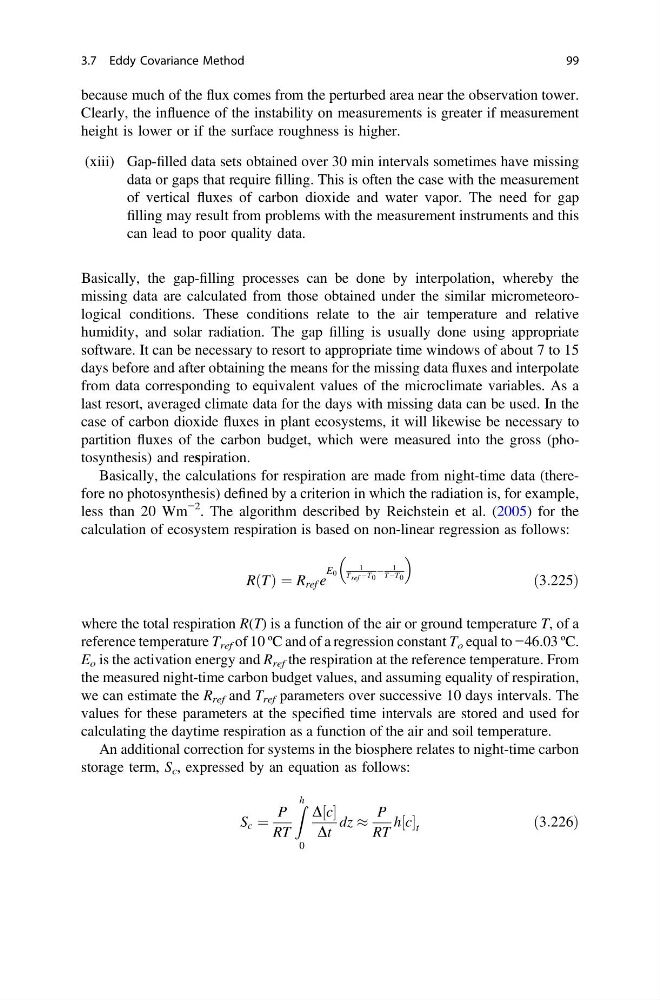
Basically, the calculations for respiration are made from night-time data (therefore no photosynthesis) defined by a criterion in which the radiation is, for example,
less than 20 Wm
−2
. The algorithm described by Reichstein et al. (2005) for the
calculation of ecosystem respiration is based on non-linear regression as follows:
R T
ð Þ ¼ R ref e
E 0
1
T ref ÀT 0
À
1
TÀT 0
ð3:225Þ
where the total respiration R(T) is a function of the air or ground temperature T, of a
reference temperature T ref of 10 ºC and of a regression constant T o equal to −46.03 ºC.
E o is the activation energy and R ref the respiration at the reference temperature. From
the measured night-time carbon budget values, and assuming equality of respiration,
we can estimate the R ref and T ref parameters over successive 10 days intervals. The
values for these parameters at the specified time intervals are stored and used for
calculating the daytime respiration as a function of the air and soil temperature.
An additional correction for systems in the biosphere relates to night-time carbon
storage term, S c , expressed by an equation as follows:
S c ¼
P
RT
Z h
0
D c
½
Dt
dz %
P
RT
h c
½ t
ð3:226Þ
3.7 Eddy Covariance Method
99
Clearly, the influence of the instability on measurements is greater if measurement
height is lower or if the surface roughness is higher.
(xiii) Gap-filled data sets obtained over 30 min intervals sometimes have missing
data or gaps that require filling. This is often the case with the measurement
of vertical fluxes of carbon dioxide and water vapor. The need for gap
filling may result from problems with the measurement instruments and this
can lead to poor quality data.
Basically, the gap-filling processes can be done by interpolation, whereby the
missing data are calculated from those obtained under the similar micrometeorological conditions. These conditions relate to the air temperature and relative
humidity, and solar radiation. The gap filling is usually done using appropriate
software. It can be necessary to resort to appropriate time windows of about 7 to 15
days before and after obtaining the means for the missing data fluxes and interpolate
from data corresponding to equivalent values of the microclimate variables. As a
last resort, averaged climate data for the days with missing data can be used. In the
case of carbon dioxide fluxes in plant ecosystems, it will likewise be necessary to
partition fluxes of the carbon budget, which were measured into the gross (photosynthesis) and respiration.
Basically, the calculations for respiration are made from night-time data (therefore no photosynthesis) defined by a criterion in which the radiation is, for example,
less than 20 Wm
−2
. The algorithm described by Reichstein et al. (2005) for the
calculation of ecosystem respiration is based on non-linear regression as follows:
R T
ð Þ ¼ R ref e
E 0
1
T ref ÀT 0
À
1
TÀT 0
ð3:225Þ
where the total respiration R(T) is a function of the air or ground temperature T, of a
reference temperature T ref of 10 ºC and of a regression constant T o equal to −46.03 ºC.
E o is the activation energy and R ref the respiration at the reference temperature. From
the measured night-time carbon budget values, and assuming equality of respiration,
we can estimate the R ref and T ref parameters over successive 10 days intervals. The
values for these parameters at the specified time intervals are stored and used for
calculating the daytime respiration as a function of the air and soil temperature.
An additional correction for systems in the biosphere relates to night-time carbon
storage term, S c , expressed by an equation as follows:
S c ¼
P
RT
Z h
0
D c
½
Dt
dz %
P
RT
h c
½ t
ð3:226Þ
3.7 Eddy Covariance Method
99