

c
2
s ¼ 403T S
ð3:173Þ
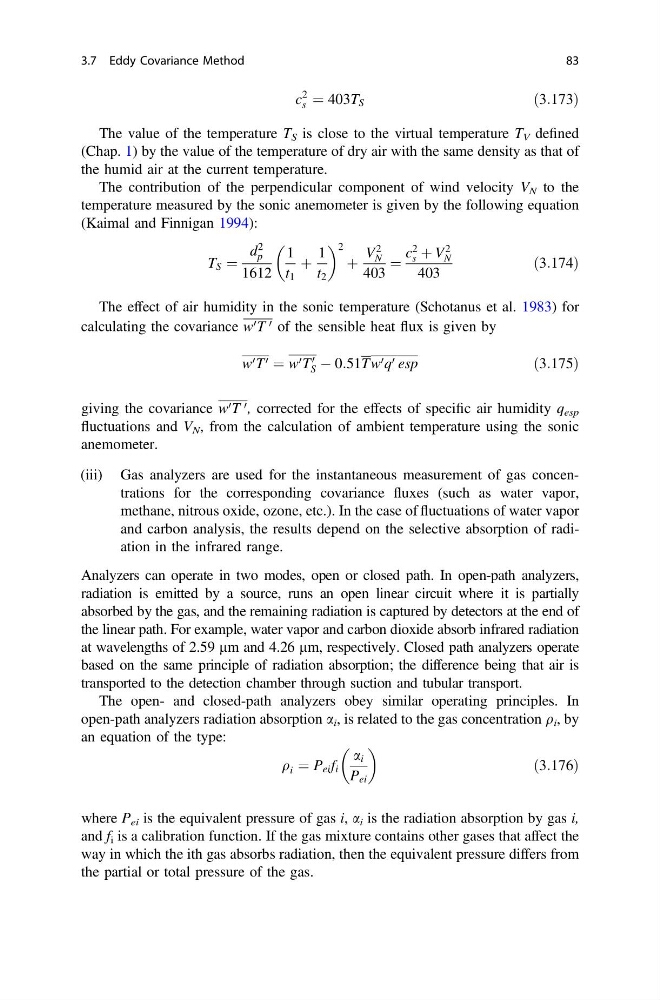
The value of the temperature T S is close to the virtual temperature T V defined
(Chap. 1) by the value of the temperature of dry air with the same density as that of
the humid air at the current temperature.
The contribution of the perpendicular component of wind velocity V N to the
temperature measured by the sonic anemometer is given by the following equation
(Kaimal and Finnigan 1994):
T S ¼
d
2
p
1612
1
t 1
þ
1
t 2
2
þ
V
2
N
403
¼
c
2
s þ V
2
N
403
ð3:174Þ
The effect of air humidity in the sonic temperature (Schotanus et al. 1983) for
calculating the covariance w 0 T 0 of the sensible heat flux is given by
w 0 T 0 ¼ w 0 T 0
S À 0:51Tw 0 q 0 esp
ð3:175Þ
giving the covariance w 0 T 0 , corrected for the effects of specific air humidity q esp
fluctuations and V N , from the calculation of ambient temperature using the sonic
anemometer.
(iii) Gas analyzers are used for the instantaneous measurement of gas concentrations for the corresponding covariance fluxes (such as water vapor,
methane, nitrous oxide, ozone, etc.). In the case of fluctuations of water vapor
and carbon analysis, the results depend on the selective absorption of radiation in the infrared range.
Analyzers can operate in two modes, open or closed path. In open-path analyzers,
radiation is emitted by a source, runs an open linear circuit where it is partially
absorbed by the gas, and the remaining radiation is captured by detectors at the end of
the linear path. For example, water vapor and carbon dioxide absorb infrared radiation
at wavelengths of 2.59 lm and 4.26 lm, respectively. Closed path analyzers operate
based on the same principle of radiation absorption; the difference being that air is
transported to the detection chamber through suction and tubular transport.
The open- and closed-path analyzers obey similar operating principles. In
open-path analyzers radiation absorption a i , is related to the gas concentration q i , by
an equation of the type:
q i ¼ P ei f i
a i
P ei
ð3:176Þ
where P ei is the equivalent pressure of gas i, a i is the radiation absorption by gas i,
and f i is a calibration function. If the gas mixture contains other gases that affect the
way in which the ith gas absorbs radiation, then the equivalent pressure differs from
the partial or total pressure of the gas.
3.7 Eddy Covariance Method
83
2
s ¼ 403T S
ð3:173Þ
The value of the temperature T S is close to the virtual temperature T V defined
(Chap. 1) by the value of the temperature of dry air with the same density as that of
the humid air at the current temperature.
The contribution of the perpendicular component of wind velocity V N to the
temperature measured by the sonic anemometer is given by the following equation
(Kaimal and Finnigan 1994):
T S ¼
d
2
p
1612
1
t 1
þ
1
t 2
2
þ
V
2
N
403
¼
c
2
s þ V
2
N
403
ð3:174Þ
The effect of air humidity in the sonic temperature (Schotanus et al. 1983) for
calculating the covariance w 0 T 0 of the sensible heat flux is given by
w 0 T 0 ¼ w 0 T 0
S À 0:51Tw 0 q 0 esp
ð3:175Þ
giving the covariance w 0 T 0 , corrected for the effects of specific air humidity q esp
fluctuations and V N , from the calculation of ambient temperature using the sonic
anemometer.
(iii) Gas analyzers are used for the instantaneous measurement of gas concentrations for the corresponding covariance fluxes (such as water vapor,
methane, nitrous oxide, ozone, etc.). In the case of fluctuations of water vapor
and carbon analysis, the results depend on the selective absorption of radiation in the infrared range.
Analyzers can operate in two modes, open or closed path. In open-path analyzers,
radiation is emitted by a source, runs an open linear circuit where it is partially
absorbed by the gas, and the remaining radiation is captured by detectors at the end of
the linear path. For example, water vapor and carbon dioxide absorb infrared radiation
at wavelengths of 2.59 lm and 4.26 lm, respectively. Closed path analyzers operate
based on the same principle of radiation absorption; the difference being that air is
transported to the detection chamber through suction and tubular transport.
The open- and closed-path analyzers obey similar operating principles. In
open-path analyzers radiation absorption a i , is related to the gas concentration q i , by
an equation of the type:
q i ¼ P ei f i
a i
P ei
ð3:176Þ
where P ei is the equivalent pressure of gas i, a i is the radiation absorption by gas i,
and f i is a calibration function. If the gas mixture contains other gases that affect the
way in which the ith gas absorbs radiation, then the equivalent pressure differs from
the partial or total pressure of the gas.
3.7 Eddy Covariance Method
83