

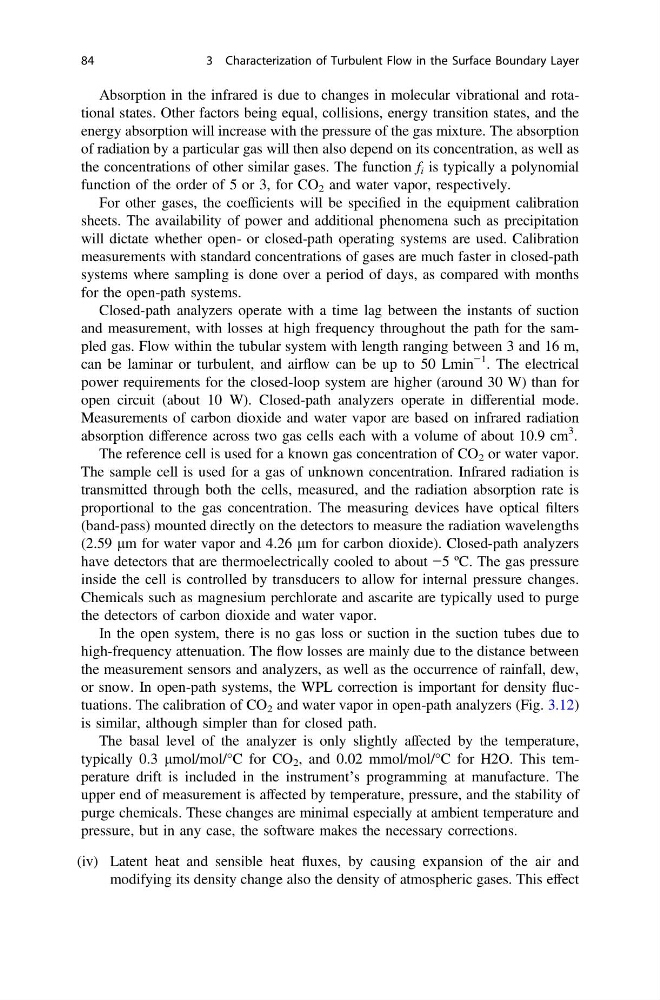
Absorption in the infrared is due to changes in molecular vibrational and rotational states. Other factors being equal, collisions, energy transition states, and the
energy absorption will increase with the pressure of the gas mixture. The absorption
of radiation by a particular gas will then also depend on its concentration, as well as
the concentrations of other similar gases. The function f i is typically a polynomial
function of the order of 5 or 3, for CO 2 and water vapor, respectively.
For other gases, the coefficients will be specified in the equipment calibration
sheets. The availability of power and additional phenomena such as precipitation
will dictate whether open- or closed-path operating systems are used. Calibration
measurements with standard concentrations of gases are much faster in closed-path
systems where sampling is done over a period of days, as compared with months
for the open-path systems.
Closed-path analyzers operate with a time lag between the instants of suction
and measurement, with losses at high frequency throughout the path for the sampled gas. Flow within the tubular system with length ranging between 3 and 16 m,
can be laminar or turbulent, and airflow can be up to 50 Lmin
−1 . The electrical
power requirements for the closed-loop system are higher (around 30 W) than for
open circuit (about 10 W). Closed-path analyzers operate in differential mode.
Measurements of carbon dioxide and water vapor are based on infrared radiation
absorption difference across two gas cells each with a volume of about 10.9 cm
3
.
The reference cell is used for a known gas concentration of CO 2 or water vapor.
The sample cell is used for a gas of unknown concentration. Infrared radiation is
transmitted through both the cells, measured, and the radiation absorption rate is
proportional to the gas concentration. The measuring devices have optical filters
(band-pass) mounted directly on the detectors to measure the radiation wavelengths
(2.59 lm for water vapor and 4.26 lm for carbon dioxide). Closed-path analyzers
have detectors that are thermoelectrically cooled to about −5 ºC. The gas pressure
inside the cell is controlled by transducers to allow for internal pressure changes.
Chemicals such as magnesium perchlorate and ascarite are typically used to purge
the detectors of carbon dioxide and water vapor.
In the open system, there is no gas loss or suction in the suction tubes due to
high-frequency attenuation. The flow losses are mainly due to the distance between
the measurement sensors and analyzers, as well as the occurrence of rainfall, dew,
or snow. In open-path systems, the WPL correction is important for density fluctuations. The calibration of CO 2 and water vapor in open-path analyzers (Fig. 3.12)
is similar, although simpler than for closed path.
The basal level of the analyzer is only slightly affected by the temperature,
typically 0.3 lmol/mol/°C for CO 2 , and 0.02 mmol/mol/°C for H2O. This temperature drift is included in the instrument’s programming at manufacture. The
upper end of measurement is affected by temperature, pressure, and the stability of
purge chemicals. These changes are minimal especially at ambient temperature and
pressure, but in any case, the software makes the necessary corrections.
(iv) Latent heat and sensible heat fluxes, by causing expansion of the air and
modifying its density change also the density of atmospheric gases. This effect
84
3 Characterization of Turbulent Flow in the Surface Boundary Layer
energy absorption will increase with the pressure of the gas mixture. The absorption
of radiation by a particular gas will then also depend on its concentration, as well as
the concentrations of other similar gases. The function f i is typically a polynomial
function of the order of 5 or 3, for CO 2 and water vapor, respectively.
For other gases, the coefficients will be specified in the equipment calibration
sheets. The availability of power and additional phenomena such as precipitation
will dictate whether open- or closed-path operating systems are used. Calibration
measurements with standard concentrations of gases are much faster in closed-path
systems where sampling is done over a period of days, as compared with months
for the open-path systems.
Closed-path analyzers operate with a time lag between the instants of suction
and measurement, with losses at high frequency throughout the path for the sampled gas. Flow within the tubular system with length ranging between 3 and 16 m,
can be laminar or turbulent, and airflow can be up to 50 Lmin
−1 . The electrical
power requirements for the closed-loop system are higher (around 30 W) than for
open circuit (about 10 W). Closed-path analyzers operate in differential mode.
Measurements of carbon dioxide and water vapor are based on infrared radiation
absorption difference across two gas cells each with a volume of about 10.9 cm
3
.
The reference cell is used for a known gas concentration of CO 2 or water vapor.
The sample cell is used for a gas of unknown concentration. Infrared radiation is
transmitted through both the cells, measured, and the radiation absorption rate is
proportional to the gas concentration. The measuring devices have optical filters
(band-pass) mounted directly on the detectors to measure the radiation wavelengths
(2.59 lm for water vapor and 4.26 lm for carbon dioxide). Closed-path analyzers
have detectors that are thermoelectrically cooled to about −5 ºC. The gas pressure
inside the cell is controlled by transducers to allow for internal pressure changes.
Chemicals such as magnesium perchlorate and ascarite are typically used to purge
the detectors of carbon dioxide and water vapor.
In the open system, there is no gas loss or suction in the suction tubes due to
high-frequency attenuation. The flow losses are mainly due to the distance between
the measurement sensors and analyzers, as well as the occurrence of rainfall, dew,
or snow. In open-path systems, the WPL correction is important for density fluctuations. The calibration of CO 2 and water vapor in open-path analyzers (Fig. 3.12)
is similar, although simpler than for closed path.
The basal level of the analyzer is only slightly affected by the temperature,
typically 0.3 lmol/mol/°C for CO 2 , and 0.02 mmol/mol/°C for H2O. This temperature drift is included in the instrument’s programming at manufacture. The
upper end of measurement is affected by temperature, pressure, and the stability of
purge chemicals. These changes are minimal especially at ambient temperature and
pressure, but in any case, the software makes the necessary corrections.
(iv) Latent heat and sensible heat fluxes, by causing expansion of the air and
modifying its density change also the density of atmospheric gases. This effect
84
3 Characterization of Turbulent Flow in the Surface Boundary Layer