

3.7 Eddy Covariance Method
Widespread application of the turbulent correlation or covariance method dates back
from the last decade. This method deals with mass and energy fluxes for quantifying
instantaneous fluctuations of vectorial and scalar variables (e.g., air temperature,
carbon concentration, water vapor vertical component of air velocity) of turbulent
eddies when they pass a measuring point. The eddy covariance method is the most
accurate for calculating mass and energy fluxes and is used to calibrate other previously discussed methods such as aerodynamic (Chap. 2), Bowen methods, or the
Penman–Monteith calculation for evapotranspiration described in Chap. 4.
The eddy covariance method is complex but the advent of technological tools,
including improved instrumentation and software for calculations and corrections,
has allowed for its extensive application in numerous natural and man-made
microsystems. In this Section, only overarching principles are presented about the
turbulent covariance method and instrumentation required for the flux measurements. For details about the calculations on the vertical flow of other atmospheric
gases (e.g., methane) the reader is directed to Burba and Anderson (2010), Foken
(2017), Papale et al. (2006), Aubinet et al. (2000), Göckede et al. (2008), Mauder
and Foken (2004) and Lee et al. (2004).
Basically, the method is based on obtaining the means for covariance, as discussed above, making possible equations for the vertical atmospheric fluxes such as
the following:
s ¼ Àq u 0 w 0 q
ð3:165Þ
n = fz/u
0.001
0.01
0.1
uw
w θ
1.0
10
100
0.1
1.0
10
0.01
cospectru
0 > z/L > -2.0
0 . 1
0
0 . 3
0 . 5
1 . 0
2 . 0
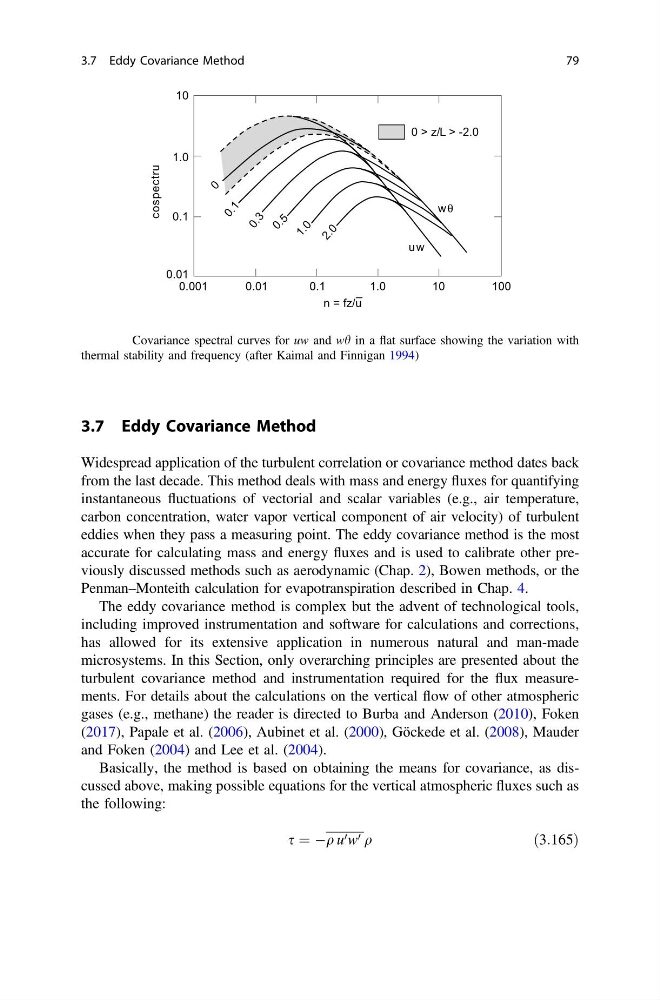
Fig. 3.9 Covariance spectral curves for uw and wh in a flat surface showing the variation with
thermal stability and frequency (after Kaimal and Finnigan 1994)
3.7 Eddy Covariance Method
79
Widespread application of the turbulent correlation or covariance method dates back
from the last decade. This method deals with mass and energy fluxes for quantifying
instantaneous fluctuations of vectorial and scalar variables (e.g., air temperature,
carbon concentration, water vapor vertical component of air velocity) of turbulent
eddies when they pass a measuring point. The eddy covariance method is the most
accurate for calculating mass and energy fluxes and is used to calibrate other previously discussed methods such as aerodynamic (Chap. 2), Bowen methods, or the
Penman–Monteith calculation for evapotranspiration described in Chap. 4.
The eddy covariance method is complex but the advent of technological tools,
including improved instrumentation and software for calculations and corrections,
has allowed for its extensive application in numerous natural and man-made
microsystems. In this Section, only overarching principles are presented about the
turbulent covariance method and instrumentation required for the flux measurements. For details about the calculations on the vertical flow of other atmospheric
gases (e.g., methane) the reader is directed to Burba and Anderson (2010), Foken
(2017), Papale et al. (2006), Aubinet et al. (2000), Göckede et al. (2008), Mauder
and Foken (2004) and Lee et al. (2004).
Basically, the method is based on obtaining the means for covariance, as discussed above, making possible equations for the vertical atmospheric fluxes such as
the following:
s ¼ Àq u 0 w 0 q
ð3:165Þ
n = fz/u
0.001
0.01
0.1
uw
w θ
1.0
10
100
0.1
1.0
10
0.01
cospectru
0 > z/L > -2.0
0 . 1
0
0 . 3
0 . 5
1 . 0
2 . 0
Fig. 3.9 Covariance spectral curves for uw and wh in a flat surface showing the variation with
thermal stability and frequency (after Kaimal and Finnigan 1994)
3.7 Eddy Covariance Method
79