

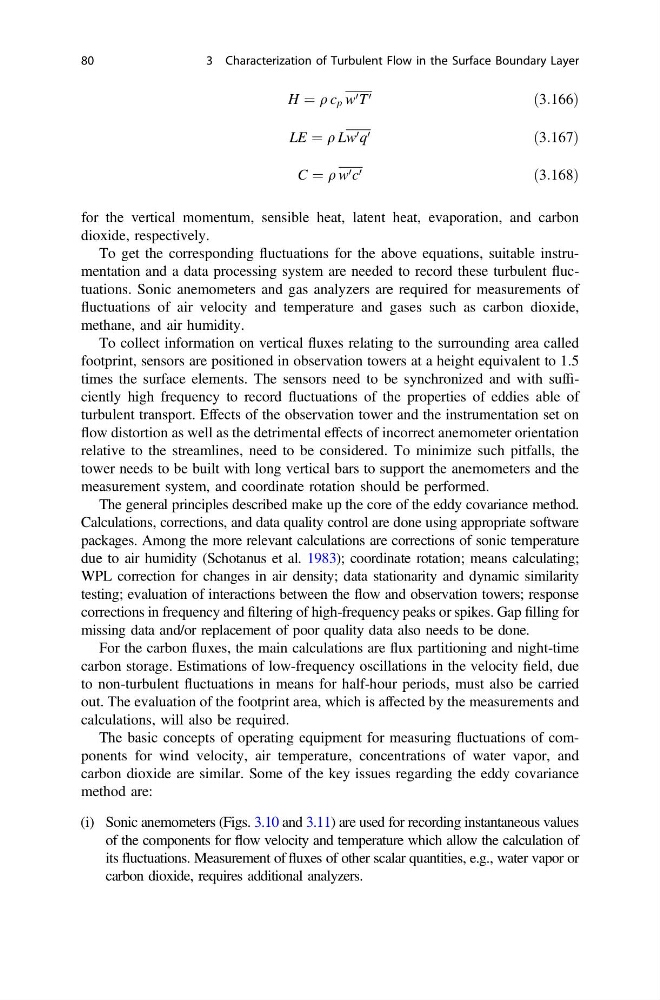
H ¼ q c p w 0 T 0
ð3:166Þ
LE ¼ q Lw 0 q 0
ð3:167Þ
C ¼ q w 0 c 0
ð3:168Þ
for the vertical momentum, sensible heat, latent heat, evaporation, and carbon
dioxide, respectively.
To get the corresponding fluctuations for the above equations, suitable instrumentation and a data processing system are needed to record these turbulent fluctuations. Sonic anemometers and gas analyzers are required for measurements of
fluctuations of air velocity and temperature and gases such as carbon dioxide,
methane, and air humidity.
To collect information on vertical fluxes relating to the surrounding area called
footprint, sensors are positioned in observation towers at a height equivalent to 1.5
times the surface elements. The sensors need to be synchronized and with sufficiently high frequency to record fluctuations of the properties of eddies able of
turbulent transport. Effects of the observation tower and the instrumentation set on
flow distortion as well as the detrimental effects of incorrect anemometer orientation
relative to the streamlines, need to be considered. To minimize such pitfalls, the
tower needs to be built with long vertical bars to support the anemometers and the
measurement system, and coordinate rotation should be performed.
The general principles described make up the core of the eddy covariance method.
Calculations, corrections, and data quality control are done using appropriate software
packages. Among the more relevant calculations are corrections of sonic temperature
due to air humidity (Schotanus et al. 1983); coordinate rotation; means calculating;
WPL correction for changes in air density; data stationarity and dynamic similarity
testing; evaluation of interactions between the flow and observation towers; response
corrections in frequency and filtering of high-frequency peaks or spikes. Gap filling for
missing data and/or replacement of poor quality data also needs to be done.
For the carbon fluxes, the main calculations are flux partitioning and night-time
carbon storage. Estimations of low-frequency oscillations in the velocity field, due
to non-turbulent fluctuations in means for half-hour periods, must also be carried
out. The evaluation of the footprint area, which is affected by the measurements and
calculations, will also be required.
The basic concepts of operating equipment for measuring fluctuations of components for wind velocity, air temperature, concentrations of water vapor, and
carbon dioxide are similar. Some of the key issues regarding the eddy covariance
method are:
(i) Sonic anemometers (Figs. 3.10 and 3.11) are used for recording instantaneous values
of the components for flow velocity and temperature which allow the calculation of
its fluctuations. Measurement of fluxes of other scalar quantities, e.g., water vapor or
carbon dioxide, requires additional analyzers.
80
3 Characterization of Turbulent Flow in the Surface Boundary Layer
ð3:166Þ
LE ¼ q Lw 0 q 0
ð3:167Þ
C ¼ q w 0 c 0
ð3:168Þ
for the vertical momentum, sensible heat, latent heat, evaporation, and carbon
dioxide, respectively.
To get the corresponding fluctuations for the above equations, suitable instrumentation and a data processing system are needed to record these turbulent fluctuations. Sonic anemometers and gas analyzers are required for measurements of
fluctuations of air velocity and temperature and gases such as carbon dioxide,
methane, and air humidity.
To collect information on vertical fluxes relating to the surrounding area called
footprint, sensors are positioned in observation towers at a height equivalent to 1.5
times the surface elements. The sensors need to be synchronized and with sufficiently high frequency to record fluctuations of the properties of eddies able of
turbulent transport. Effects of the observation tower and the instrumentation set on
flow distortion as well as the detrimental effects of incorrect anemometer orientation
relative to the streamlines, need to be considered. To minimize such pitfalls, the
tower needs to be built with long vertical bars to support the anemometers and the
measurement system, and coordinate rotation should be performed.
The general principles described make up the core of the eddy covariance method.
Calculations, corrections, and data quality control are done using appropriate software
packages. Among the more relevant calculations are corrections of sonic temperature
due to air humidity (Schotanus et al. 1983); coordinate rotation; means calculating;
WPL correction for changes in air density; data stationarity and dynamic similarity
testing; evaluation of interactions between the flow and observation towers; response
corrections in frequency and filtering of high-frequency peaks or spikes. Gap filling for
missing data and/or replacement of poor quality data also needs to be done.
For the carbon fluxes, the main calculations are flux partitioning and night-time
carbon storage. Estimations of low-frequency oscillations in the velocity field, due
to non-turbulent fluctuations in means for half-hour periods, must also be carried
out. The evaluation of the footprint area, which is affected by the measurements and
calculations, will also be required.
The basic concepts of operating equipment for measuring fluctuations of components for wind velocity, air temperature, concentrations of water vapor, and
carbon dioxide are similar. Some of the key issues regarding the eddy covariance
method are:
(i) Sonic anemometers (Figs. 3.10 and 3.11) are used for recording instantaneous values
of the components for flow velocity and temperature which allow the calculation of
its fluctuations. Measurement of fluxes of other scalar quantities, e.g., water vapor or
carbon dioxide, requires additional analyzers.
80
3 Characterization of Turbulent Flow in the Surface Boundary Layer