

Assessing Inhomogeneous Indicator-Related Typologies Through the Reverse. . .
41
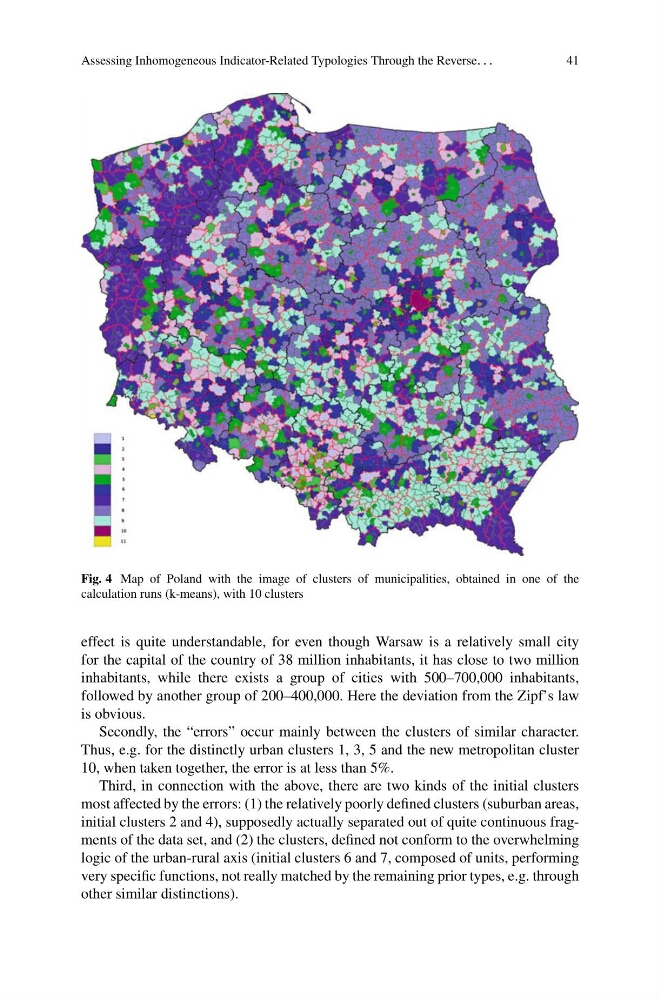
Fig. 4 Map of Poland with the image of clusters of municipalities, obtained in one of the
calculation runs (k-means), with 10 clusters
effect is quite understandable, for even though Warsaw is a relatively small city
for the capital of the country of 38 million inhabitants, it has close to two million
inhabitants, while there exists a group of cities with 500–700,000 inhabitants,
followed by another group of 200–400,000. Here the deviation from the Zipf’s law
is obvious.
Secondly, the “errors” occur mainly between the clusters of similar character.
Thus, e.g. for the distinctly urban clusters 1, 3, 5 and the new metropolitan cluster
10, when taken together, the error is at less than 5%.
Third, in connection with the above, there are two kinds of the initial clusters
most affected by the errors: (1) the relatively poorly defined clusters (suburban areas,
initial clusters 2 and 4), supposedly actually separated out of quite continuous fragments of the data set, and (2) the clusters, defined not conform to the overwhelming
logic of the urban-rural axis (initial clusters 6 and 7, composed of units, performing
very specific functions, not really matched by the remaining prior types, e.g. through
other similar distinctions).
41
Fig. 4 Map of Poland with the image of clusters of municipalities, obtained in one of the
calculation runs (k-means), with 10 clusters
effect is quite understandable, for even though Warsaw is a relatively small city
for the capital of the country of 38 million inhabitants, it has close to two million
inhabitants, while there exists a group of cities with 500–700,000 inhabitants,
followed by another group of 200–400,000. Here the deviation from the Zipf’s law
is obvious.
Secondly, the “errors” occur mainly between the clusters of similar character.
Thus, e.g. for the distinctly urban clusters 1, 3, 5 and the new metropolitan cluster
10, when taken together, the error is at less than 5%.
Third, in connection with the above, there are two kinds of the initial clusters
most affected by the errors: (1) the relatively poorly defined clusters (suburban areas,
initial clusters 2 and 4), supposedly actually separated out of quite continuous fragments of the data set, and (2) the clusters, defined not conform to the overwhelming
logic of the urban-rural axis (initial clusters 6 and 7, composed of units, performing
very specific functions, not really matched by the remaining prior types, e.g. through
other similar distinctions).