

Looking for Alternatives? Split-Shots as an Exemplary Case
159
Thus, an alternatives analysis is
• a process for identifying, comparing, and selecting safer alternatives to chemicals
of concern.
• intended to facilitate an informed consideration of the advantages and disadvantages of alternatives to a chemical of concern
whereas an alternatives analysis is not
• a safety assessment, where the primary goal is to ensure that exposure is below a
prescribed standard,
• a risk assessment, where risk associated with a given level of exposure is
calculated
• a sustainability assessment, that considers all aspects of a chemical’s life cycle,
including energy and material use
3.1 Aggregated Data
Due to the low number of compared elements (6) relative to the total number of
indicators (13) a direct partial ordering of the compared elements based on all
indicators is not meaningful due to a possible lack of robustness (Sørensen et al.
2000). Even ordering based on the single indicators groups gives only little sense.
Thus, some kind of aggregation of the sub-indicators appears appropriate. Hence,
the 13 indicators are aggregated into 4 groups, i.e., Technical and Performance
Criteria (TPCr), Environmental Criteria (ENCr), Human Health Criteria (HHCr)
and Cost criteria (Cost), respectively. The aggregation is carried out by a simple
addition of the indicator values for these four groups. Thus,
• TPCr = dens + hard + mall + lowm + corr
• EnCr = hito + toaq + dwst
• HHCr = carc + devt + ocex
• Cost = repr + avail
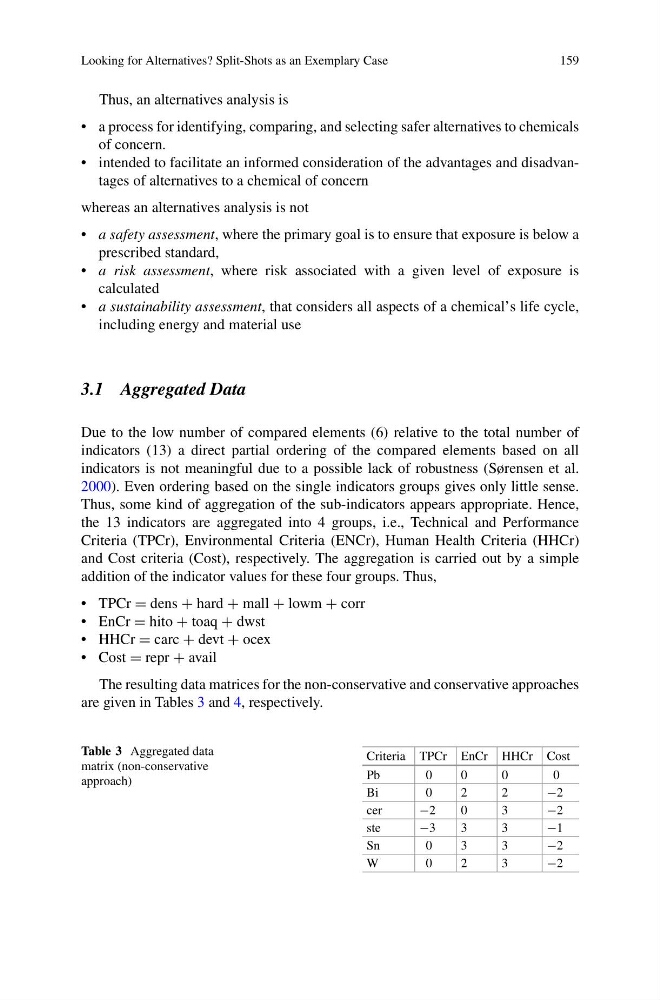
The resulting data matrices for the non-conservative and conservative approaches
are given in Tables 3 and 4, respectively.
Table 3 Aggregated data
matrix (non-conservative
approach)
Criteria TPCr EnCr HHCr Cost
Pb
0
0
0
0
Bi
0
2
2
−2
cer
−2
0
3
−2
ste
−3
3
3
−1
Sn
0
3
3
−2
W
0
2
3
−2
159
Thus, an alternatives analysis is
• a process for identifying, comparing, and selecting safer alternatives to chemicals
of concern.
• intended to facilitate an informed consideration of the advantages and disadvantages of alternatives to a chemical of concern
whereas an alternatives analysis is not
• a safety assessment, where the primary goal is to ensure that exposure is below a
prescribed standard,
• a risk assessment, where risk associated with a given level of exposure is
calculated
• a sustainability assessment, that considers all aspects of a chemical’s life cycle,
including energy and material use
3.1 Aggregated Data
Due to the low number of compared elements (6) relative to the total number of
indicators (13) a direct partial ordering of the compared elements based on all
indicators is not meaningful due to a possible lack of robustness (Sørensen et al.
2000). Even ordering based on the single indicators groups gives only little sense.
Thus, some kind of aggregation of the sub-indicators appears appropriate. Hence,
the 13 indicators are aggregated into 4 groups, i.e., Technical and Performance
Criteria (TPCr), Environmental Criteria (ENCr), Human Health Criteria (HHCr)
and Cost criteria (Cost), respectively. The aggregation is carried out by a simple
addition of the indicator values for these four groups. Thus,
• TPCr = dens + hard + mall + lowm + corr
• EnCr = hito + toaq + dwst
• HHCr = carc + devt + ocex
• Cost = repr + avail
The resulting data matrices for the non-conservative and conservative approaches
are given in Tables 3 and 4, respectively.
Table 3 Aggregated data
matrix (non-conservative
approach)
Criteria TPCr EnCr HHCr Cost
Pb
0
0
0
0
Bi
0
2
2
−2
cer
−2
0
3
−2
ste
−3
3
3
−1
Sn
0
3
3
−2
W
0
2
3
−2