

Introduction into Sampling Theory, Applying Partial Order Concepts
143
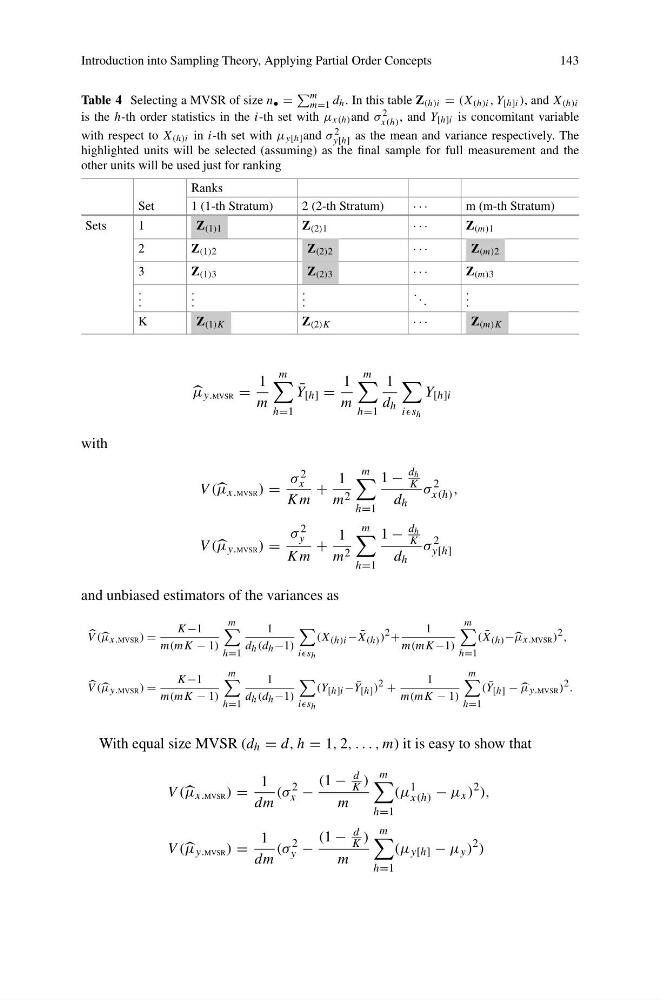
Table 4 Selecting a MVSR of size n • =
m
m=1 d h . In this table Z (h)i = (X (h)i , Y [h]i ), and X (h)i
is the h-th order statistics in the i-th set with μ x(h) and σ 2
x(h) , and Y [h]i is concomitant variable
with respect to X (h)i in i-th set with μ y[h] and σ 2
y[h] as the mean and variance respectively. The
highlighted units will be selected (assuming) as the final sample for full measurement and the
other units will be used just for ranking
Ranks
Set
1 (1-th Stratum)
2 (2-th Stratum)
· · ·
m (m-th Stratum)
Sets
1
Z (1)1
Z (2)1
· · ·
Z (m)1
2
Z (1)2
Z (2)2
· · ·
Z (m)2
3
Z (1)3
Z (2)3
· · ·
Z (m)3
. . .
. . .
. . .
. . .
. . .
K
Z (1)K
Z (2)K
· · ·
Z (m)K
μ y.MVSR =
1
m
m
h=1
¯
Y [h] =
1
m
m
h=1
1
d h
iis h
Y [h]i
with
V ( μ x.MVSR ) =
σ 2
x
Km
+
1
m 2
m
h=1
1 −
d h
K
d h
σ
2
x(h) ,
V ( μ y.MVSR ) =
σ 2
y
Km
+
1
m 2
m
h=1
1 −
d h
K
d h
σ
2
y[h]
and unbiased estimators of the variances as
V ( μ x.MVSR ) =
K−1
m(mK − 1)
m
h=1
1
d h (d h −1)
iis h
(X (h)i − ¯
X (h) ) 2 +
1
m(mK−1)
m
h=1
( ¯
X (h) − μ x.MVSR ) 2 ,
V ( μ y.MVSR ) =
K−1
m(mK − 1)
m
h=1
1
d h (d h −1)
iis h
(Y [h]i − ¯
Y [h] ) 2 +
1
m(mK − 1)
m
h=1
( ¯
Y [h] − μ y.MVSR ) 2 .
With equal size MVSR (d h = d, h = 1, 2, . . . , m) it is easy to show that
V ( μ x.MVSR ) =
1
dm
(σ
2
x −
(1 −
d
K )
m
m
h=1
(μ
1
x(h) − μ x )
2 ),
V ( μ y.MVSR ) =
1
dm
(σ
2
y −
(1 −
d
K )
m
m
h=1
(μ y[h] − μ y )
2 )
143
Table 4 Selecting a MVSR of size n • =
m
m=1 d h . In this table Z (h)i = (X (h)i , Y [h]i ), and X (h)i
is the h-th order statistics in the i-th set with μ x(h) and σ 2
x(h) , and Y [h]i is concomitant variable
with respect to X (h)i in i-th set with μ y[h] and σ 2
y[h] as the mean and variance respectively. The
highlighted units will be selected (assuming) as the final sample for full measurement and the
other units will be used just for ranking
Ranks
Set
1 (1-th Stratum)
2 (2-th Stratum)
· · ·
m (m-th Stratum)
Sets
1
Z (1)1
Z (2)1
· · ·
Z (m)1
2
Z (1)2
Z (2)2
· · ·
Z (m)2
3
Z (1)3
Z (2)3
· · ·
Z (m)3
. . .
. . .
. . .
. . .
. . .
K
Z (1)K
Z (2)K
· · ·
Z (m)K
μ y.MVSR =
1
m
m
h=1
¯
Y [h] =
1
m
m
h=1
1
d h
iis h
Y [h]i
with
V ( μ x.MVSR ) =
σ 2
x
Km
+
1
m 2
m
h=1
1 −
d h
K
d h
σ
2
x(h) ,
V ( μ y.MVSR ) =
σ 2
y
Km
+
1
m 2
m
h=1
1 −
d h
K
d h
σ
2
y[h]
and unbiased estimators of the variances as
V ( μ x.MVSR ) =
K−1
m(mK − 1)
m
h=1
1
d h (d h −1)
iis h
(X (h)i − ¯
X (h) ) 2 +
1
m(mK−1)
m
h=1
( ¯
X (h) − μ x.MVSR ) 2 ,
V ( μ y.MVSR ) =
K−1
m(mK − 1)
m
h=1
1
d h (d h −1)
iis h
(Y [h]i − ¯
Y [h] ) 2 +
1
m(mK − 1)
m
h=1
( ¯
Y [h] − μ y.MVSR ) 2 .
With equal size MVSR (d h = d, h = 1, 2, . . . , m) it is easy to show that
V ( μ x.MVSR ) =
1
dm
(σ
2
x −
(1 −
d
K )
m
m
h=1
(μ
1
x(h) − μ x )
2 ),
V ( μ y.MVSR ) =
1
dm
(σ
2
y −
(1 −
d
K )
m
m
h=1
(μ y[h] − μ y )
2 )