

142
B. Panahbehagh and R. Bruggemann
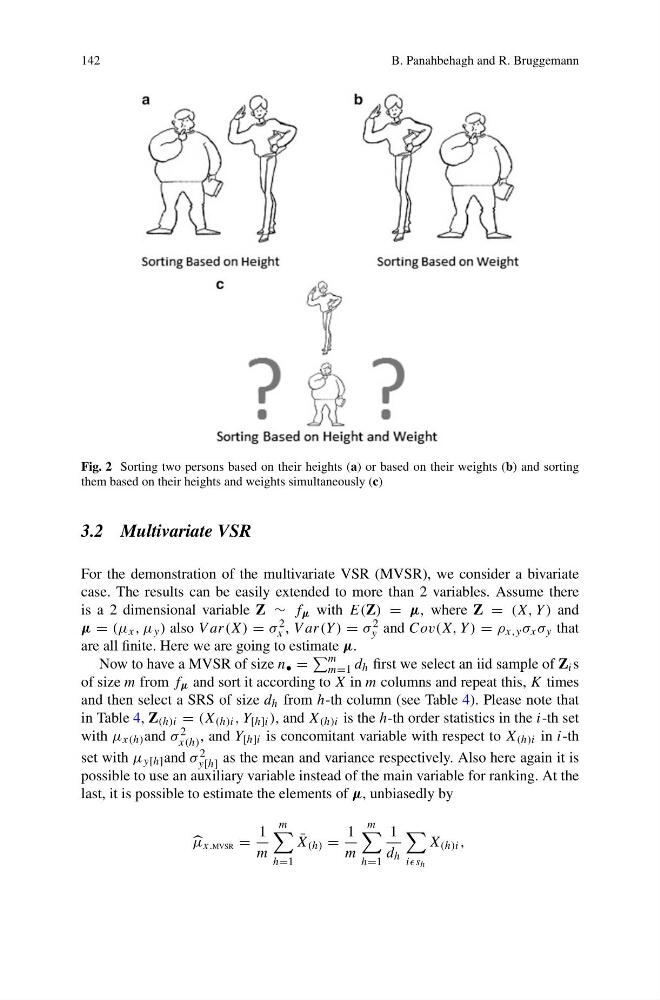
Fig. 2 Sorting two persons based on their heights (a) or based on their weights (b) and sorting
them based on their heights and weights simultaneously (c)
3.2 Multivariate VSR
For the demonstration of the multivariate VSR (MVSR), we consider a bivariate
case. The results can be easily extended to more than 2 variables. Assume there
is a 2 dimensional variable Z ∼ f µ with E(Z) = µ, where Z = (X, Y ) and
µ = (μ x , μ y ) also V ar(X) = σ 2
x , V ar(Y ) = σ 2
y and Cov(X, Y ) = ρ x,y σ x σ y that
are all finite. Here we are going to estimate µ.
Now to have a MVSR of size n • =
m
m=1 d h first we select an iid sample of Z i s
of size m from f µ and sort it according to X in m columns and repeat this, K times
and then select a SRS of size d h from h-th column (see Table 4). Please note that
in Table 4, Z (h)i = (X (h)i , Y [h]i ), and X (h)i is the h-th order statistics in the i-th set
with μ x(h) and σ 2
x(h) , and Y [h]i is concomitant variable with respect to X (h)i in i-th
set with μ y[h] and σ 2
y[h] as the mean and variance respectively. Also here again it is
possible to use an auxiliary variable instead of the main variable for ranking. At the
last, it is possible to estimate the elements of µ, unbiasedly by
μ x.MVSR =
1
m
m
h=1
¯
X (h) =
1
m
m
h=1
1
d h
iis h
X (h)i ,
B. Panahbehagh and R. Bruggemann
Fig. 2 Sorting two persons based on their heights (a) or based on their weights (b) and sorting
them based on their heights and weights simultaneously (c)
3.2 Multivariate VSR
For the demonstration of the multivariate VSR (MVSR), we consider a bivariate
case. The results can be easily extended to more than 2 variables. Assume there
is a 2 dimensional variable Z ∼ f µ with E(Z) = µ, where Z = (X, Y ) and
µ = (μ x , μ y ) also V ar(X) = σ 2
x , V ar(Y ) = σ 2
y and Cov(X, Y ) = ρ x,y σ x σ y that
are all finite. Here we are going to estimate µ.
Now to have a MVSR of size n • =
m
m=1 d h first we select an iid sample of Z i s
of size m from f µ and sort it according to X in m columns and repeat this, K times
and then select a SRS of size d h from h-th column (see Table 4). Please note that
in Table 4, Z (h)i = (X (h)i , Y [h]i ), and X (h)i is the h-th order statistics in the i-th set
with μ x(h) and σ 2
x(h) , and Y [h]i is concomitant variable with respect to X (h)i in i-th
set with μ y[h] and σ 2
y[h] as the mean and variance respectively. Also here again it is
possible to use an auxiliary variable instead of the main variable for ranking. At the
last, it is possible to estimate the elements of µ, unbiasedly by
μ x.MVSR =
1
m
m
h=1
¯
X (h) =
1
m
m
h=1
1
d h
iis h
X (h)i ,