

98
R. Bruggemann and A. Kerber
4 Two Examples
4.1 Example: Refrigerants
Refrigerants are chemicals, which reduce the temperature during a controlled
evaporation process in various machines (Restrepo et al. 2008a, b; Bruggemann
et al. 2011). In BK the data were transformed to binary ones, and based on this,
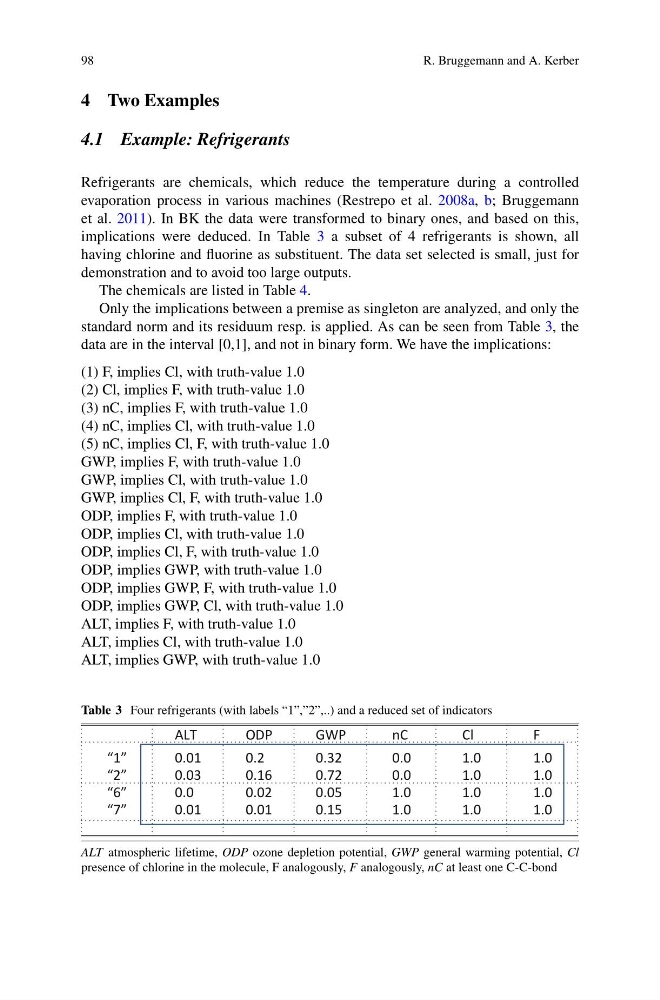
implications were deduced. In Table 3 a subset of 4 refrigerants is shown, all
having chlorine and fluorine as substituent. The data set selected is small, just for
demonstration and to avoid too large outputs.
The chemicals are listed in Table 4.
Only the implications between a premise as singleton are analyzed, and only the
standard norm and its residuum resp. is applied. As can be seen from Table 3, the
data are in the interval [0,1], and not in binary form. We have the implications:
(1) F, implies Cl, with truth-value 1.0
(2) Cl, implies F, with truth-value 1.0
(3) nC, implies F, with truth-value 1.0
(4) nC, implies Cl, with truth-value 1.0
(5) nC, implies Cl, F, with truth-value 1.0
GWP, implies F, with truth-value 1.0
GWP, implies Cl, with truth-value 1.0
GWP, implies Cl, F, with truth-value 1.0
ODP, implies F, with truth-value 1.0
ODP, implies Cl, with truth-value 1.0
ODP, implies Cl, F, with truth-value 1.0
ODP, implies GWP, with truth-value 1.0
ODP, implies GWP, F, with truth-value 1.0
ODP, implies GWP, Cl, with truth-value 1.0
ALT, implies F, with truth-value 1.0
ALT, implies Cl, with truth-value 1.0
ALT, implies GWP, with truth-value 1.0
Table 3 Four refrigerants (with labels “1”,”2”,..) and a reduced set of indicators
“1”
“2”
“6”
“7”
ALT
0.01
0.03
0.0
0.01
0.2
0.16
0.02
0.01
ODP
0.32
0.72
0.05
0.15
GWP
0.0
0.0
1.0
1.0
nC
1.0
1.0
1.0
1.0
Cl
1.0
1.0
1.0
1.0
F
ALT atmospheric lifetime, ODP ozone depletion potential, GWP general warming potential, Cl
presence of chlorine in the molecule, F analogously, F analogously, nC at least one C-C-bond
R. Bruggemann and A. Kerber
4 Two Examples
4.1 Example: Refrigerants
Refrigerants are chemicals, which reduce the temperature during a controlled
evaporation process in various machines (Restrepo et al. 2008a, b; Bruggemann
et al. 2011). In BK the data were transformed to binary ones, and based on this,
implications were deduced. In Table 3 a subset of 4 refrigerants is shown, all
having chlorine and fluorine as substituent. The data set selected is small, just for
demonstration and to avoid too large outputs.
The chemicals are listed in Table 4.
Only the implications between a premise as singleton are analyzed, and only the
standard norm and its residuum resp. is applied. As can be seen from Table 3, the
data are in the interval [0,1], and not in binary form. We have the implications:
(1) F, implies Cl, with truth-value 1.0
(2) Cl, implies F, with truth-value 1.0
(3) nC, implies F, with truth-value 1.0
(4) nC, implies Cl, with truth-value 1.0
(5) nC, implies Cl, F, with truth-value 1.0
GWP, implies F, with truth-value 1.0
GWP, implies Cl, with truth-value 1.0
GWP, implies Cl, F, with truth-value 1.0
ODP, implies F, with truth-value 1.0
ODP, implies Cl, with truth-value 1.0
ODP, implies Cl, F, with truth-value 1.0
ODP, implies GWP, with truth-value 1.0
ODP, implies GWP, F, with truth-value 1.0
ODP, implies GWP, Cl, with truth-value 1.0
ALT, implies F, with truth-value 1.0
ALT, implies Cl, with truth-value 1.0
ALT, implies GWP, with truth-value 1.0
Table 3 Four refrigerants (with labels “1”,”2”,..) and a reduced set of indicators
“1”
“2”
“6”
“7”
ALT
0.01
0.03
0.0
0.01
0.2
0.16
0.02
0.01
ODP
0.32
0.72
0.05
0.15
GWP
0.0
0.0
1.0
1.0
nC
1.0
1.0
1.0
1.0
Cl
1.0
1.0
1.0
1.0
F
ALT atmospheric lifetime, ODP ozone depletion potential, GWP general warming potential, Cl
presence of chlorine in the molecule, F analogously, F analogously, nC at least one C-C-bond