

Evaluations as Sets over Lattices – Application Point of View
99
Table 4 Chemicals, labeled
by “1”, ”2”, . . .
Label Chemical
“1”
CCl 3 F
“2”
CCl 2 F 2
“6”
C 2 H 3 Cl 2 F
“7”
C 2 H 2 ClF 2
The first five implications are trivial, as one can see from the molecular formulas,
because Cl and F are always present. Nevertheless, a series of implications is found,
where the truth value equals 1. However, it should be clear that the restriction of only
4 chemicals is very severe, especially when originally 40 refrigerants were part of
a partial order driven analysis (Restrepo et al. 2008a). That usually the truth values
are rarely 1 will be shown in the next section.
4.2 Eight German Regions Along the River Rhine
The Environmental Protection Agency of the German state Baden-Württemberg
initialized a large monitoring study, concerning the pollution by lead, Pb, cadmium,
Cd, zinc, Zn and sulfur, S. Different targets were investigated, so for example
the herb layer (see for a general overview: Bruggemann et al. 1998, 1999). The
herb layer is of interest, because it supports to identify middle range transport
phenomena. The total concentrations were measured in mg/kg dry mass. Here, in
this section, eight regions along the river Rhine, from the German part of Basel, until
Karlsruhe are used as example. Originally the interest in these regions was to clarify
whether or not a trend can be observed, following downstreams (Bruggemann et al.
1997). The regions are labelled by {1,10,24,31,19,43,52,56}.
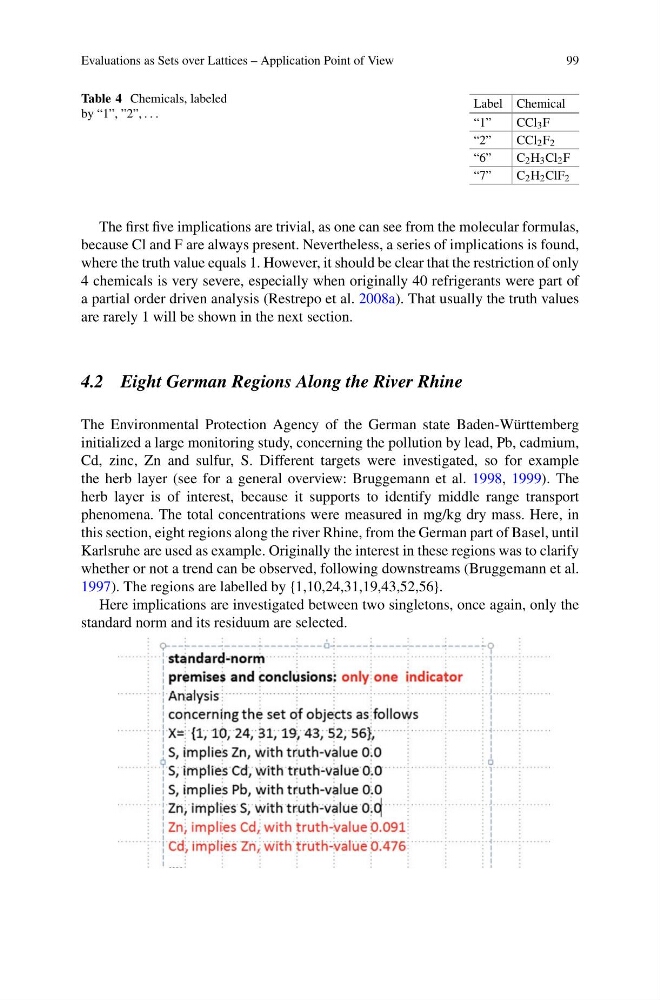
Here implications are investigated between two singletons, once again, only the
standard norm and its residuum are selected.
99
Table 4 Chemicals, labeled
by “1”, ”2”, . . .
Label Chemical
“1”
CCl 3 F
“2”
CCl 2 F 2
“6”
C 2 H 3 Cl 2 F
“7”
C 2 H 2 ClF 2
The first five implications are trivial, as one can see from the molecular formulas,
because Cl and F are always present. Nevertheless, a series of implications is found,
where the truth value equals 1. However, it should be clear that the restriction of only
4 chemicals is very severe, especially when originally 40 refrigerants were part of
a partial order driven analysis (Restrepo et al. 2008a). That usually the truth values
are rarely 1 will be shown in the next section.
4.2 Eight German Regions Along the River Rhine
The Environmental Protection Agency of the German state Baden-Württemberg
initialized a large monitoring study, concerning the pollution by lead, Pb, cadmium,
Cd, zinc, Zn and sulfur, S. Different targets were investigated, so for example
the herb layer (see for a general overview: Bruggemann et al. 1998, 1999). The
herb layer is of interest, because it supports to identify middle range transport
phenomena. The total concentrations were measured in mg/kg dry mass. Here, in
this section, eight regions along the river Rhine, from the German part of Basel, until
Karlsruhe are used as example. Originally the interest in these regions was to clarify
whether or not a trend can be observed, following downstreams (Bruggemann et al.
1997). The regions are labelled by {1,10,24,31,19,43,52,56}.
Here implications are investigated between two singletons, once again, only the
standard norm and its residuum are selected.