

Evaluations as Sets over Lattices – Application Point of View
95
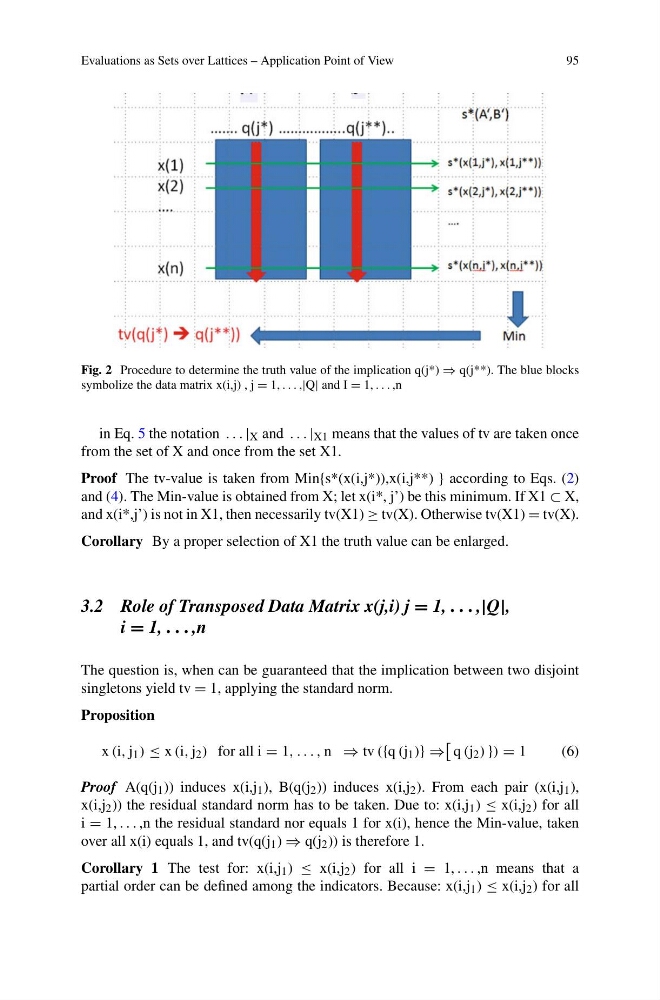
Fig. 2 Procedure to determine the truth value of the implication q(j*) ⇒ q(j**). The blue blocks
symbolize the data matrix x(i,j) , j = 1, . . . ,|Q| and I = 1, . . . ,n
in Eq. 5 the notation . . . | X and . . . | X1 means that the values of tv are taken once
from the set of X and once from the set X1.
Proof The tv-value is taken from Min{s*(x(i,j*)),x(i,j**) } according to Eqs. (2)
and (4). The Min-value is obtained from X; let x(i*, j’) be this minimum. If X1 ⊂ X,
and x(i*,j’) is not in X1, then necessarily tv(X1) ≥ tv(X). Otherwise tv(X1) = tv(X).
Corollary By a proper selection of X1 the truth value can be enlarged.
3.2 Role of Transposed Data Matrix x(j,i) j = 1, . . . ,|Q|,
i = 1, . . . ,n
The question is, when can be guaranteed that the implication between two disjoint
singletons yield tv = 1, applying the standard norm.
Proposition
x (i, j 1 ) ≤ x (i, j 2 ) for all i = 1, . . . , n ⇒ tv ({q (j 1 )} ⇒
q (j 2 ) }) = 1
(6)
Proof A(q(j 1 )) induces x(i,j 1 ), B(q(j 2 )) induces x(i,j 2 ). From each pair (x(i,j 1 ),
x(i,j 2 )) the residual standard norm has to be taken. Due to: x(i,j 1 ) ≤ x(i,j 2 ) for all
i = 1, . . . ,n the residual standard nor equals 1 for x(i), hence the Min-value, taken
over all x(i) equals 1, and tv(q(j 1 ) ⇒ q(j 2 )) is therefore 1.
Corollary 1 The test for: x(i,j 1 ) ≤ x(i,j 2 ) for all i = 1, . . . ,n means that a
partial order can be defined among the indicators. Because: x(i,j 1 ) ≤ x(i,j 2 ) for all
95
Fig. 2 Procedure to determine the truth value of the implication q(j*) ⇒ q(j**). The blue blocks
symbolize the data matrix x(i,j) , j = 1, . . . ,|Q| and I = 1, . . . ,n
in Eq. 5 the notation . . . | X and . . . | X1 means that the values of tv are taken once
from the set of X and once from the set X1.
Proof The tv-value is taken from Min{s*(x(i,j*)),x(i,j**) } according to Eqs. (2)
and (4). The Min-value is obtained from X; let x(i*, j’) be this minimum. If X1 ⊂ X,
and x(i*,j’) is not in X1, then necessarily tv(X1) ≥ tv(X). Otherwise tv(X1) = tv(X).
Corollary By a proper selection of X1 the truth value can be enlarged.
3.2 Role of Transposed Data Matrix x(j,i) j = 1, . . . ,|Q|,
i = 1, . . . ,n
The question is, when can be guaranteed that the implication between two disjoint
singletons yield tv = 1, applying the standard norm.
Proposition
x (i, j 1 ) ≤ x (i, j 2 ) for all i = 1, . . . , n ⇒ tv ({q (j 1 )} ⇒
q (j 2 ) }) = 1
(6)
Proof A(q(j 1 )) induces x(i,j 1 ), B(q(j 2 )) induces x(i,j 2 ). From each pair (x(i,j 1 ),
x(i,j 2 )) the residual standard norm has to be taken. Due to: x(i,j 1 ) ≤ x(i,j 2 ) for all
i = 1, . . . ,n the residual standard nor equals 1 for x(i), hence the Min-value, taken
over all x(i) equals 1, and tv(q(j 1 ) ⇒ q(j 2 )) is therefore 1.
Corollary 1 The test for: x(i,j 1 ) ≤ x(i,j 2 ) for all i = 1, . . . ,n means that a
partial order can be defined among the indicators. Because: x(i,j 1 ) ≤ x(i,j 2 ) for all