

94
R. Bruggemann and A. Kerber
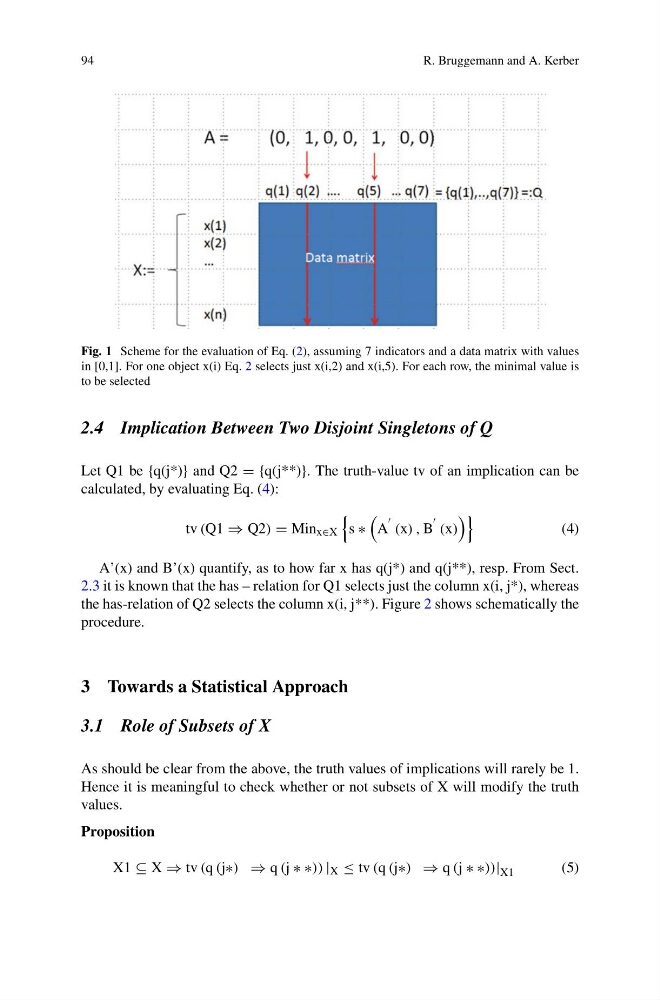
Fig. 1 Scheme for the evaluation of Eq. (2), assuming 7 indicators and a data matrix with values
in [0,1]. For one object x(i) Eq. 2 selects just x(i,2) and x(i,5). For each row, the minimal value is
to be selected
2.4 Implication Between Two Disjoint Singletons of Q
Let Q1 be {q(j*)} and Q2 = {q(j**)}. The truth-value tv of an implication can be
calculated, by evaluating Eq. (4):
tv (Q1 ⇒ Q2) = Min x∈X
s ∗
A
(x) , B
(x)
(4)
A’(x) and B’(x) quantify, as to how far x has q(j*) and q(j**), resp. From Sect.
2.3 it is known that the has – relation for Q1 selects just the column x(i, j*), whereas
the has-relation of Q2 selects the column x(i, j**). Figure 2 shows schematically the
procedure.
3 Towards a Statistical Approach
3.1 Role of Subsets of X
As should be clear from the above, the truth values of implications will rarely be 1.
Hence it is meaningful to check whether or not subsets of X will modify the truth
values.
Proposition
X1 ⊆ X ⇒ tv (q (j∗) ⇒ q (j ∗ ∗)) | X ≤ tv (q (j∗) ⇒ q (j ∗ ∗))| X1
(5)
R. Bruggemann and A. Kerber
Fig. 1 Scheme for the evaluation of Eq. (2), assuming 7 indicators and a data matrix with values
in [0,1]. For one object x(i) Eq. 2 selects just x(i,2) and x(i,5). For each row, the minimal value is
to be selected
2.4 Implication Between Two Disjoint Singletons of Q
Let Q1 be {q(j*)} and Q2 = {q(j**)}. The truth-value tv of an implication can be
calculated, by evaluating Eq. (4):
tv (Q1 ⇒ Q2) = Min x∈X
s ∗
A
(x) , B
(x)
(4)
A’(x) and B’(x) quantify, as to how far x has q(j*) and q(j**), resp. From Sect.
2.3 it is known that the has – relation for Q1 selects just the column x(i, j*), whereas
the has-relation of Q2 selects the column x(i, j**). Figure 2 shows schematically the
procedure.
3 Towards a Statistical Approach
3.1 Role of Subsets of X
As should be clear from the above, the truth values of implications will rarely be 1.
Hence it is meaningful to check whether or not subsets of X will modify the truth
values.
Proposition
X1 ⊆ X ⇒ tv (q (j∗) ⇒ q (j ∗ ∗)) | X ≤ tv (q (j∗) ⇒ q (j ∗ ∗))| X1
(5)