

1.6. THE SECOND DERIVATIVE
53
At any point where f ′ (x) is positive, it means that the slope of the tangent line to f is
positive, and therefore the function f is increasing (or rising) at that point. Similarly, if
f ′ (a) is negative, we know that the graph of f is decreasing (or falling) at that point.
In the next part of our study, we work to understand not only whether the function
f is increasing or decreasing at a point or on an interval, but also how the function
f is increasing or decreasing. Comparing the two tangent lines shown in Figure 1.25,
we see that at point A, the value of f ′ (x) is positive and relatively close to zero, which
coincides with the graph rising slowly. By contrast, at point B, the derivative is negative
and relatively large in absolute value, which is tied to the fact that f is decreasing rapidly
at B. It also makes sense to not only ask whether the value of the derivative function is
positive or negative and whether the derivative is large or small, but also to ask “how is
the derivative changing?”
We also now know that the derivative, y = f ′ (x), is itself a function. This means that
we can consider taking its derivative – the derivative of the derivative – and therefore ask
questions like “what does the derivative of the derivative tell us about how the original
function behaves?” As we have done regularly in our work to date, we start with an
investigation of a familiar problem in the context of a moving object.
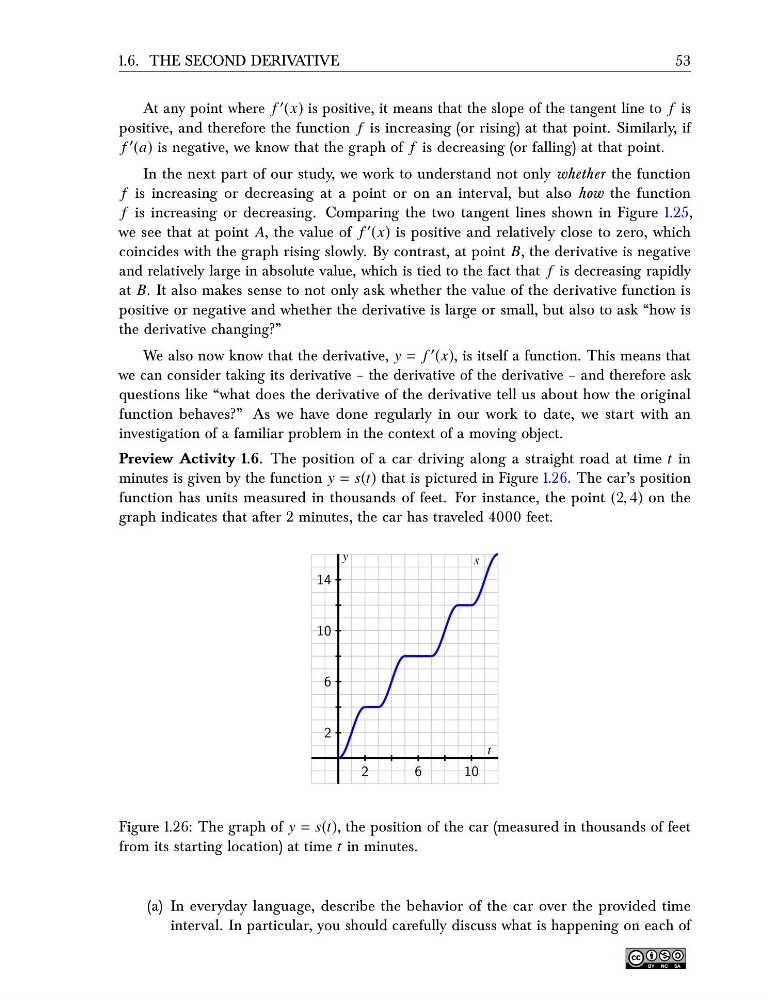
Preview Activity 1.6. The position of a car driving along a straight road at time t in
minutes is given by the function y = s(t) that is pictured in Figure 1.26. The car’s position
function has units measured in thousands of feet. For instance, the point (2, 4) on the
graph indicates that after 2 minutes, the car has traveled 4000 feet.
2
6
10
2
6
10
14
t
y
s
Figure 1.26: The graph of y = s(t), the position of the car (measured in thousands of feet
from its starting location) at time t in minutes.
(a) In everyday language, describe the behavior of the car over the provided time
interval. In particular, you should carefully discuss what is happening on each of
53
At any point where f ′ (x) is positive, it means that the slope of the tangent line to f is
positive, and therefore the function f is increasing (or rising) at that point. Similarly, if
f ′ (a) is negative, we know that the graph of f is decreasing (or falling) at that point.
In the next part of our study, we work to understand not only whether the function
f is increasing or decreasing at a point or on an interval, but also how the function
f is increasing or decreasing. Comparing the two tangent lines shown in Figure 1.25,
we see that at point A, the value of f ′ (x) is positive and relatively close to zero, which
coincides with the graph rising slowly. By contrast, at point B, the derivative is negative
and relatively large in absolute value, which is tied to the fact that f is decreasing rapidly
at B. It also makes sense to not only ask whether the value of the derivative function is
positive or negative and whether the derivative is large or small, but also to ask “how is
the derivative changing?”
We also now know that the derivative, y = f ′ (x), is itself a function. This means that
we can consider taking its derivative – the derivative of the derivative – and therefore ask
questions like “what does the derivative of the derivative tell us about how the original
function behaves?” As we have done regularly in our work to date, we start with an
investigation of a familiar problem in the context of a moving object.
Preview Activity 1.6. The position of a car driving along a straight road at time t in
minutes is given by the function y = s(t) that is pictured in Figure 1.26. The car’s position
function has units measured in thousands of feet. For instance, the point (2, 4) on the
graph indicates that after 2 minutes, the car has traveled 4000 feet.
2
6
10
2
6
10
14
t
y
s
Figure 1.26: The graph of y = s(t), the position of the car (measured in thousands of feet
from its starting location) at time t in minutes.
(a) In everyday language, describe the behavior of the car over the provided time
interval. In particular, you should carefully discuss what is happening on each of