

52
1.6. THE SECOND DERIVATIVE
1.6 The second derivative
Motivating Questions
In this section, we strive to understand the ideas generated by the following important
questions:
• How does the derivative of a function tell us whether the function is increasing or
decreasing at a point or on an interval?
• What can we learn by taking the derivative of the derivative (to achieve the second
derivative) of a function f ?
• What does it mean to say that a function is concave up or concave down? How
are these characteristics connected to certain properties of the derivative of the
function?
• What are the units of the second derivative? How do they help us understand the
rate of change of the rate of change?
Introduction
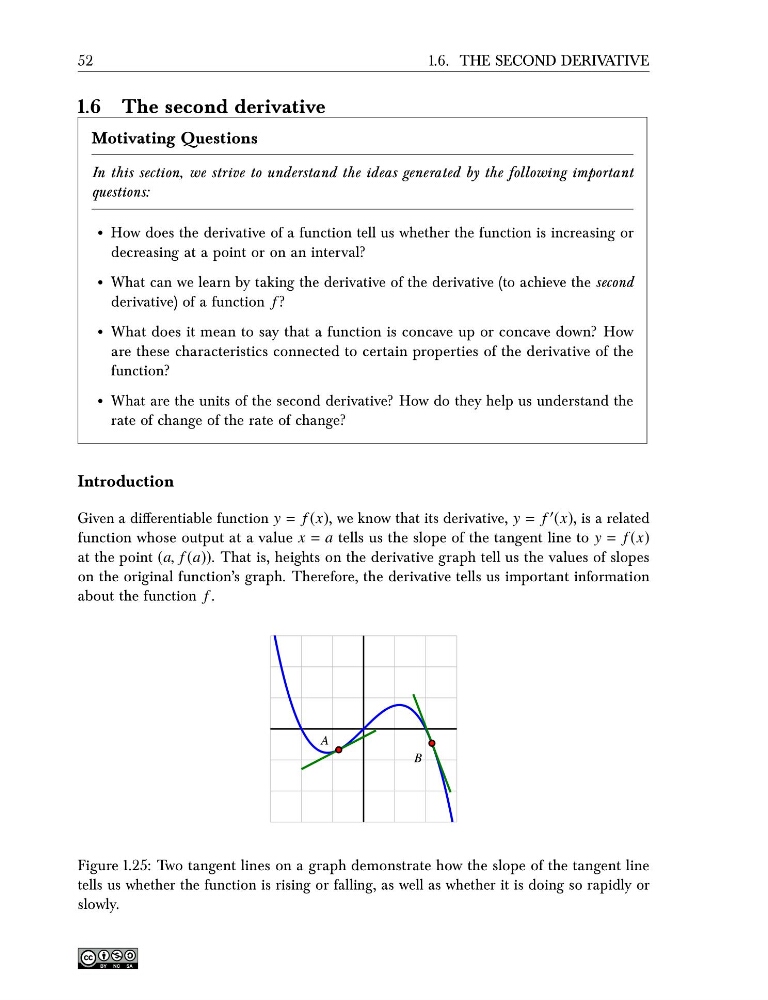
Given a differentiable function y = f (x), we know that its derivative, y = f ′ (x), is a related
function whose output at a value x = a tells us the slope of the tangent line to y = f (x)
at the point (a, f (a)). That is, heights on the derivative graph tell us the values of slopes
on the original function’s graph. Therefore, the derivative tells us important information
about the function f .
A
B
Figure 1.25: Two tangent lines on a graph demonstrate how the slope of the tangent line
tells us whether the function is rising or falling, as well as whether it is doing so rapidly or
slowly.
1.6. THE SECOND DERIVATIVE
1.6 The second derivative
Motivating Questions
In this section, we strive to understand the ideas generated by the following important
questions:
• How does the derivative of a function tell us whether the function is increasing or
decreasing at a point or on an interval?
• What can we learn by taking the derivative of the derivative (to achieve the second
derivative) of a function f ?
• What does it mean to say that a function is concave up or concave down? How
are these characteristics connected to certain properties of the derivative of the
function?
• What are the units of the second derivative? How do they help us understand the
rate of change of the rate of change?
Introduction
Given a differentiable function y = f (x), we know that its derivative, y = f ′ (x), is a related
function whose output at a value x = a tells us the slope of the tangent line to y = f (x)
at the point (a, f (a)). That is, heights on the derivative graph tell us the values of slopes
on the original function’s graph. Therefore, the derivative tells us important information
about the function f .
A
B
Figure 1.25: Two tangent lines on a graph demonstrate how the slope of the tangent line
tells us whether the function is rising or falling, as well as whether it is doing so rapidly or
slowly.