

436
7.6. POPULATION GROWTH AND THE LOGISTIC EQUATION
(b) Find all equilibrium solutions of the equation
dP
dt =
1
2 P and classify them as stable
or unstable.
(c) If P(0) is positive, describe the long-term behavior of the solution to
dP
dt =
1
2 P.
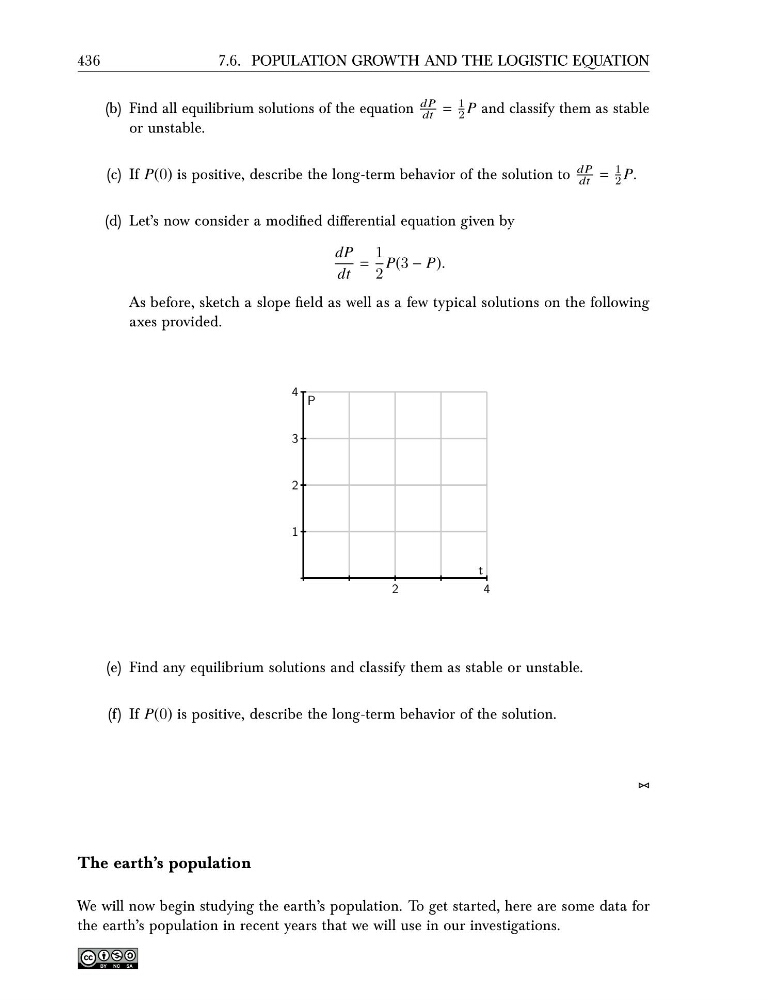
(d) Let’s now consider a modified differential equation given by
dP
dt
=
1
2
P(3 − P).
As before, sketch a slope field as well as a few typical solutions on the following
axes provided.
2
4
1
2
3
4
t
P
(e) Find any equilibrium solutions and classify them as stable or unstable.
(f) If P(0) is positive, describe the long-term behavior of the solution.
⊲⊳
The earth’s population
We will now begin studying the earth’s population. To get started, here are some data for
the earth’s population in recent years that we will use in our investigations.
7.6. POPULATION GROWTH AND THE LOGISTIC EQUATION
(b) Find all equilibrium solutions of the equation
dP
dt =
1
2 P and classify them as stable
or unstable.
(c) If P(0) is positive, describe the long-term behavior of the solution to
dP
dt =
1
2 P.
(d) Let’s now consider a modified differential equation given by
dP
dt
=
1
2
P(3 − P).
As before, sketch a slope field as well as a few typical solutions on the following
axes provided.
2
4
1
2
3
4
t
P
(e) Find any equilibrium solutions and classify them as stable or unstable.
(f) If P(0) is positive, describe the long-term behavior of the solution.
⊲⊳
The earth’s population
We will now begin studying the earth’s population. To get started, here are some data for
the earth’s population in recent years that we will use in our investigations.