

7.6. POPULATION GROWTH AND THE LOGISTIC EQUATION
437
Year Population (in billions)
1998
5.932
1999
6.008
2000
6.084
2001
6.159
2002
6.234
2005
6.456
2006
6.531
2007
6.606
2008
6.681
2009
6.756
2010
6.831
Activity 7.13.
Our first model will be based on the following assumption:
The rate of change of the population is proportional to the population.
On the face of it, this seems pretty reasonable. When there is a relatively small number
of people, there will be fewer births and deaths so the rate of change will be small.
When there is a larger number of people, there will be more births and deaths so we
expect a larger rate of change.
If P(t) is the population t years after the year 2000, we may express this assumption as
dP
dt
= k P
where k is a constant of proportionality.
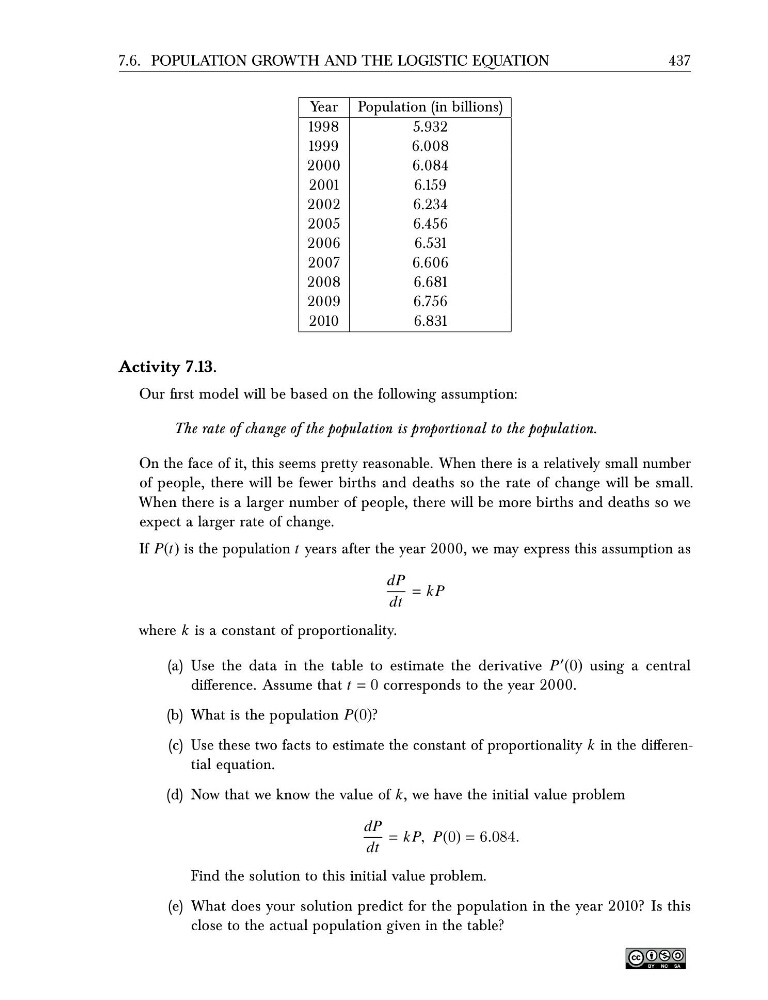
(a) Use the data in the table to estimate the derivative P ′ (0) using a central
difference. Assume that t = 0 corresponds to the year 2000.
(b) What is the population P(0)?
(c) Use these two facts to estimate the constant of proportionality k in the differential equation.
(d) Now that we know the value of k, we have the initial value problem
dP
dt
= k P, P(0) = 6.084.
Find the solution to this initial value problem.
(e) What does your solution predict for the population in the year 2010? Is this
close to the actual population given in the table?
437
Year Population (in billions)
1998
5.932
1999
6.008
2000
6.084
2001
6.159
2002
6.234
2005
6.456
2006
6.531
2007
6.606
2008
6.681
2009
6.756
2010
6.831
Activity 7.13.
Our first model will be based on the following assumption:
The rate of change of the population is proportional to the population.
On the face of it, this seems pretty reasonable. When there is a relatively small number
of people, there will be fewer births and deaths so the rate of change will be small.
When there is a larger number of people, there will be more births and deaths so we
expect a larger rate of change.
If P(t) is the population t years after the year 2000, we may express this assumption as
dP
dt
= k P
where k is a constant of proportionality.
(a) Use the data in the table to estimate the derivative P ′ (0) using a central
difference. Assume that t = 0 corresponds to the year 2000.
(b) What is the population P(0)?
(c) Use these two facts to estimate the constant of proportionality k in the differential equation.
(d) Now that we know the value of k, we have the initial value problem
dP
dt
= k P, P(0) = 6.084.
Find the solution to this initial value problem.
(e) What does your solution predict for the population in the year 2010? Is this
close to the actual population given in the table?