

7.6. POPULATION GROWTH AND THE LOGISTIC EQUATION
435
7.6 Population Growth and the Logistic Equation
Motivating Questions
In this section, we strive to understand the ideas generated by the following important
questions:
• How can we use differential equations to realistically model the growth of a
population?
• How can we assess the accuracy of our models?
Introduction
The growth of the earth’s population is one of the pressing issues of our time. Will the
population continue to grow? Or will it perhaps level off at some point, and if so, when?
In this section, we will look at two ways in which we may use differential equations to help
us address questions such as these.
Before we begin, let’s consider again two important differential equations that we have
seen in earlier work this chapter.
Preview Activity 7.6. Recall that one model for population growth states that a population
grows at a rate proportional to its size.
(a) We begin with the differential equation
dP
dt
=
1
2
P.
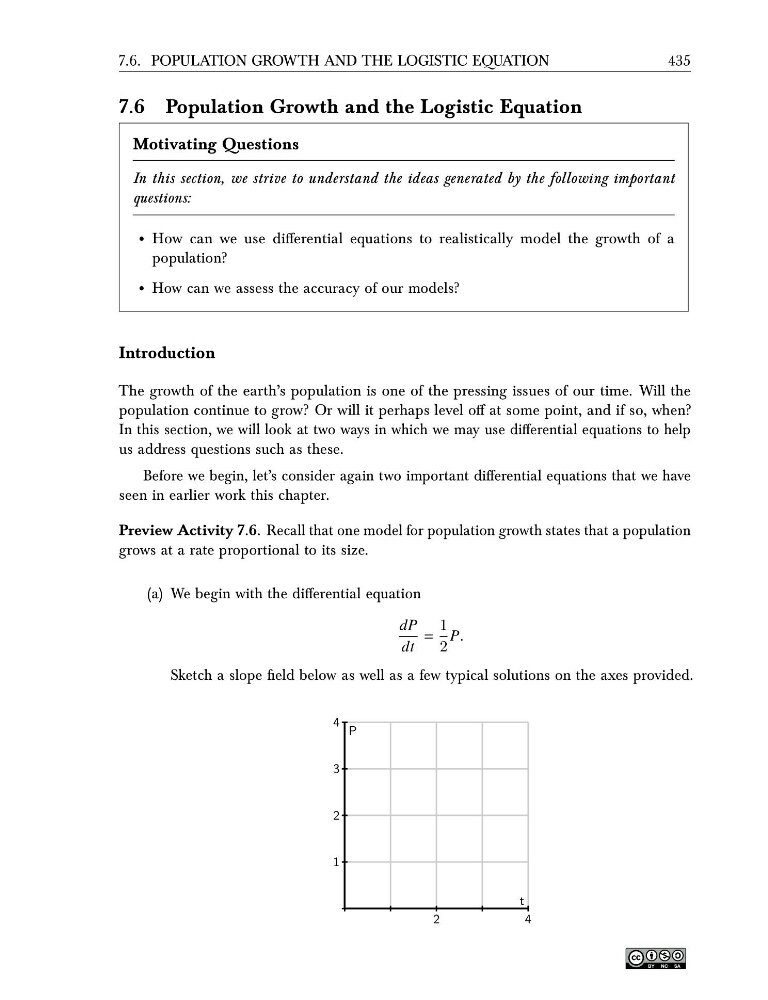
Sketch a slope field below as well as a few typical solutions on the axes provided.
2
4
1
2
3
4
t
P
435
7.6 Population Growth and the Logistic Equation
Motivating Questions
In this section, we strive to understand the ideas generated by the following important
questions:
• How can we use differential equations to realistically model the growth of a
population?
• How can we assess the accuracy of our models?
Introduction
The growth of the earth’s population is one of the pressing issues of our time. Will the
population continue to grow? Or will it perhaps level off at some point, and if so, when?
In this section, we will look at two ways in which we may use differential equations to help
us address questions such as these.
Before we begin, let’s consider again two important differential equations that we have
seen in earlier work this chapter.
Preview Activity 7.6. Recall that one model for population growth states that a population
grows at a rate proportional to its size.
(a) We begin with the differential equation
dP
dt
=
1
2
P.
Sketch a slope field below as well as a few typical solutions on the axes provided.
2
4
1
2
3
4
t
P