

404
7.2. QUALITATIVE BEHAVIOR OF SOLUTIONS TO DES
Constant solutions are found by setting f (y) = −
1
2 (y − 4) = 0, which we immediately see
implies that y = 4.
Values of y for which f (y) = 0 in an autonomous differential equation
dy
dt = f (y) are
usually called or equilibrium solutions of the differential equation.
Activity 7.5.
Consider the autonomous differential equation
dy
dt
= −
1
2
y(y − 4).
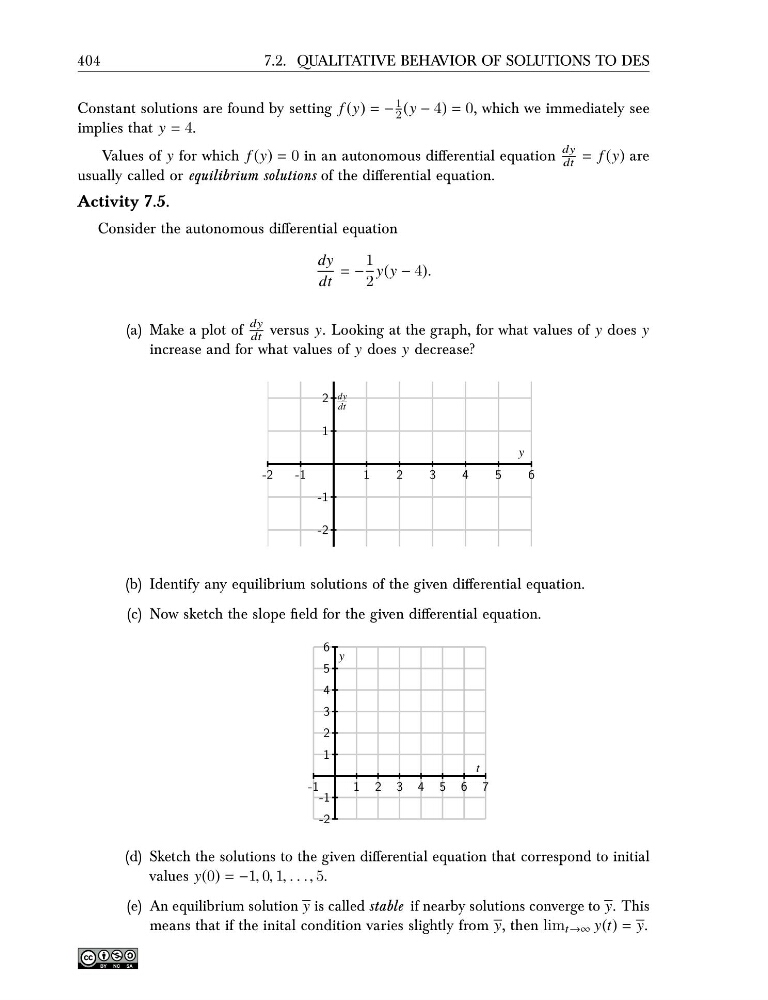
(a) Make a plot of
dy
dt versus y. Looking at the graph, for what values of y does y
increase and for what values of y does y decrease?
-2
-1
1
2
3
4
5
6
-2
-1
1
2
y
dy
dt
(b) Identify any equilibrium solutions of the given differential equation.
(c) Now sketch the slope field for the given differential equation.
-1
1 2 3 4 5 6 7
-2
-1
1
2
3
4
5
6
t
y
(d) Sketch the solutions to the given differential equation that correspond to initial
values y(0) = −1, 0, 1, . . . , 5.
(e) An equilibrium solution y is called stable if nearby solutions converge to y. This
means that if the inital condition varies slightly from y, then lim t→∞ y(t) = y.
7.2. QUALITATIVE BEHAVIOR OF SOLUTIONS TO DES
Constant solutions are found by setting f (y) = −
1
2 (y − 4) = 0, which we immediately see
implies that y = 4.
Values of y for which f (y) = 0 in an autonomous differential equation
dy
dt = f (y) are
usually called or equilibrium solutions of the differential equation.
Activity 7.5.
Consider the autonomous differential equation
dy
dt
= −
1
2
y(y − 4).
(a) Make a plot of
dy
dt versus y. Looking at the graph, for what values of y does y
increase and for what values of y does y decrease?
-2
-1
1
2
3
4
5
6
-2
-1
1
2
y
dy
dt
(b) Identify any equilibrium solutions of the given differential equation.
(c) Now sketch the slope field for the given differential equation.
-1
1 2 3 4 5 6 7
-2
-1
1
2
3
4
5
6
t
y
(d) Sketch the solutions to the given differential equation that correspond to initial
values y(0) = −1, 0, 1, . . . , 5.
(e) An equilibrium solution y is called stable if nearby solutions converge to y. This
means that if the inital condition varies slightly from y, then lim t→∞ y(t) = y.