

7.2. QUALITATIVE BEHAVIOR OF SOLUTIONS TO DES
403
-1
1
2
3
4
5
6
7
-2
-1
1
2
3
y
dy
dt
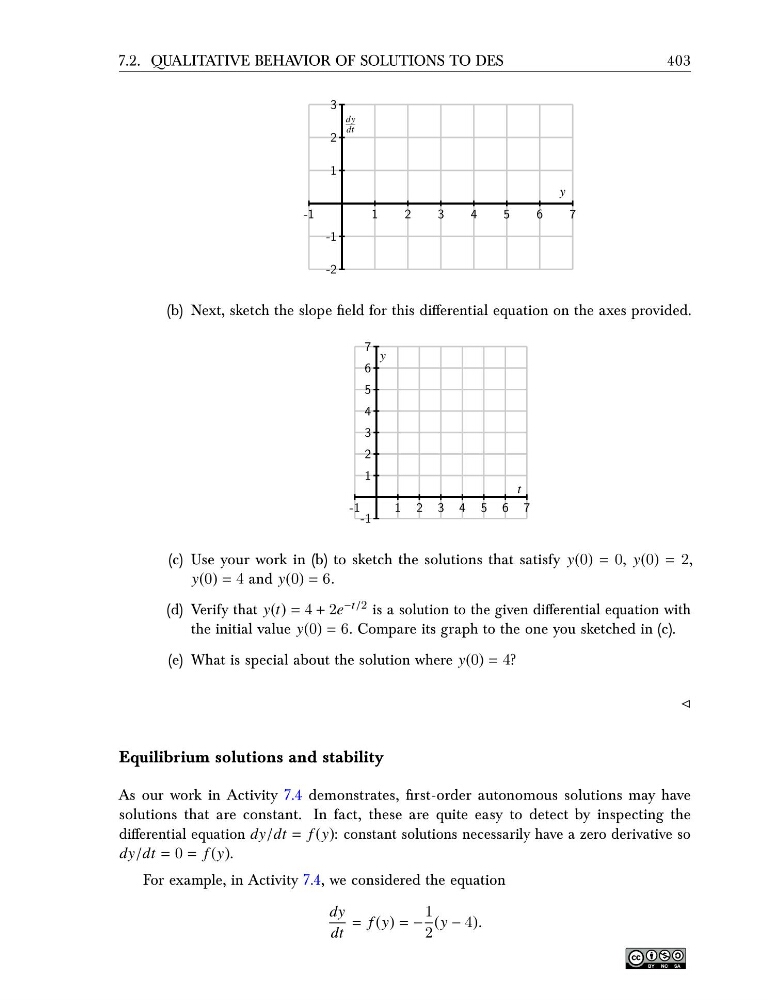
(b) Next, sketch the slope field for this differential equation on the axes provided.
-1
1 2 3 4 5 6 7
-1
1
2
3
4
5
6
7
t
y
(c) Use your work in (b) to sketch the solutions that satisfy y(0) = 0, y(0) = 2,
y(0) = 4 and y(0) = 6.
(d) Verify that y(t) = 4 + 2e −t/2 is a solution to the given differential equation with
the initial value y(0) = 6. Compare its graph to the one you sketched in (c).
(e) What is special about the solution where y(0) = 4?
⊳
Equilibrium solutions and stability
As our work in Activity 7.4 demonstrates, first-order autonomous solutions may have
solutions that are constant. In fact, these are quite easy to detect by inspecting the
differential equation dy/dt = f (y): constant solutions necessarily have a zero derivative so
dy/dt = 0 = f (y).
For example, in Activity 7.4, we considered the equation
dy
dt
= f (y) = −
1
2
(y − 4).
403
-1
1
2
3
4
5
6
7
-2
-1
1
2
3
y
dy
dt
(b) Next, sketch the slope field for this differential equation on the axes provided.
-1
1 2 3 4 5 6 7
-1
1
2
3
4
5
6
7
t
y
(c) Use your work in (b) to sketch the solutions that satisfy y(0) = 0, y(0) = 2,
y(0) = 4 and y(0) = 6.
(d) Verify that y(t) = 4 + 2e −t/2 is a solution to the given differential equation with
the initial value y(0) = 6. Compare its graph to the one you sketched in (c).
(e) What is special about the solution where y(0) = 4?
⊳
Equilibrium solutions and stability
As our work in Activity 7.4 demonstrates, first-order autonomous solutions may have
solutions that are constant. In fact, these are quite easy to detect by inspecting the
differential equation dy/dt = f (y): constant solutions necessarily have a zero derivative so
dy/dt = 0 = f (y).
For example, in Activity 7.4, we considered the equation
dy
dt
= f (y) = −
1
2
(y − 4).