

344
6.2. USING DEFINITE INTEGRALS TO FIND VOLUME
Letting △x → 0 and using a definite integral to add the volumes of the slices, we find that
V =
3
0
π · 2
2 dx.
Moreover, since
3
0
4π dx = 12π, we have found that the volume of the cylinder is 12π.
The principal problem of interest in our upcoming work will be to find the volume of
certain solids whose cross-sections are all thin cylinders (or washers) and to do so by
using a definite integral. To that end, we first consider another familiar shape in Preview
Activity 6.2: a circular cone.
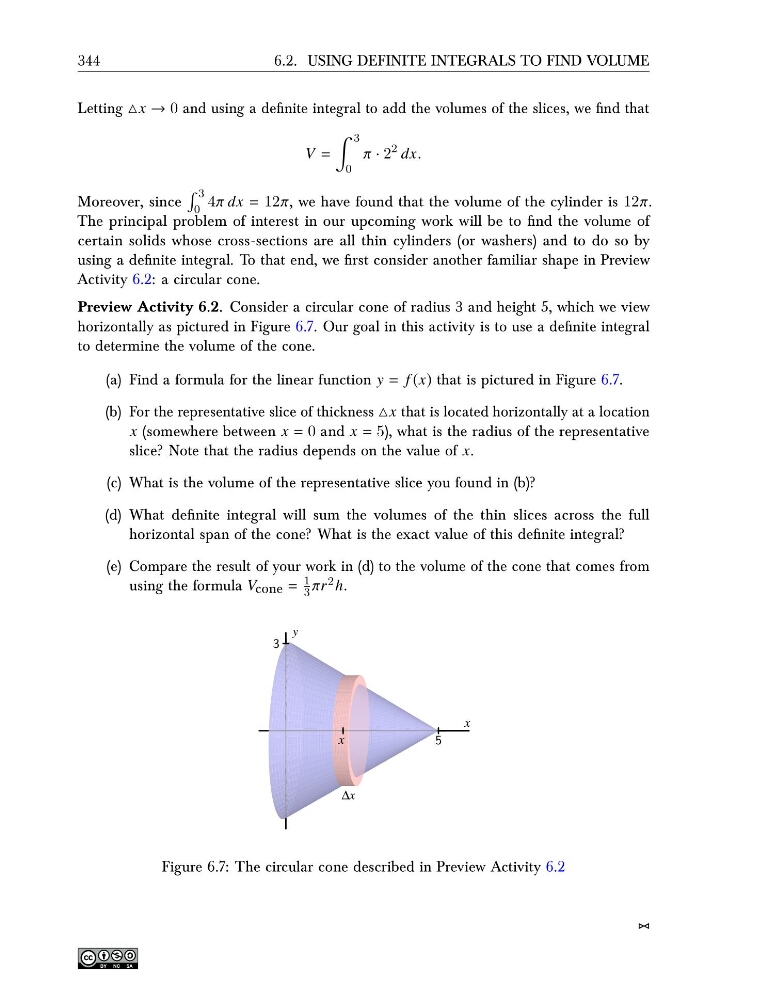
Preview Activity 6.2. Consider a circular cone of radius 3 and height 5, which we view
horizontally as pictured in Figure 6.7. Our goal in this activity is to use a definite integral
to determine the volume of the cone.
(a) Find a formula for the linear function y = f (x) that is pictured in Figure 6.7.
(b) For the representative slice of thickness △x that is located horizontally at a location
x (somewhere between x = 0 and x = 5), what is the radius of the representative
slice? Note that the radius depends on the value of x.
(c) What is the volume of the representative slice you found in (b)?
(d) What definite integral will sum the volumes of the thin slices across the full
horizontal span of the cone? What is the exact value of this definite integral?
(e) Compare the result of your work in (d) to the volume of the cone that comes from
using the formula V cone =
1
3 πr 2 h.
5
x
3
x
y
∆x
Figure 6.7: The circular cone described in Preview Activity 6.2
⊲⊳
6.2. USING DEFINITE INTEGRALS TO FIND VOLUME
Letting △x → 0 and using a definite integral to add the volumes of the slices, we find that
V =
3
0
π · 2
2 dx.
Moreover, since
3
0
4π dx = 12π, we have found that the volume of the cylinder is 12π.
The principal problem of interest in our upcoming work will be to find the volume of
certain solids whose cross-sections are all thin cylinders (or washers) and to do so by
using a definite integral. To that end, we first consider another familiar shape in Preview
Activity 6.2: a circular cone.
Preview Activity 6.2. Consider a circular cone of radius 3 and height 5, which we view
horizontally as pictured in Figure 6.7. Our goal in this activity is to use a definite integral
to determine the volume of the cone.
(a) Find a formula for the linear function y = f (x) that is pictured in Figure 6.7.
(b) For the representative slice of thickness △x that is located horizontally at a location
x (somewhere between x = 0 and x = 5), what is the radius of the representative
slice? Note that the radius depends on the value of x.
(c) What is the volume of the representative slice you found in (b)?
(d) What definite integral will sum the volumes of the thin slices across the full
horizontal span of the cone? What is the exact value of this definite integral?
(e) Compare the result of your work in (d) to the volume of the cone that comes from
using the formula V cone =
1
3 πr 2 h.
5
x
3
x
y
∆x
Figure 6.7: The circular cone described in Preview Activity 6.2
⊲⊳