

6.2. USING DEFINITE INTEGRALS TO FIND VOLUME
345
The Volume of a Solid of Revolution
A solid of revolution is a three dimensional solid that can be generated by revolving one
or more curves around a fixed axis. For example, we can think of a circular cylinder as a
solid of revolution: in Figure 6.6, this could be accomplished by revolving the line segment
from (0, 2) to (3, 2) about the x-axis. Likewise, the circular cone in Figure 6.7 is the solid
of revolution generated by revolving the portion of the line y = 3 −
3
5 x from x = 0 to x = 5
about the x-axis. It is particularly important to notice in any solid of revolution that if we
slice the solid perpendicular to the axis of revolution, the resulting cross-section is circular.
We consider two examples to highlight some of the natural issues that arise in
determining the volume of a solid of revolution.
Example 6.1. Find the volume of the solid of revolution generated when the region R
bounded by y = 4 − x 2 and the x-axis is revolved about the x-axis.
Solution.
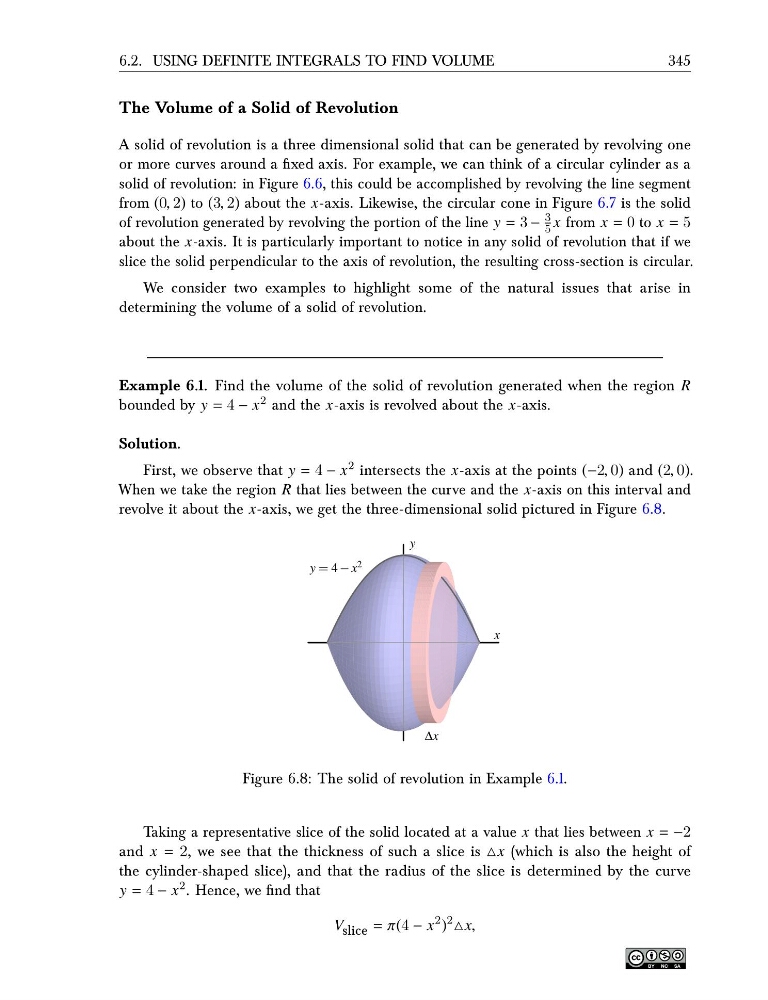
First, we observe that y = 4 − x 2 intersects the x-axis at the points (−2, 0) and (2, 0).
When we take the region R that lies between the curve and the x-axis on this interval and
revolve it about the x-axis, we get the three-dimensional solid pictured in Figure 6.8.
x
y
∆x
y = 4 − x 2
Figure 6.8: The solid of revolution in Example 6.1.
Taking a representative slice of the solid located at a value x that lies between x = −2
and x = 2, we see that the thickness of such a slice is △x (which is also the height of
the cylinder-shaped slice), and that the radius of the slice is determined by the curve
y = 4 − x 2 . Hence, we find that
V slice = π(4 − x
2 )
2 △x,
345
The Volume of a Solid of Revolution
A solid of revolution is a three dimensional solid that can be generated by revolving one
or more curves around a fixed axis. For example, we can think of a circular cylinder as a
solid of revolution: in Figure 6.6, this could be accomplished by revolving the line segment
from (0, 2) to (3, 2) about the x-axis. Likewise, the circular cone in Figure 6.7 is the solid
of revolution generated by revolving the portion of the line y = 3 −
3
5 x from x = 0 to x = 5
about the x-axis. It is particularly important to notice in any solid of revolution that if we
slice the solid perpendicular to the axis of revolution, the resulting cross-section is circular.
We consider two examples to highlight some of the natural issues that arise in
determining the volume of a solid of revolution.
Example 6.1. Find the volume of the solid of revolution generated when the region R
bounded by y = 4 − x 2 and the x-axis is revolved about the x-axis.
Solution.
First, we observe that y = 4 − x 2 intersects the x-axis at the points (−2, 0) and (2, 0).
When we take the region R that lies between the curve and the x-axis on this interval and
revolve it about the x-axis, we get the three-dimensional solid pictured in Figure 6.8.
x
y
∆x
y = 4 − x 2
Figure 6.8: The solid of revolution in Example 6.1.
Taking a representative slice of the solid located at a value x that lies between x = −2
and x = 2, we see that the thickness of such a slice is △x (which is also the height of
the cylinder-shaped slice), and that the radius of the slice is determined by the curve
y = 4 − x 2 . Hence, we find that
V slice = π(4 − x
2 )
2 △x,