

6.2. USING DEFINITE INTEGRALS TO FIND VOLUME
343
6.2 Using Definite Integrals to Find Volume
Motivating Questions
In this section, we strive to understand the ideas generated by the following important
questions:
• How can we use a definite integral to find the volume of a three-dimensional
solid of revolution that results from revolving a two-dimensional region about a
particular axis?
• In what circumstances do we integrate with respect to y instead of integrating with
respect to x?
• What adjustments do we need to make if we revolve about a line other than the xor y-axis?
Introduction
3
x
2
x
y
∆x
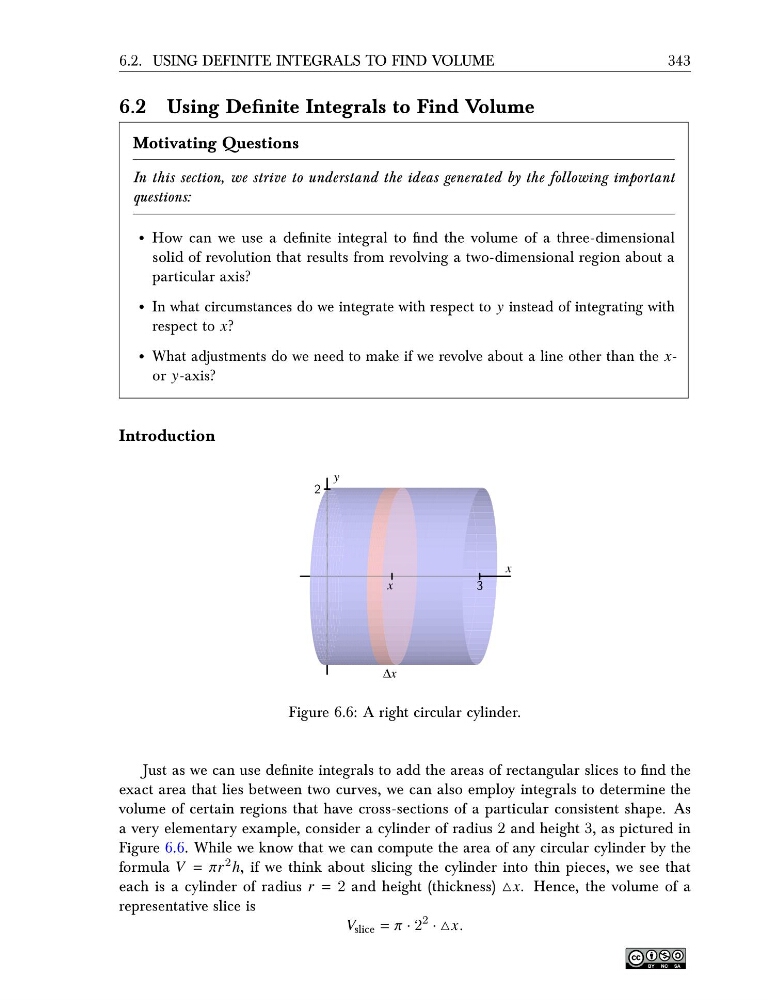
Figure 6.6: A right circular cylinder.
Just as we can use definite integrals to add the areas of rectangular slices to find the
exact area that lies between two curves, we can also employ integrals to determine the
volume of certain regions that have cross-sections of a particular consistent shape. As
a very elementary example, consider a cylinder of radius 2 and height 3, as pictured in
Figure 6.6. While we know that we can compute the area of any circular cylinder by the
formula V = πr 2 h, if we think about slicing the cylinder into thin pieces, we see that
each is a cylinder of radius r = 2 and height (thickness) △x. Hence, the volume of a
representative slice is
V slice = π · 2
2 · △x.
343
6.2 Using Definite Integrals to Find Volume
Motivating Questions
In this section, we strive to understand the ideas generated by the following important
questions:
• How can we use a definite integral to find the volume of a three-dimensional
solid of revolution that results from revolving a two-dimensional region about a
particular axis?
• In what circumstances do we integrate with respect to y instead of integrating with
respect to x?
• What adjustments do we need to make if we revolve about a line other than the xor y-axis?
Introduction
3
x
2
x
y
∆x
Figure 6.6: A right circular cylinder.
Just as we can use definite integrals to add the areas of rectangular slices to find the
exact area that lies between two curves, we can also employ integrals to determine the
volume of certain regions that have cross-sections of a particular consistent shape. As
a very elementary example, consider a cylinder of radius 2 and height 3, as pictured in
Figure 6.6. While we know that we can compute the area of any circular cylinder by the
formula V = πr 2 h, if we think about slicing the cylinder into thin pieces, we see that
each is a cylinder of radius r = 2 and height (thickness) △x. Hence, the volume of a
representative slice is
V slice = π · 2
2 · △x.