

6.1. USING DEFINITE INTEGRALS TO FIND AREA AND LENGTH
335
1
2
3
2
4
6
g
1
2
3
2
4
6
g
f
1
2
3
2
4
6
f
g
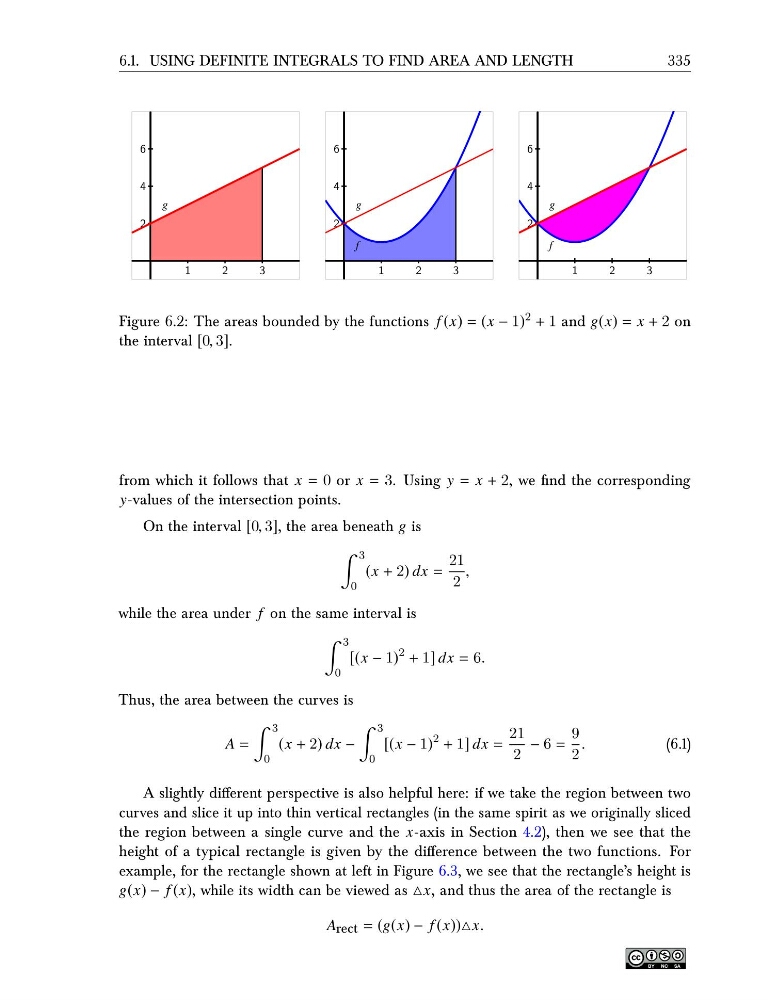
Figure 6.2: The areas bounded by the functions f (x) = (x − 1) 2 + 1 and g(x) = x + 2 on
the interval [0, 3].
from which it follows that x = 0 or x = 3. Using y = x + 2, we find the corresponding
y-values of the intersection points.
On the interval [0, 3], the area beneath g is
3
0
(x + 2) dx =
21
2
,
while the area under f on the same interval is
3
0
[(x − 1)
2 + 1] dx = 6.
Thus, the area between the curves is
A =
3
0
(x + 2) dx −
3
0
[(x − 1)
2 + 1] dx =
21
2
− 6 =
9
2
.
(6.1)
A slightly different perspective is also helpful here: if we take the region between two
curves and slice it up into thin vertical rectangles (in the same spirit as we originally sliced
the region between a single curve and the x-axis in Section 4.2), then we see that the
height of a typical rectangle is given by the difference between the two functions. For
example, for the rectangle shown at left in Figure 6.3, we see that the rectangle’s height is
g(x) − f (x), while its width can be viewed as △x, and thus the area of the rectangle is
A rect = (g(x) − f (x))△x.
335
1
2
3
2
4
6
g
1
2
3
2
4
6
g
f
1
2
3
2
4
6
f
g
Figure 6.2: The areas bounded by the functions f (x) = (x − 1) 2 + 1 and g(x) = x + 2 on
the interval [0, 3].
from which it follows that x = 0 or x = 3. Using y = x + 2, we find the corresponding
y-values of the intersection points.
On the interval [0, 3], the area beneath g is
3
0
(x + 2) dx =
21
2
,
while the area under f on the same interval is
3
0
[(x − 1)
2 + 1] dx = 6.
Thus, the area between the curves is
A =
3
0
(x + 2) dx −
3
0
[(x − 1)
2 + 1] dx =
21
2
− 6 =
9
2
.
(6.1)
A slightly different perspective is also helpful here: if we take the region between two
curves and slice it up into thin vertical rectangles (in the same spirit as we originally sliced
the region between a single curve and the x-axis in Section 4.2), then we see that the
height of a typical rectangle is given by the difference between the two functions. For
example, for the rectangle shown at left in Figure 6.3, we see that the rectangle’s height is
g(x) − f (x), while its width can be viewed as △x, and thus the area of the rectangle is
A rect = (g(x) − f (x))△x.