

336
6.1. USING DEFINITE INTEGRALS TO FIND AREA AND LENGTH
g
f
x
△x
g(x) − f (x)
1
2
3
2
4
6
f
g
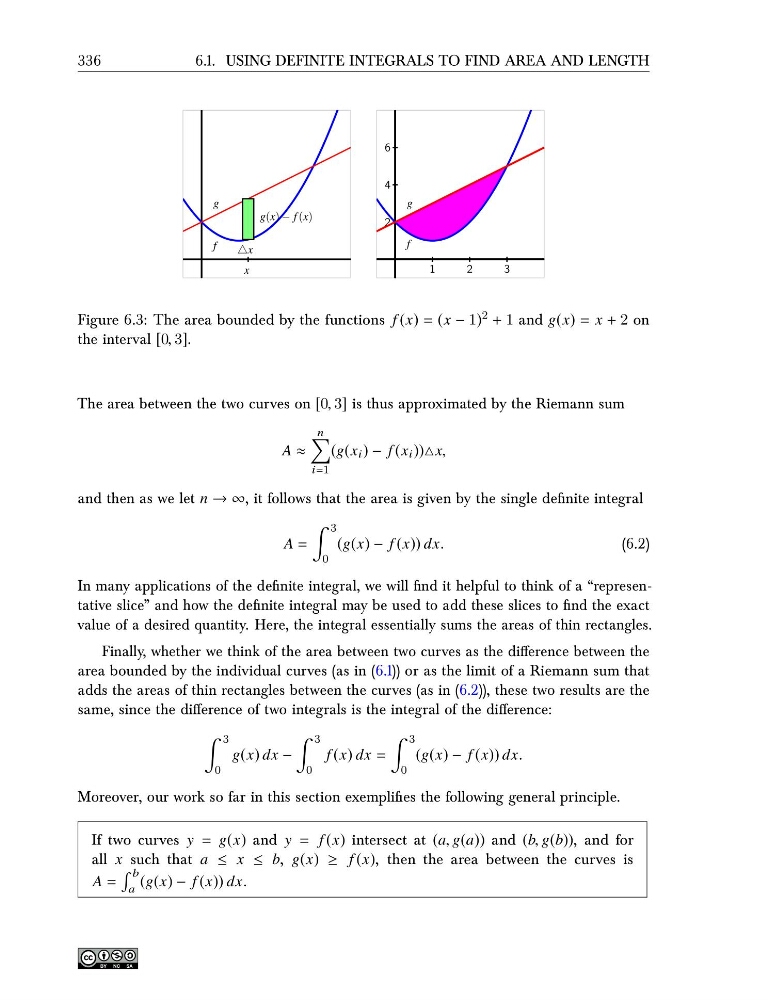
Figure 6.3: The area bounded by the functions f (x) = (x − 1) 2 + 1 and g(x) = x + 2 on
the interval [0, 3].
The area between the two curves on [0, 3] is thus approximated by the Riemann sum
A ≈
n
i=1
(g(x i ) − f (x i ))△x,
and then as we let n → ∞, it follows that the area is given by the single definite integral
A =
3
0
(g(x) − f (x)) dx.
(6.2)
In many applications of the definite integral, we will find it helpful to think of a “representative slice” and how the definite integral may be used to add these slices to find the exact
value of a desired quantity. Here, the integral essentially sums the areas of thin rectangles.
Finally, whether we think of the area between two curves as the difference between the
area bounded by the individual curves (as in (6.1)) or as the limit of a Riemann sum that
adds the areas of thin rectangles between the curves (as in (6.2)), these two results are the
same, since the difference of two integrals is the integral of the difference:
3
0
g(x) dx −
3
0
f (x) dx =
3
0
(g(x) − f (x)) dx.
Moreover, our work so far in this section exemplifies the following general principle.
If two curves y = g(x) and y = f (x) intersect at (a, g(a)) and (b, g(b)), and for
all x such that a ≤ x ≤ b, g(x) ≥ f (x), then the area between the curves is
A =
b
a
(g(x) − f (x)) dx.
6.1. USING DEFINITE INTEGRALS TO FIND AREA AND LENGTH
g
f
x
△x
g(x) − f (x)
1
2
3
2
4
6
f
g
Figure 6.3: The area bounded by the functions f (x) = (x − 1) 2 + 1 and g(x) = x + 2 on
the interval [0, 3].
The area between the two curves on [0, 3] is thus approximated by the Riemann sum
A ≈
n
i=1
(g(x i ) − f (x i ))△x,
and then as we let n → ∞, it follows that the area is given by the single definite integral
A =
3
0
(g(x) − f (x)) dx.
(6.2)
In many applications of the definite integral, we will find it helpful to think of a “representative slice” and how the definite integral may be used to add these slices to find the exact
value of a desired quantity. Here, the integral essentially sums the areas of thin rectangles.
Finally, whether we think of the area between two curves as the difference between the
area bounded by the individual curves (as in (6.1)) or as the limit of a Riemann sum that
adds the areas of thin rectangles between the curves (as in (6.2)), these two results are the
same, since the difference of two integrals is the integral of the difference:
3
0
g(x) dx −
3
0
f (x) dx =
3
0
(g(x) − f (x)) dx.
Moreover, our work so far in this section exemplifies the following general principle.
If two curves y = g(x) and y = f (x) intersect at (a, g(a)) and (b, g(b)), and for
all x such that a ≤ x ≤ b, g(x) ≥ f (x), then the area between the curves is
A =
b
a
(g(x) − f (x)) dx.