

334
6.1. USING DEFINITE INTEGRALS TO FIND AREA AND LENGTH
Preview Activity 6.1. Consider the functions given by f (x) = 5−(x −1) 2 and g(x) = 4− x.
(a) Use algebra to find the points where the graphs of f and g intersect.
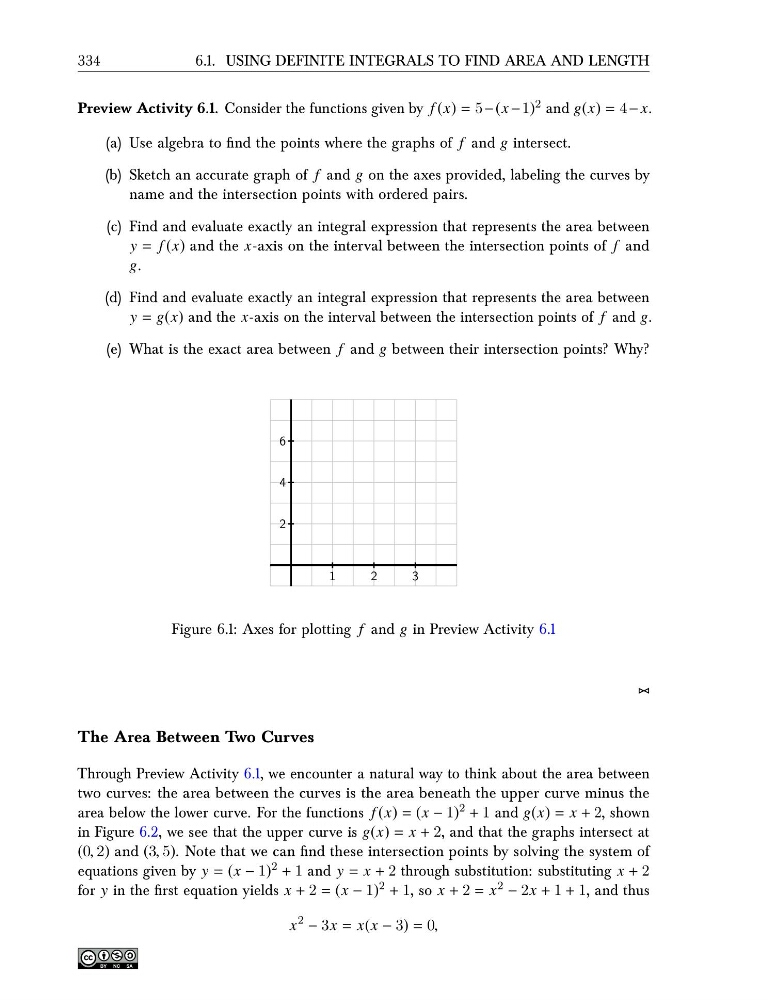
(b) Sketch an accurate graph of f and g on the axes provided, labeling the curves by
name and the intersection points with ordered pairs.
(c) Find and evaluate exactly an integral expression that represents the area between
y = f (x) and the x-axis on the interval between the intersection points of f and
g.
(d) Find and evaluate exactly an integral expression that represents the area between
y = g(x) and the x-axis on the interval between the intersection points of f and g.
(e) What is the exact area between f and g between their intersection points? Why?
1
2
3
2
4
6
Figure 6.1: Axes for plotting f and g in Preview Activity 6.1
⊲⊳
The Area Between Two Curves
Through Preview Activity 6.1, we encounter a natural way to think about the area between
two curves: the area between the curves is the area beneath the upper curve minus the
area below the lower curve. For the functions f (x) = (x − 1) 2 + 1 and g(x) = x + 2, shown
in Figure 6.2, we see that the upper curve is g(x) = x + 2, and that the graphs intersect at
(0, 2) and (3, 5). Note that we can find these intersection points by solving the system of
equations given by y = (x − 1) 2 + 1 and y = x + 2 through substitution: substituting x + 2
for y in the first equation yields x + 2 = (x − 1) 2 + 1, so x + 2 = x 2 − 2x + 1 + 1, and thus
x
2 − 3x = x(x − 3) = 0,
6.1. USING DEFINITE INTEGRALS TO FIND AREA AND LENGTH
Preview Activity 6.1. Consider the functions given by f (x) = 5−(x −1) 2 and g(x) = 4− x.
(a) Use algebra to find the points where the graphs of f and g intersect.
(b) Sketch an accurate graph of f and g on the axes provided, labeling the curves by
name and the intersection points with ordered pairs.
(c) Find and evaluate exactly an integral expression that represents the area between
y = f (x) and the x-axis on the interval between the intersection points of f and
g.
(d) Find and evaluate exactly an integral expression that represents the area between
y = g(x) and the x-axis on the interval between the intersection points of f and g.
(e) What is the exact area between f and g between their intersection points? Why?
1
2
3
2
4
6
Figure 6.1: Axes for plotting f and g in Preview Activity 6.1
⊲⊳
The Area Between Two Curves
Through Preview Activity 6.1, we encounter a natural way to think about the area between
two curves: the area between the curves is the area beneath the upper curve minus the
area below the lower curve. For the functions f (x) = (x − 1) 2 + 1 and g(x) = x + 2, shown
in Figure 6.2, we see that the upper curve is g(x) = x + 2, and that the graphs intersect at
(0, 2) and (3, 5). Note that we can find these intersection points by solving the system of
equations given by y = (x − 1) 2 + 1 and y = x + 2 through substitution: substituting x + 2
for y in the first equation yields x + 2 = (x − 1) 2 + 1, so x + 2 = x 2 − 2x + 1 + 1, and thus
x
2 − 3x = x(x − 3) = 0,