

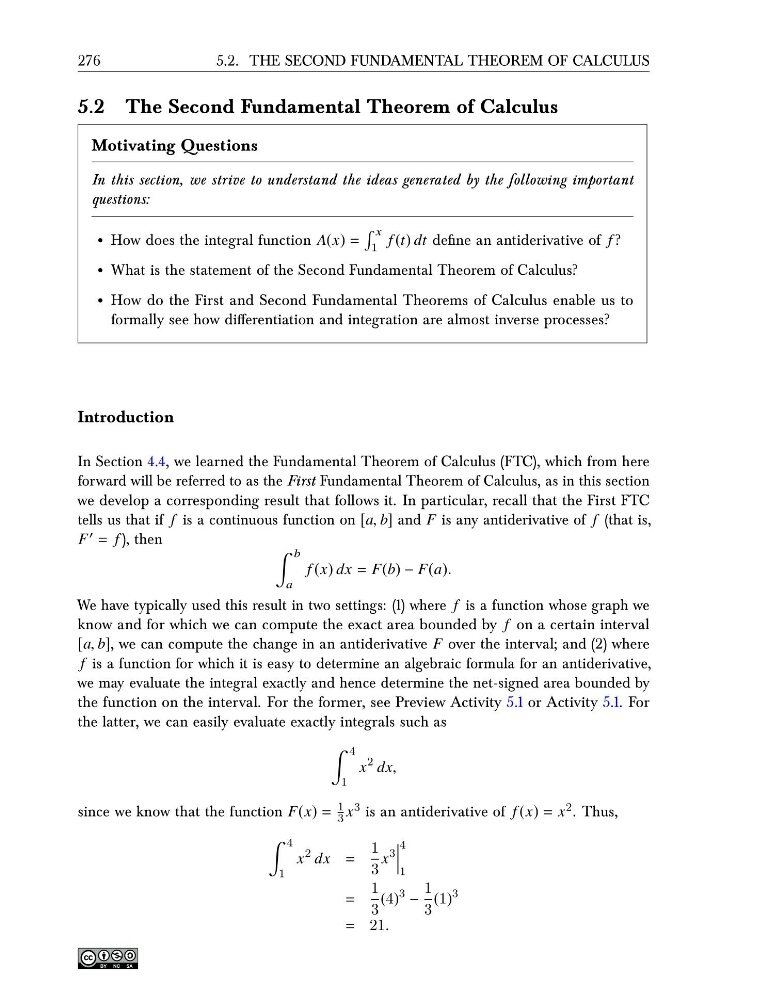
276
5.2. THE SECOND FUNDAMENTAL THEOREM OF CALCULUS
5.2 The Second Fundamental Theorem of Calculus
Motivating Questions
In this section, we strive to understand the ideas generated by the following important
questions:
• How does the integral function A(x) =
x
1
f (t) dt define an antiderivative of f ?
• What is the statement of the Second Fundamental Theorem of Calculus?
• How do the First and Second Fundamental Theorems of Calculus enable us to
formally see how differentiation and integration are almost inverse processes?
Introduction
In Section 4.4, we learned the Fundamental Theorem of Calculus (FTC), which from here
forward will be referred to as the First Fundamental Theorem of Calculus, as in this section
we develop a corresponding result that follows it. In particular, recall that the First FTC
tells us that if f is a continuous function on [a, b] and F is any antiderivative of f (that is,
F ′ = f ), then
b
a
f (x) dx = F(b) − F(a).
We have typically used this result in two settings: (1) where f is a function whose graph we
know and for which we can compute the exact area bounded by f on a certain interval
[a, b], we can compute the change in an antiderivative F over the interval; and (2) where
f is a function for which it is easy to determine an algebraic formula for an antiderivative,
we may evaluate the integral exactly and hence determine the net-signed area bounded by
the function on the interval. For the former, see Preview Activity 5.1 or Activity 5.1. For
the latter, we can easily evaluate exactly integrals such as
4
1
x
2 dx,
since we know that the function F(x) =
1
3 x 3 is an antiderivative of f (x) = x 2 . Thus,
4
1
x
2 dx =
1
3
x
3
4
1
=
1
3
(4)
3 −
1
3
(1)
3
= 21.
5.2. THE SECOND FUNDAMENTAL THEOREM OF CALCULUS
5.2 The Second Fundamental Theorem of Calculus
Motivating Questions
In this section, we strive to understand the ideas generated by the following important
questions:
• How does the integral function A(x) =
x
1
f (t) dt define an antiderivative of f ?
• What is the statement of the Second Fundamental Theorem of Calculus?
• How do the First and Second Fundamental Theorems of Calculus enable us to
formally see how differentiation and integration are almost inverse processes?
Introduction
In Section 4.4, we learned the Fundamental Theorem of Calculus (FTC), which from here
forward will be referred to as the First Fundamental Theorem of Calculus, as in this section
we develop a corresponding result that follows it. In particular, recall that the First FTC
tells us that if f is a continuous function on [a, b] and F is any antiderivative of f (that is,
F ′ = f ), then
b
a
f (x) dx = F(b) − F(a).
We have typically used this result in two settings: (1) where f is a function whose graph we
know and for which we can compute the exact area bounded by f on a certain interval
[a, b], we can compute the change in an antiderivative F over the interval; and (2) where
f is a function for which it is easy to determine an algebraic formula for an antiderivative,
we may evaluate the integral exactly and hence determine the net-signed area bounded by
the function on the interval. For the former, see Preview Activity 5.1 or Activity 5.1. For
the latter, we can easily evaluate exactly integrals such as
4
1
x
2 dx,
since we know that the function F(x) =
1
3 x 3 is an antiderivative of f (x) = x 2 . Thus,
4
1
x
2 dx =
1
3
x
3
4
1
=
1
3
(4)
3 −
1
3
(1)
3
= 21.