

5.2. THE SECOND FUNDAMENTAL THEOREM OF CALCULUS
277
Here we see that the First FTC can be viewed from at least two perspectives: first, as a
tool to find the difference F(b) − F(a) for an antiderivative F of the integrand f . In this
situation, we need to be able to determine the value of the integral
b
a
f (x) dx exactly,
perhaps through known geometric formulas for area. It is possible that we may not have a
formula for F itself. From a second perspective, the First FTC provides a way to find the
exact value of a definite integral, and hence a certain net-signed area exactly, by finding
an antiderivative of the integrand and evaluating its total change over the interval. In
this latter case, we need to know a formula for the antiderivative F, as this enables us to
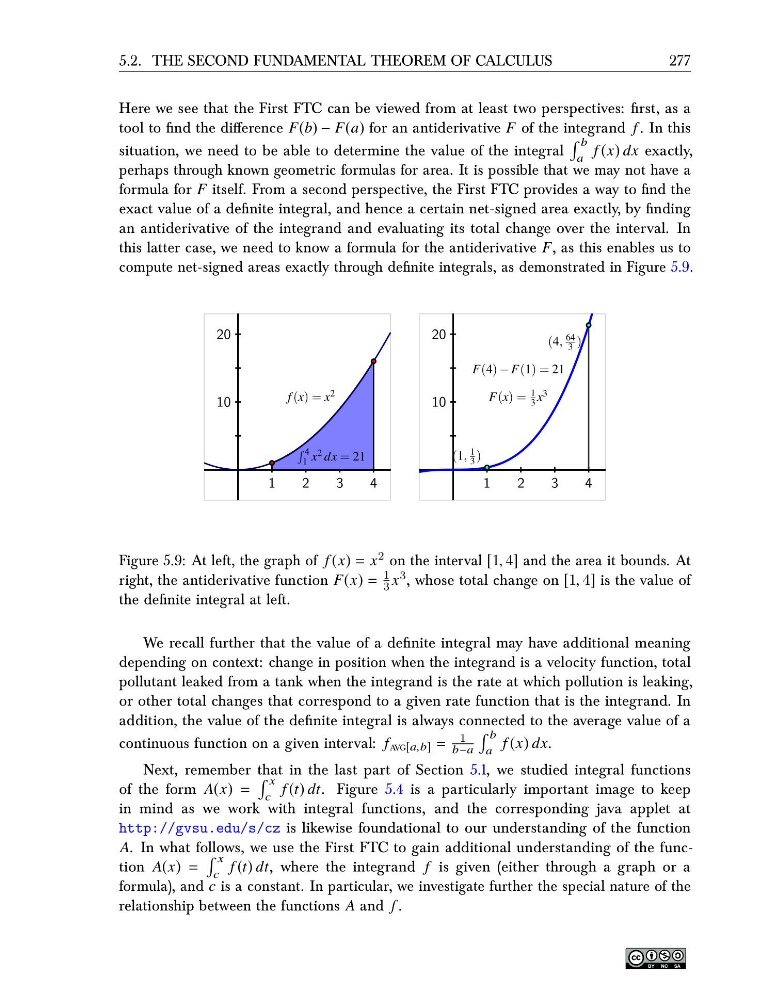
compute net-signed areas exactly through definite integrals, as demonstrated in Figure 5.9.
10
20
1
2
3
4
f (x) = x 2
4
1 x 2 dx = 21
10
20
1
2
3
4
F(x) =
1
3 x 3
(1,
1
3 )
(4,
64
3 )
F(4) − F(1) = 21
Figure 5.9: At left, the graph of f (x) = x 2 on the interval [1, 4] and the area it bounds. At
right, the antiderivative function F(x) =
1
3 x 3 , whose total change on [1, 4] is the value of
the definite integral at left.
We recall further that the value of a definite integral may have additional meaning
depending on context: change in position when the integrand is a velocity function, total
pollutant leaked from a tank when the integrand is the rate at which pollution is leaking,
or other total changes that correspond to a given rate function that is the integrand. In
addition, the value of the definite integral is always connected to the average value of a
continuous function on a given interval: f AVG[a, b] =
1
b−a
b
a
f (x) dx.
Next, remember that in the last part of Section 5.1, we studied integral functions
of the form A(x) =
x
c
f (t) dt. Figure 5.4 is a particularly important image to keep
in mind as we work with integral functions, and the corresponding java applet at
http://gvsu.edu/s/cz is likewise foundational to our understanding of the function
A. In what follows, we use the First FTC to gain additional understanding of the function A(x) =
x
c
f (t) dt, where the integrand f is given (either through a graph or a
formula), and c is a constant. In particular, we investigate further the special nature of the
relationship between the functions A and f .
277
Here we see that the First FTC can be viewed from at least two perspectives: first, as a
tool to find the difference F(b) − F(a) for an antiderivative F of the integrand f . In this
situation, we need to be able to determine the value of the integral
b
a
f (x) dx exactly,
perhaps through known geometric formulas for area. It is possible that we may not have a
formula for F itself. From a second perspective, the First FTC provides a way to find the
exact value of a definite integral, and hence a certain net-signed area exactly, by finding
an antiderivative of the integrand and evaluating its total change over the interval. In
this latter case, we need to know a formula for the antiderivative F, as this enables us to
compute net-signed areas exactly through definite integrals, as demonstrated in Figure 5.9.
10
20
1
2
3
4
f (x) = x 2
4
1 x 2 dx = 21
10
20
1
2
3
4
F(x) =
1
3 x 3
(1,
1
3 )
(4,
64
3 )
F(4) − F(1) = 21
Figure 5.9: At left, the graph of f (x) = x 2 on the interval [1, 4] and the area it bounds. At
right, the antiderivative function F(x) =
1
3 x 3 , whose total change on [1, 4] is the value of
the definite integral at left.
We recall further that the value of a definite integral may have additional meaning
depending on context: change in position when the integrand is a velocity function, total
pollutant leaked from a tank when the integrand is the rate at which pollution is leaking,
or other total changes that correspond to a given rate function that is the integrand. In
addition, the value of the definite integral is always connected to the average value of a
continuous function on a given interval: f AVG[a, b] =
1
b−a
b
a
f (x) dx.
Next, remember that in the last part of Section 5.1, we studied integral functions
of the form A(x) =
x
c
f (t) dt. Figure 5.4 is a particularly important image to keep
in mind as we work with integral functions, and the corresponding java applet at
http://gvsu.edu/s/cz is likewise foundational to our understanding of the function
A. In what follows, we use the First FTC to gain additional understanding of the function A(x) =
x
c
f (t) dt, where the integrand f is given (either through a graph or a
formula), and c is a constant. In particular, we investigate further the special nature of the
relationship between the functions A and f .