

252
4.4. THE FUNDAMENTAL THEOREM OF CALCULUS
The Fundamental Theorem of Calculus
Consider the setting where we know the position function s(t) of an object moving along
an axis, as well as its corresponding velocity function v(t), and for the moment let us
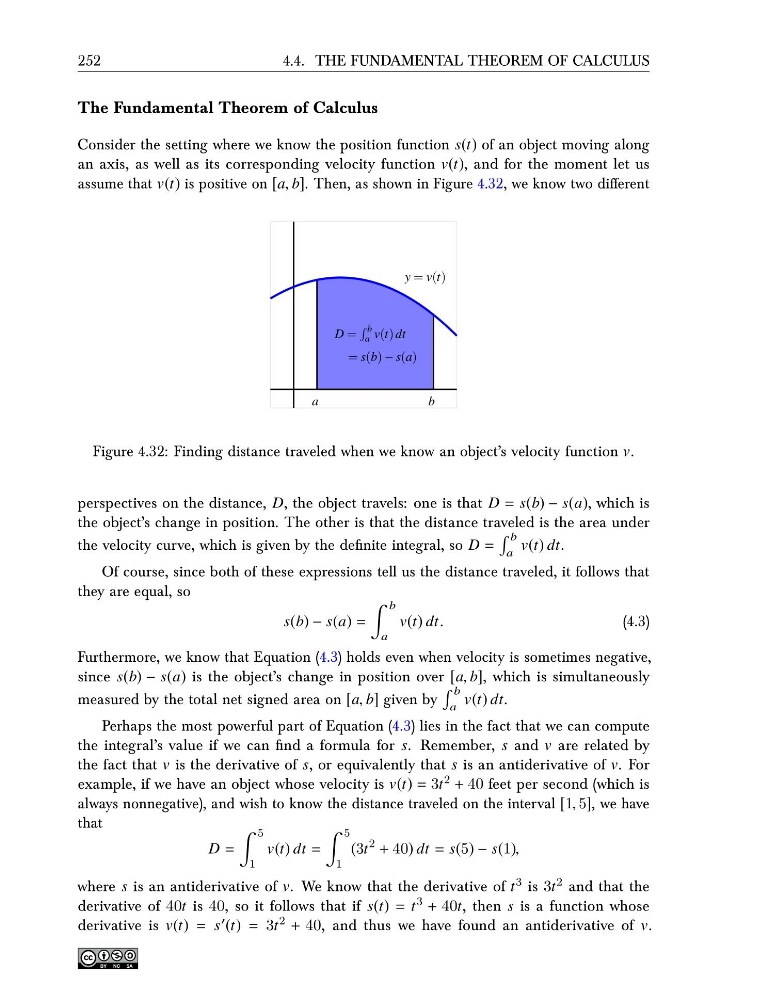
assume that v(t) is positive on [a, b]. Then, as shown in Figure 4.32, we know two different
a
b
D =
b
a v(t) dt
= s(b) − s(a)
y = v(t)
Figure 4.32: Finding distance traveled when we know an object’s velocity function v.
perspectives on the distance, D, the object travels: one is that D = s(b) − s(a), which is
the object’s change in position. The other is that the distance traveled is the area under
the velocity curve, which is given by the definite integral, so D =
b
a
v(t) dt.
Of course, since both of these expressions tell us the distance traveled, it follows that
they are equal, so
s(b) − s(a) =
b
a
v(t) dt.
(4.3)
Furthermore, we know that Equation (4.3) holds even when velocity is sometimes negative,
since s(b) − s(a) is the object’s change in position over [a, b], which is simultaneously
measured by the total net signed area on [a, b] given by
b
a
v(t) dt.
Perhaps the most powerful part of Equation (4.3) lies in the fact that we can compute
the integral’s value if we can find a formula for s. Remember, s and v are related by
the fact that v is the derivative of s, or equivalently that s is an antiderivative of v. For
example, if we have an object whose velocity is v(t) = 3t 2 + 40 feet per second (which is
always nonnegative), and wish to know the distance traveled on the interval [1, 5], we have
that
D =
5
1
v(t) dt =
5
1
(3t
2 + 40) dt = s(5) − s(1),
where s is an antiderivative of v. We know that the derivative of t 3 is 3t 2 and that the
derivative of 40t is 40, so it follows that if s(t) = t 3 + 40t, then s is a function whose
derivative is v(t) = s ′ (t) = 3t 2 + 40, and thus we have found an antiderivative of v.
4.4. THE FUNDAMENTAL THEOREM OF CALCULUS
The Fundamental Theorem of Calculus
Consider the setting where we know the position function s(t) of an object moving along
an axis, as well as its corresponding velocity function v(t), and for the moment let us
assume that v(t) is positive on [a, b]. Then, as shown in Figure 4.32, we know two different
a
b
D =
b
a v(t) dt
= s(b) − s(a)
y = v(t)
Figure 4.32: Finding distance traveled when we know an object’s velocity function v.
perspectives on the distance, D, the object travels: one is that D = s(b) − s(a), which is
the object’s change in position. The other is that the distance traveled is the area under
the velocity curve, which is given by the definite integral, so D =
b
a
v(t) dt.
Of course, since both of these expressions tell us the distance traveled, it follows that
they are equal, so
s(b) − s(a) =
b
a
v(t) dt.
(4.3)
Furthermore, we know that Equation (4.3) holds even when velocity is sometimes negative,
since s(b) − s(a) is the object’s change in position over [a, b], which is simultaneously
measured by the total net signed area on [a, b] given by
b
a
v(t) dt.
Perhaps the most powerful part of Equation (4.3) lies in the fact that we can compute
the integral’s value if we can find a formula for s. Remember, s and v are related by
the fact that v is the derivative of s, or equivalently that s is an antiderivative of v. For
example, if we have an object whose velocity is v(t) = 3t 2 + 40 feet per second (which is
always nonnegative), and wish to know the distance traveled on the interval [1, 5], we have
that
D =
5
1
v(t) dt =
5
1
(3t
2 + 40) dt = s(5) − s(1),
where s is an antiderivative of v. We know that the derivative of t 3 is 3t 2 and that the
derivative of 40t is 40, so it follows that if s(t) = t 3 + 40t, then s is a function whose
derivative is v(t) = s ′ (t) = 3t 2 + 40, and thus we have found an antiderivative of v.