

4.4. THE FUNDAMENTAL THEOREM OF CALCULUS
253
Therefore,
D =
5
1
3t
2 + 40 dt = s(5) − s(1)
= (5
3 + 40 · 5) − (1
3 + 40 · 1) = 284 feet.
Note the key lesson of this example: to find the distance traveled, we needed to compute
the area under a curve, which is given by the definite integral. But to evaluate the integral,
we found an antiderivative, s, of the velocity function, and then computed the total change
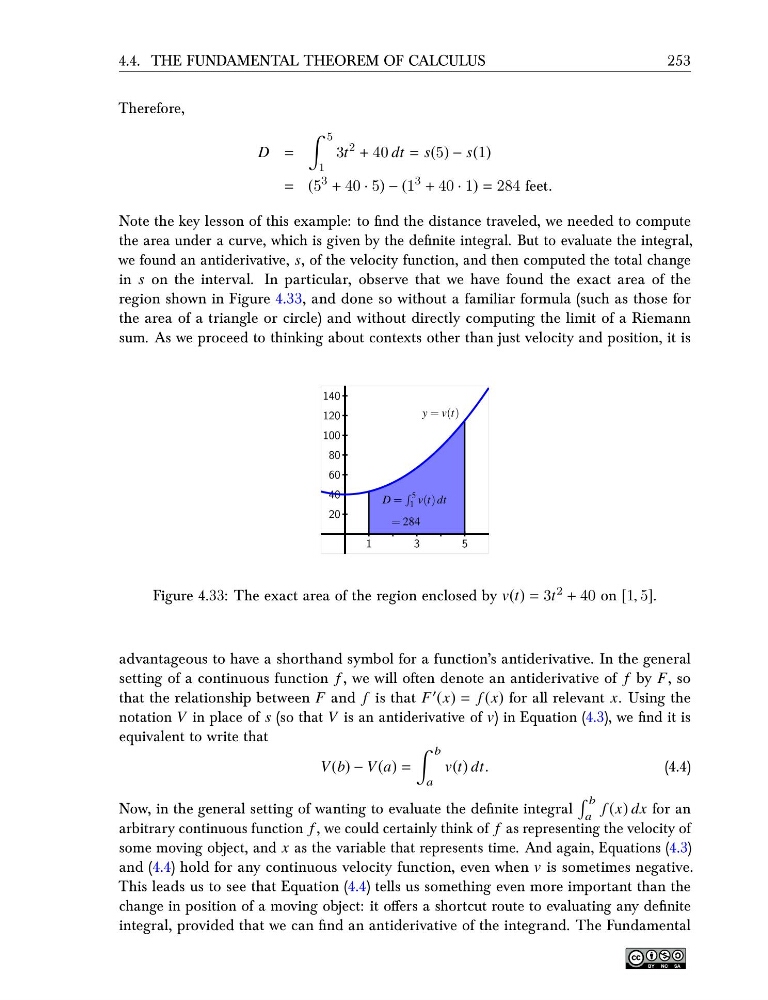
in s on the interval. In particular, observe that we have found the exact area of the
region shown in Figure 4.33, and done so without a familiar formula (such as those for
the area of a triangle or circle) and without directly computing the limit of a Riemann
sum. As we proceed to thinking about contexts other than just velocity and position, it is
1
3
5
20
40
60
80
100
120
140
D =
5
1 v(t) dt
= 284
y = v(t)
Figure 4.33: The exact area of the region enclosed by v(t) = 3t 2 + 40 on [1, 5].
advantageous to have a shorthand symbol for a function’s antiderivative. In the general
setting of a continuous function f , we will often denote an antiderivative of f by F, so
that the relationship between F and f is that F ′ (x) = f (x) for all relevant x. Using the
notation V in place of s (so that V is an antiderivative of v) in Equation (4.3), we find it is
equivalent to write that
V (b) − V (a) =
b
a
v(t) dt.
(4.4)
Now, in the general setting of wanting to evaluate the definite integral
b
a
f (x) dx for an
arbitrary continuous function f , we could certainly think of f as representing the velocity of
some moving object, and x as the variable that represents time. And again, Equations (4.3)
and (4.4) hold for any continuous velocity function, even when v is sometimes negative.
This leads us to see that Equation (4.4) tells us something even more important than the
change in position of a moving object: it offers a shortcut route to evaluating any definite
integral, provided that we can find an antiderivative of the integrand. The Fundamental
253
Therefore,
D =
5
1
3t
2 + 40 dt = s(5) − s(1)
= (5
3 + 40 · 5) − (1
3 + 40 · 1) = 284 feet.
Note the key lesson of this example: to find the distance traveled, we needed to compute
the area under a curve, which is given by the definite integral. But to evaluate the integral,
we found an antiderivative, s, of the velocity function, and then computed the total change
in s on the interval. In particular, observe that we have found the exact area of the
region shown in Figure 4.33, and done so without a familiar formula (such as those for
the area of a triangle or circle) and without directly computing the limit of a Riemann
sum. As we proceed to thinking about contexts other than just velocity and position, it is
1
3
5
20
40
60
80
100
120
140
D =
5
1 v(t) dt
= 284
y = v(t)
Figure 4.33: The exact area of the region enclosed by v(t) = 3t 2 + 40 on [1, 5].
advantageous to have a shorthand symbol for a function’s antiderivative. In the general
setting of a continuous function f , we will often denote an antiderivative of f by F, so
that the relationship between F and f is that F ′ (x) = f (x) for all relevant x. Using the
notation V in place of s (so that V is an antiderivative of v) in Equation (4.3), we find it is
equivalent to write that
V (b) − V (a) =
b
a
v(t) dt.
(4.4)
Now, in the general setting of wanting to evaluate the definite integral
b
a
f (x) dx for an
arbitrary continuous function f , we could certainly think of f as representing the velocity of
some moving object, and x as the variable that represents time. And again, Equations (4.3)
and (4.4) hold for any continuous velocity function, even when v is sometimes negative.
This leads us to see that Equation (4.4) tells us something even more important than the
change in position of a moving object: it offers a shortcut route to evaluating any definite
integral, provided that we can find an antiderivative of the integrand. The Fundamental