

242
4.3. THE DEFINITE INTEGRAL
a factor of 2 on the area it bounds with the x-axis. Because multiplying the function by
2 doubles its height at every x-value, we see that if we consider a typical rectangle from
a Riemann sum, the difference in area comes from the changed height of the rectangle:
f (x i ) for the original function, versus 2 f (x i ) in the doubled function, in the case of left
sum. Hence, in Figure 4.26, we see that for the pictured rectangles with areas A and B, it
follows B = 2A. As this will happen in every such rectangle, regardless of the value of n
and the type of sum we use, we see that in the limit, the area of the red region bounded
by y = 2 f (x) will be twice that of the area of the blue region bounded by y = f (x). As
there is nothing special about the value 2 compared to an arbitrary constant k, it turns
out that the following general principle holds.
Constant Multiple Rule: If f is a continuous function and k is any real number
then
b
a
k · f (x) dx = k
b
a
f (x) dx.
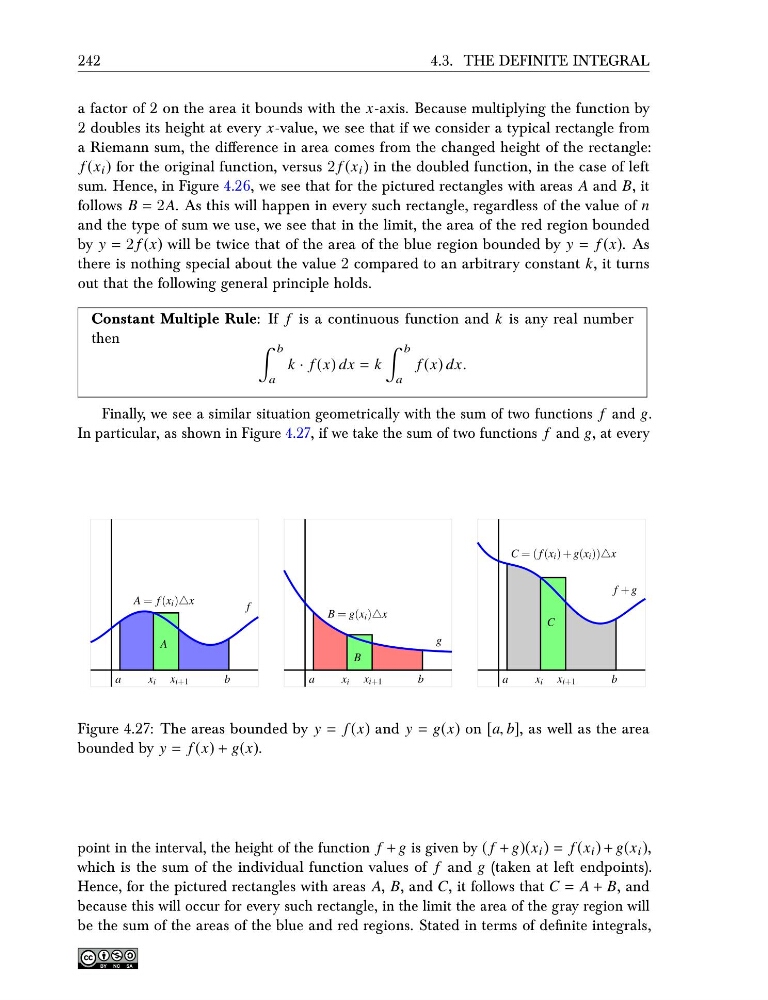
Finally, we see a similar situation geometrically with the sum of two functions f and g.
In particular, as shown in Figure 4.27, if we take the sum of two functions f and g, at every
a
x i
A = f (x i )△x
A
x i+1
b
f
a
x i
B = g(x i )△x
B
x i+1
b
g
a
x i
C = ( f (x i ) + g(x i ))△x
C
x i+1
b
f + g
Figure 4.27: The areas bounded by y = f (x) and y = g(x) on [a, b], as well as the area
bounded by y = f (x) + g(x).
point in the interval, the height of the function f + g is given by ( f + g)(x i ) = f (x i ) + g(x i ),
which is the sum of the individual function values of f and g (taken at left endpoints).
Hence, for the pictured rectangles with areas A, B, and C, it follows that C = A + B, and
because this will occur for every such rectangle, in the limit the area of the gray region will
be the sum of the areas of the blue and red regions. Stated in terms of definite integrals,
4.3. THE DEFINITE INTEGRAL
a factor of 2 on the area it bounds with the x-axis. Because multiplying the function by
2 doubles its height at every x-value, we see that if we consider a typical rectangle from
a Riemann sum, the difference in area comes from the changed height of the rectangle:
f (x i ) for the original function, versus 2 f (x i ) in the doubled function, in the case of left
sum. Hence, in Figure 4.26, we see that for the pictured rectangles with areas A and B, it
follows B = 2A. As this will happen in every such rectangle, regardless of the value of n
and the type of sum we use, we see that in the limit, the area of the red region bounded
by y = 2 f (x) will be twice that of the area of the blue region bounded by y = f (x). As
there is nothing special about the value 2 compared to an arbitrary constant k, it turns
out that the following general principle holds.
Constant Multiple Rule: If f is a continuous function and k is any real number
then
b
a
k · f (x) dx = k
b
a
f (x) dx.
Finally, we see a similar situation geometrically with the sum of two functions f and g.
In particular, as shown in Figure 4.27, if we take the sum of two functions f and g, at every
a
x i
A = f (x i )△x
A
x i+1
b
f
a
x i
B = g(x i )△x
B
x i+1
b
g
a
x i
C = ( f (x i ) + g(x i ))△x
C
x i+1
b
f + g
Figure 4.27: The areas bounded by y = f (x) and y = g(x) on [a, b], as well as the area
bounded by y = f (x) + g(x).
point in the interval, the height of the function f + g is given by ( f + g)(x i ) = f (x i ) + g(x i ),
which is the sum of the individual function values of f and g (taken at left endpoints).
Hence, for the pictured rectangles with areas A, B, and C, it follows that C = A + B, and
because this will occur for every such rectangle, in the limit the area of the gray region will
be the sum of the areas of the blue and red regions. Stated in terms of definite integrals,