

4.3. THE DEFINITE INTEGRAL
243
we have the following general rule.
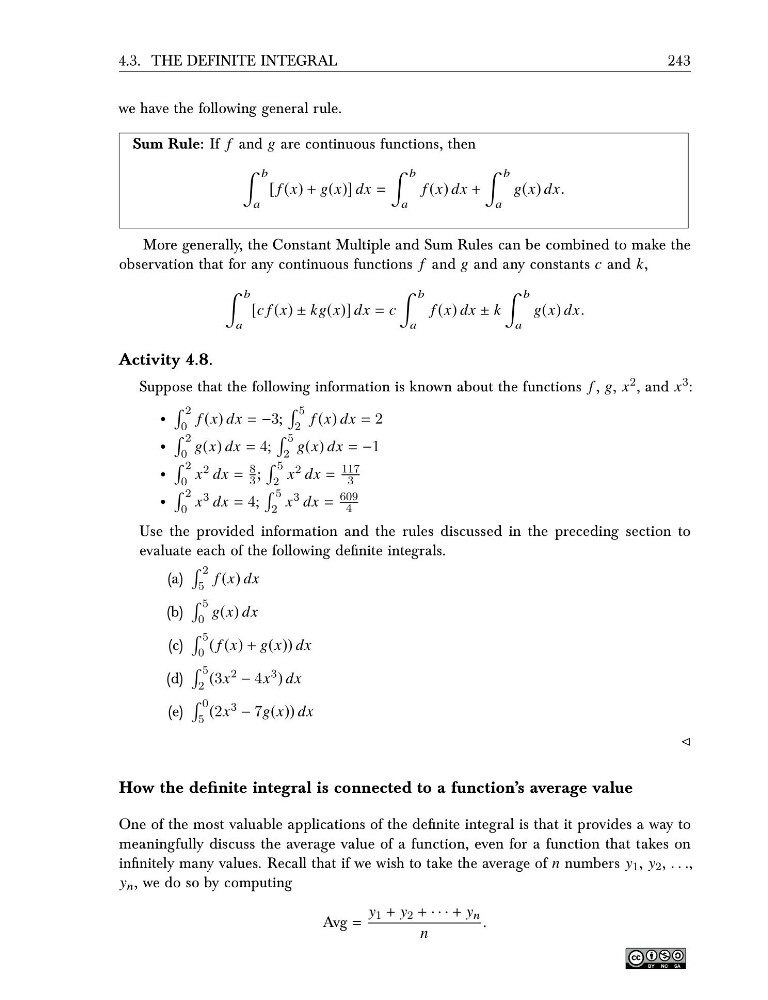
Sum Rule: If f and g are continuous functions, then
b
a
[ f (x) + g(x)] dx =
b
a
f (x) dx +
b
a
g(x) dx.
More generally, the Constant Multiple and Sum Rules can be combined to make the
observation that for any continuous functions f and g and any constants c and k,
b
a
[c f (x) ± kg(x)] dx = c
b
a
f (x) dx ± k
b
a
g(x) dx.
Activity 4.8.
Suppose that the following information is known about the functions f , g, x 2 , and x 3 :
•
2
0
f (x) dx = −3;
5
2
f (x) dx = 2
•
2
0
g(x) dx = 4;
5
2
g(x) dx = −1
•
2
0
x 2 dx =
8
3 ;
5
2
x 2 dx =
117
3
•
2
0
x 3 dx = 4;
5
2
x 3 dx =
609
4
Use the provided information and the rules discussed in the preceding section to
evaluate each of the following definite integrals.
(a)
2
5
f (x) dx
(b)
5
0
g(x) dx
(c)
5
0
( f (x) + g(x)) dx
(d)
5
2
(3x 2 − 4x 3 ) dx
(e)
0
5
(2x 3 − 7g(x)) dx
⊳
How the definite integral is connected to a function’s average value
One of the most valuable applications of the definite integral is that it provides a way to
meaningfully discuss the average value of a function, even for a function that takes on
infinitely many values. Recall that if we wish to take the average of n numbers y 1 , y 2 , . . .,
y n , we do so by computing
Avg =
y 1 + y 2 + · · · + y n
n
.
243
we have the following general rule.
Sum Rule: If f and g are continuous functions, then
b
a
[ f (x) + g(x)] dx =
b
a
f (x) dx +
b
a
g(x) dx.
More generally, the Constant Multiple and Sum Rules can be combined to make the
observation that for any continuous functions f and g and any constants c and k,
b
a
[c f (x) ± kg(x)] dx = c
b
a
f (x) dx ± k
b
a
g(x) dx.
Activity 4.8.
Suppose that the following information is known about the functions f , g, x 2 , and x 3 :
•
2
0
f (x) dx = −3;
5
2
f (x) dx = 2
•
2
0
g(x) dx = 4;
5
2
g(x) dx = −1
•
2
0
x 2 dx =
8
3 ;
5
2
x 2 dx =
117
3
•
2
0
x 3 dx = 4;
5
2
x 3 dx =
609
4
Use the provided information and the rules discussed in the preceding section to
evaluate each of the following definite integrals.
(a)
2
5
f (x) dx
(b)
5
0
g(x) dx
(c)
5
0
( f (x) + g(x)) dx
(d)
5
2
(3x 2 − 4x 3 ) dx
(e)
0
5
(2x 3 − 7g(x)) dx
⊳
How the definite integral is connected to a function’s average value
One of the most valuable applications of the definite integral is that it provides a way to
meaningfully discuss the average value of a function, even for a function that takes on
infinitely many values. Recall that if we wish to take the average of n numbers y 1 , y 2 , . . .,
y n , we do so by computing
Avg =
y 1 + y 2 + · · · + y n
n
.