

4.3. THE DEFINITE INTEGRAL
241
change the sign of the integral’s value.
If f is a continuous function and a and b are real numbers, then
a
b
f (x) dx = −
b
a
f (x) dx.
This result makes sense because if we integrate from a to b, then in the defining Riemann
sum △x =
b−a
n , while if we integrate from b to a, △x =
a−b
n = −
b−a
n , and this is the only
change in the sum used to define the integral.
There are two additional properties of the definite integral that we need to understand.
Recall that when we worked with derivative rules in Chapter 2, we found that both the
Constant Multiple Rule and the Sum Rule held. The Constant Multiple Rule tells us that
if f is a differentiable function and k is a constant, then
d
dx
[k f (x)] = k f
′ (x),
and the Sum Rule states that if f and g are differentiable functions, then
d
dx
[ f (x) + g(x)] = f
′ (x) + g
′ (x).
These rules are useful because they enable us to deal individually with the simplest parts
of certain functions and take advantage of the elementary operations of addition and
multiplying by a constant. They also tell us that the process of taking the derivative
respects addition and multiplying by constants in the simplest possible way.
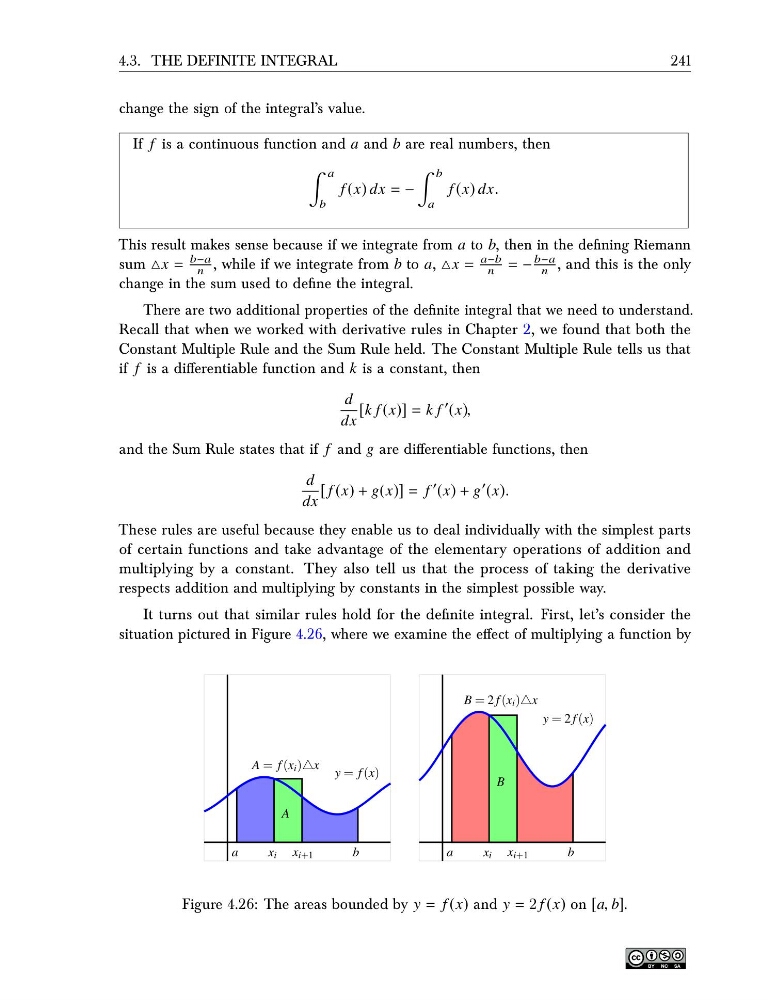
It turns out that similar rules hold for the definite integral. First, let’s consider the
situation pictured in Figure 4.26, where we examine the effect of multiplying a function by
a
x i
A = f (x i )△x
A
x i+1
b
y = f (x)
a
x i
B
B = 2 f (x i )△x
x i+1
b
y = 2 f (x)
Figure 4.26: The areas bounded by y = f (x) and y = 2 f (x) on [a, b].
241
change the sign of the integral’s value.
If f is a continuous function and a and b are real numbers, then
a
b
f (x) dx = −
b
a
f (x) dx.
This result makes sense because if we integrate from a to b, then in the defining Riemann
sum △x =
b−a
n , while if we integrate from b to a, △x =
a−b
n = −
b−a
n , and this is the only
change in the sum used to define the integral.
There are two additional properties of the definite integral that we need to understand.
Recall that when we worked with derivative rules in Chapter 2, we found that both the
Constant Multiple Rule and the Sum Rule held. The Constant Multiple Rule tells us that
if f is a differentiable function and k is a constant, then
d
dx
[k f (x)] = k f
′ (x),
and the Sum Rule states that if f and g are differentiable functions, then
d
dx
[ f (x) + g(x)] = f
′ (x) + g
′ (x).
These rules are useful because they enable us to deal individually with the simplest parts
of certain functions and take advantage of the elementary operations of addition and
multiplying by a constant. They also tell us that the process of taking the derivative
respects addition and multiplying by constants in the simplest possible way.
It turns out that similar rules hold for the definite integral. First, let’s consider the
situation pictured in Figure 4.26, where we examine the effect of multiplying a function by
a
x i
A = f (x i )△x
A
x i+1
b
y = f (x)
a
x i
B
B = 2 f (x i )△x
x i+1
b
y = 2 f (x)
Figure 4.26: The areas bounded by y = f (x) and y = 2 f (x) on [a, b].