

240
4.3. THE DEFINITE INTEGRAL
Some properties of the definite integral
With the perspective that the definite integral of a function f over an interval [a, b]
measures the net signed area bounded by f and the x-axis over the interval, we naturally
arrive at several different standard properties of the definite integral. In addition, it is
helpful to remember that the definite integral is defined in terms of Riemann sums that
fundamentally consist of the areas of rectangles.
If we consider the definite integral
a
a
f (x) dx for any real number a, it is evident
that no area is being bounded because the interval begins and ends with the same point.
Hence,
If f is a continuous function and a is a real number, then
a
a
f (x) dx = 0.
y = f (x)
A 1
A 2
a
b
c
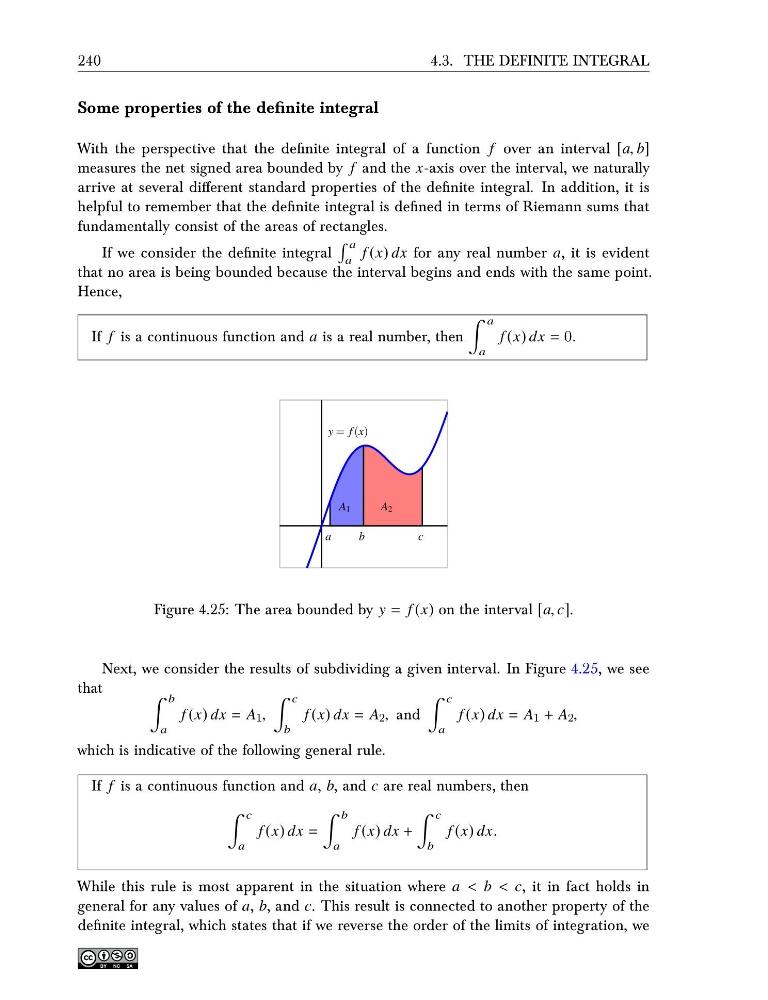
Figure 4.25: The area bounded by y = f (x) on the interval [a, c].
Next, we consider the results of subdividing a given interval. In Figure 4.25, we see
that
b
a
f (x) dx = A 1 ,
c
b
f (x) dx = A 2 , and
c
a
f (x) dx = A 1 + A 2 ,
which is indicative of the following general rule.
If f is a continuous function and a, b, and c are real numbers, then
c
a
f (x) dx =
b
a
f (x) dx +
c
b
f (x) dx.
While this rule is most apparent in the situation where a < b < c, it in fact holds in
general for any values of a, b, and c. This result is connected to another property of the
definite integral, which states that if we reverse the order of the limits of integration, we
4.3. THE DEFINITE INTEGRAL
Some properties of the definite integral
With the perspective that the definite integral of a function f over an interval [a, b]
measures the net signed area bounded by f and the x-axis over the interval, we naturally
arrive at several different standard properties of the definite integral. In addition, it is
helpful to remember that the definite integral is defined in terms of Riemann sums that
fundamentally consist of the areas of rectangles.
If we consider the definite integral
a
a
f (x) dx for any real number a, it is evident
that no area is being bounded because the interval begins and ends with the same point.
Hence,
If f is a continuous function and a is a real number, then
a
a
f (x) dx = 0.
y = f (x)
A 1
A 2
a
b
c
Figure 4.25: The area bounded by y = f (x) on the interval [a, c].
Next, we consider the results of subdividing a given interval. In Figure 4.25, we see
that
b
a
f (x) dx = A 1 ,
c
b
f (x) dx = A 2 , and
c
a
f (x) dx = A 1 + A 2 ,
which is indicative of the following general rule.
If f is a continuous function and a, b, and c are real numbers, then
c
a
f (x) dx =
b
a
f (x) dx +
c
b
f (x) dx.
While this rule is most apparent in the situation where a < b < c, it in fact holds in
general for any values of a, b, and c. This result is connected to another property of the
definite integral, which states that if we reverse the order of the limits of integration, we